Contents
The wavy cap (Psilocybe cyanescens) is a psychoactive mushroom1 that contains psilocybin, psilocin and baeocystin, and MykoWeb lists its edibility simply as hallucinogenic3. It is usually found growing on rotting woodchip mulch, in Britain mainly in autumn and winter, and in the United States mainly in the Pacific Northwest, south to the San Francisco Bay Area4. In the UK it is known as the Blueleg Brownie, in the USA as Wavy Caps2.
How to identify wavy cap
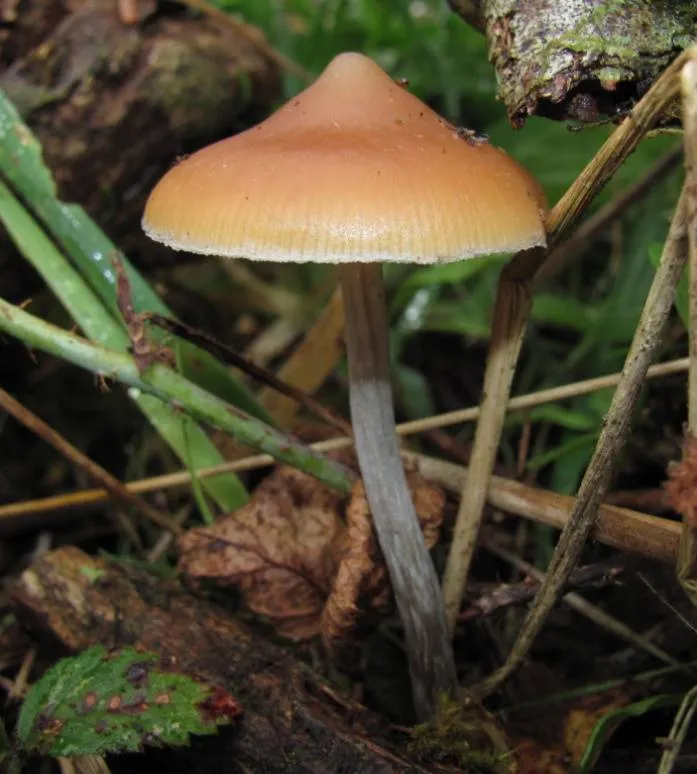
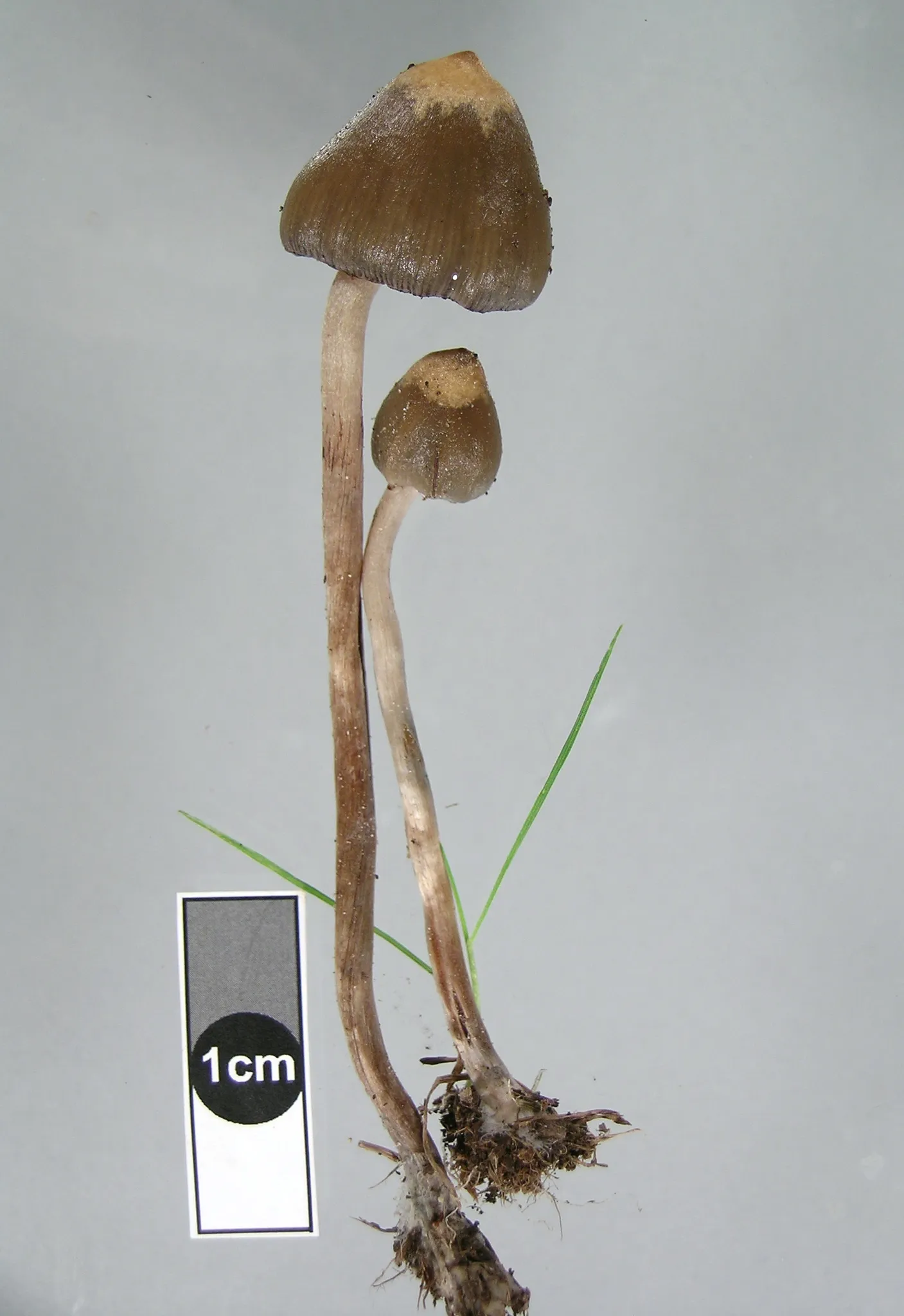
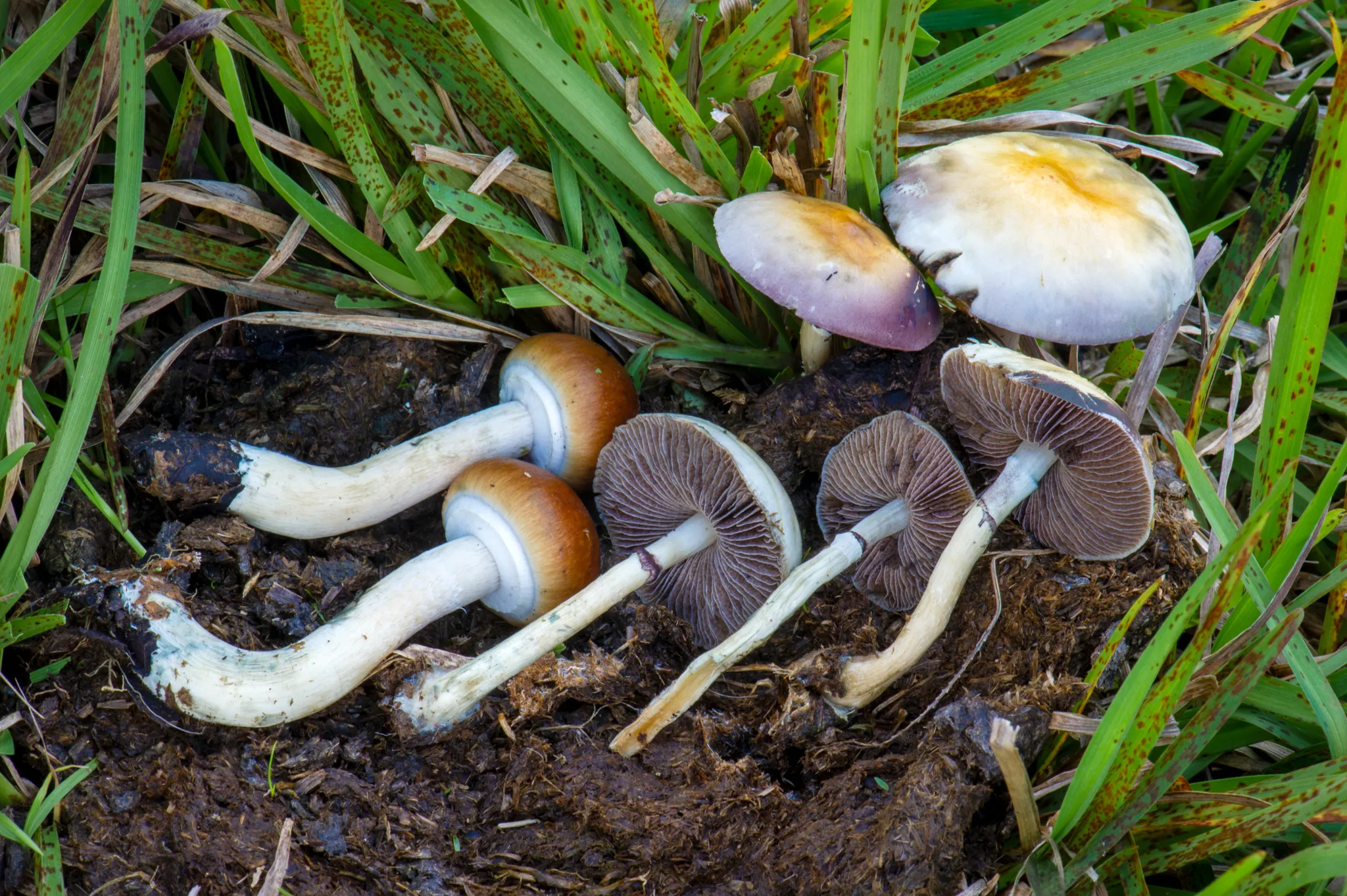
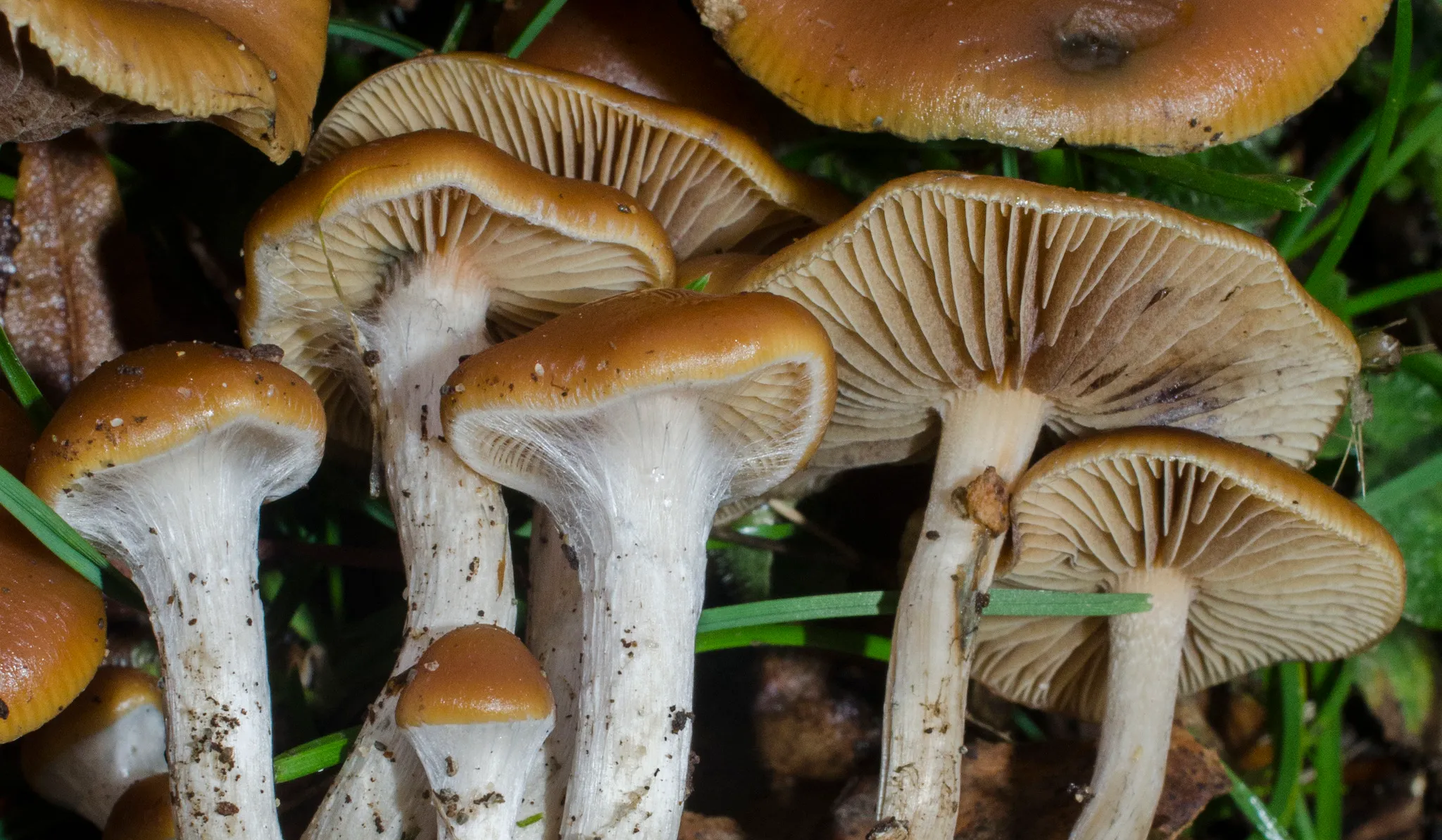
Start with the cap. It is 2 to 5 cm across according to First Nature, or 2 to 4.5 cm broad in MykoWeb’s California data: convex, becoming nearly plane with a low umbo, slightly sticky, with lined margins that usually become wavy at maturity. The colour is chestnut-brown, soon fading to yellow brown or buff3 as the cap dries, and the caps bruise bluish, especially at the margin2.
Turn it over. The brown adnate or slightly decurrent gills turn purple-brown as the spores mature, and their edges remain pale. The stem is 3 to 6 mm in diameter and 4.5 to 8 cm tall, white, fibrous and bruising pale blue, sometimes with a clavate base with blue rhizomorphs. There is no distinct ring4: the fibrillose partial veil leaves an evanescent superior ring zone2 on the stem.
The blue colour comes mainly from the oxidation of psilocin; fresh fruit bodies generally bruise blueish or blue-green where damaged, and the staining remains visible after drying4. The smell is indistinct or very faintly mealy. The spore print is very dark purple-brown, or purple-brown to purple-grey in MykoWeb’s description, from ellipsoidal, smooth spores of 9-12.5 x 5-7 µm2. MykoWeb sums the species up as a chestnut-brown, striate, wavy-margined cap and a blue-staining fruiting body3.
Is wavy cap edible or poisonous?
First Nature warns not to taste it, because its toxic hallucinogens are potentially dangerous2, and MykoWeb notes that it is sometimes the subject of experimentation, a potentially dangerous practice because of toxic look-alikes3 in Galerina, Conocybe and Inocybe (see below). One general reference adds that it is not generally regarded as physically dangerous to adults, and a guide to psilocybin rates its physical risk as low and its psychological risk as moderate5. Its psychedelic effects come mainly from psilocybin and psilocin. One general reference reports North American fruiting bodies at 0.66% to 1.96% total indole content by dry weight, and calls North American specimens among the most potent of psychedelic mushrooms4.
In the body, psilocybin is converted into psilocin, which primarily targets serotonin 5-HT2A receptors in the cortex. A guide to psilocybin says an experience typically unfolds over four to six hours, with effects beginning 20 to 60 minutes after ingestion. At the peak, colours become vivid, emotional amplification is common and time perception distorts. The same guide lists the risks: anxiety, paranoia, confusion, or overwhelming emotion, and physical side effects, generally mild, such as nausea, dilated pupils, slightly elevated heart rate and blood pressure. It adds that psilocybin is generally contraindicated for people with a personal or close family history5 of psychosis. First Nature notes that these compounds occasionally cause vomiting, stomach pains and anxiety attacks, so some authorities advise that it should be treated as poisonous2.
The law differs by country. The mushroom itself is not covered by the Convention on Psychotropic Substances, but many countries prohibit possession of psilocybin mushrooms under their domestic laws; the United States, Germany and New Zealand are among those that have banned or severely regulated its possession4. In the United Kingdom, psilocybin is Class A under the Misuse of Drugs Act 1971, and since July 2005 fresh psilocybin mushrooms are controlled as well2. In the United States, Oregon launched the first legal psilocybin service programme in 2023, with Colorado following with a similar framework. Australia became, in July 2023, the first country to formally approve psilocybin for therapeutic use, by authorised psychiatrists for treatment-resistant depression. In Canada, Section 56 exemptions have allowed some patients access to psilocybin-assisted therapy5. Never eat a wild mushroom on the strength of a web page or an app: have it identified in person by an expert.
Where and when does wavy cap grow?
Wavy cap is a saprobic mushroom most often found on woodchip mulch, not usually on bark2. MykoWeb finds it scattered to gregarious on woody debris, leaf litter, and wood chips3, and it grows especially in and along mulched plant beds in urban areas. Once, 100,000 fruits4 were found on a racetrack in the south of England.
It also grows in New Zealand, Western Europe, Central Europe and parts of west Asia (Iran). In Britain it is increasingly frequent in the south and apparently spreading northwards, probably an introduced species from North America, and First Nature also records it in many parts of western and central mainland Europe as well as in Australia2. The spread may be due in part to its mycelium colonising the distribution network of woodchip suppliers4.
Fruiting depends on a drop in temperature. In the San Francisco Bay Area it typically fruits from late October to February4; in California MykoWeb gives late summer in watered areas to mid-winter3; and in Britain it appears mainly in autumn and winter2.
Wavy cap lookalikes
- Funeral bell (Galerina marginata): First Nature calls it deadly poisonous; it holds the same deadly amatoxins found in the death cap, which cause sickness and vomiting followed eventually by liver damage and, if not treated promptly, death. The two can grow side-by-side, and the funeral bell also grows on rotting wood, with brown to yellow-brown caps that fade in colour when drying6. Its spore print is rusty brown, not wavy cap’s dark purple-brown, so a spore print is essential4. It has a distinct stem ring and does not bruise blue2, though that ring sometimes disappears with age7. And its flesh is unchanging when sliced8.
- Mower’s mushroom (Panaeolina foenisecii): First Nature names it as similar but notes it is a grassland species2, found on lawns, roadside verges and other grassy places. Its gills turn mottled dark brown. First Nature reports evidence that children can become ill after eating it and says that, on a precautionary basis at least, it should be treated as a toxic toadstool9; a second source calls it not edible10.
- Other caramel-capped Psilocybe species: wavy cap belongs to the Psilocybe cyanescens complex, whose members are often difficult or impossible to distinguish except by range without a microscope or DNA. One close relative, Psilocybe allenii, described in 2012 from California and Washington, is told apart by macromorphological features or ITS sequencing4.
Wavy cap in history
Elsie Maud Wakefield first described the species in 1946, from a type specimen in woodchip mulch beds at the Royal Botanic Garden, Kew; MykoWeb lists the protologue as Dennis and Wakefield’s 1946 paper3 New or interesting British fungi. She had begun collecting it as early as 19104. The epithet cyanescens means ‘turning blue’2.