Contents
Psilocybe cubensis is a psychoactive mushroom whose main compounds are psilocybin and psilocin1. It grows on cattle dung, sugar-cane mulch and rich pasture soil across a pantropical range that runs from the Gulf Coast of the United States and Central America through the Caribbean and South America to Southeast Asia and Australia, and every part of it stains blue when bruised.
How to identify Psilocybe cubensis
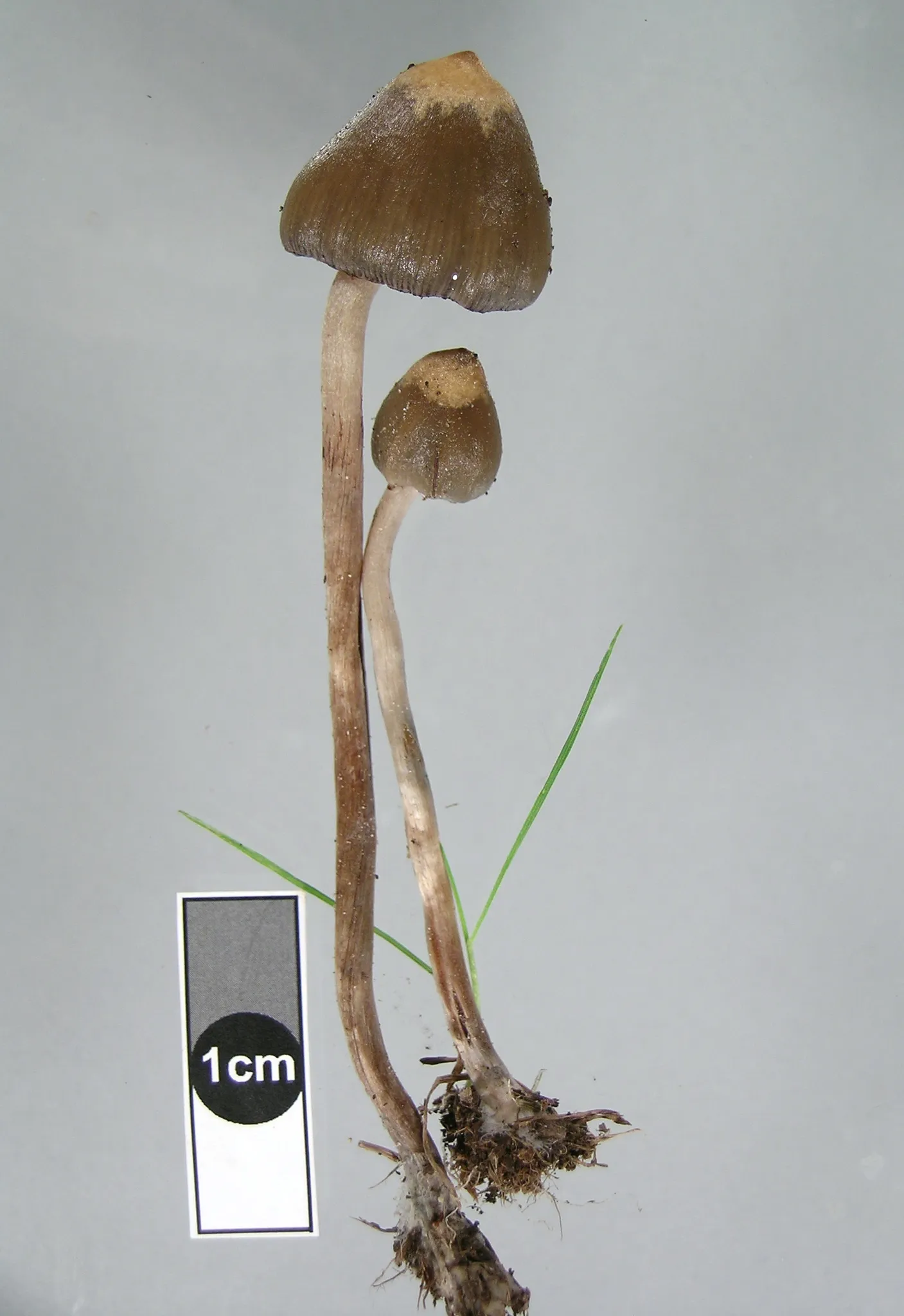
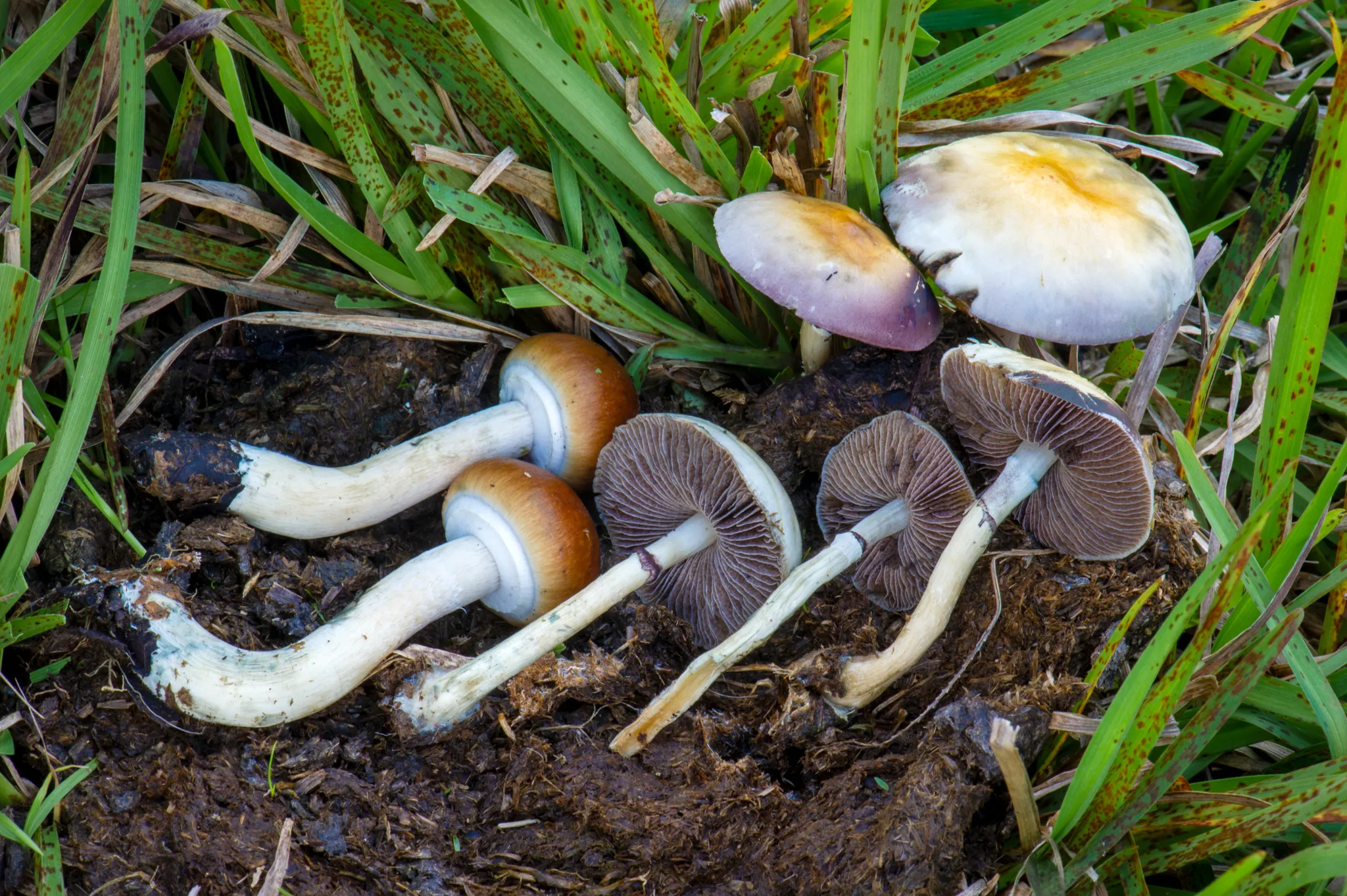
Start with the cap: 1.6 to 8 cm across1, opening conic to convex with a small central point and flattening out with age. The colour starts brown, pales almost to white at the margin, and fades further to golden-brown or yellowish with age, on a surface that is smooth, sticky and sometimes flecked with white veil remnants.
Turn it over. The narrow gills are grey, attached to the stem and sometimes pulling free of it, darkening to purplish-black and somewhat mottled as spores mature, though the edges stay whitish. The stem runs 4 to 15 cm long and 0.4 to 1.4 cm thick1, white and hollow, yellowing with age, and carries a persistent, membranous ring that often takes on the gills’ colour once falling spores dust it.
Cut it. The mushroom has no smell and has been described as tasting mealy (farinaceous), with an alkaline or metallic aftertaste, and the fruiting body is 90% water. The spore print is purple, from sub-ellipsoid spores 11.5 to 17.3 by 8 to 11.5 µm1. Any bruise or cut stains blue.
Is Psilocybe cubensis edible or poisonous?
Psilocybe cubensis is a psychoactive mushroom. Its main compounds are psilocybin and psilocin, present in the whole mushroom at concentrations of about 0.14–0.42% by wet weight and 0.37–1.30% by dry weight1, together with the related tryptamines baeocystin, norbaeocystin and aeruginascin. In the body, psilocybin converts to psilocin, crossing the blood-brain barrier2 to act mainly on cortical serotonin 5-HT2A receptors.
Effects usually begin after about 20 to 60 minutes and may last four to ten hours, depending on how it was taken; a second account gives a typical total of four to six hours2, with onset, a visual peak, a gradual descent and an afterglow of openness or clarity lasting hours to days. Physically, a 15-year-old in Canada suffered transient kidney failure in 2019 after eating cultivated P. cubensis1.
Legal status varies sharply by country. Psilocybin and psilocin are Schedule I under the 1971 UN Convention, and in the United States growing or possessing the mushroom is unlawful in every state, though its spores may be bought and held for microscopy. In Florida, the state Supreme Court ruled in 1978 in Fiske vs Florida that possession of the mushrooms was not unlawful, as they cannot be considered a “container” for psilocybin under the wording of the law. Denver decriminalised the mushrooms for those 21 and up in May 2019, Oakland followed in June 2019 and Santa Cruz in January 2020, and in November 2020 Oregon decriminalised possession for recreational use. Oregon launched a licensed psilocybin service programme in 2023, and Colorado followed with a similar framework. In the United Kingdom it is Class A, with penalties of up to seven years for possession and life imprisonment for supply, while in the Netherlands, psilocybin truffles remain legal and support a retreat industry. In Canada, Section 56 exemptions have let some patients access psilocybin-assisted therapy2, and in Brazil the mushrooms are legal but extractions from them are not1. Never eat a wild mushroom on the strength of a web page or an app: have it identified in person by an expert.
Where and when does Psilocybe cubensis grow?
Psilocybe cubensis is found on cow and occasionally horse dung, sugar-cane mulch or rich pasture soil1, and in Asia on water-buffalo dung. It grows naturally in tropical and subtropical conditions, often near cattle.
Its pantropical range covers the Gulf Coast states, Mexico, Central America, the Caribbean, South America and south and southeast Asia, from Argentina and Brazil to Thailand, India, Australia and Fiji. In March 2018 it was collected in Zimbabwe for the first time1, the first psilocybin mushroom reported there.
Its mushrooms appear February–December in the northern hemisphere, November–April in the southern1.
Psilocybe cubensis lookalikes
Species named as similar to it include mushrooms of the genus Galerina and Pholiotina rugosa, all potentially deadly1, and Chlorophyllum molybdites, and that account says all of these grow in pastures, a habitat like the one P. cubensis prefers.
- Galerina marginata: a yellowish-brown to orange-brown cap, 2 to 6 cm broad, on a stem with a white to rusty apical ring; it grows scattered to clustered on well-decayed wood, not on dung, and leaves a rusty-brown spore print. It is deadly poisonous, with lethal alpha-amanitin levels, and several poisonings and at least one death3 have resulted from collectors mistaking it for a hallucinogenic mushroom.
- Pholiotina rugosa: a small, conical, butterscotch-brown cap 1 to 2.5 cm broad, with a striate-grooved ring, on soil, often near woody debris, not dung; its spore print is dull rusty-brown. It too contains deadly amanitoxins4.
- Chlorophyllum molybdites: grows scattered, gregarious or in rings, primarily in grass, but is far larger and scalier, with gills that mature buff-brown to greyish-olive and a dull olive to ochre spore print instead of purple. It is toxic, causing gastrointestinal upsets and more poisonings in North America5 than any other mushroom; a second account calls it poisonous, causing potentially serious vomiting and diarrhea6.
- Panaeolus cyanescens: also coprophilous and bruises blue-green, but its cap is smaller, 1.5 to 4 cm across7, fading from light brown to off-white, with a black spore print in place of purple.
Psilocybe cubensis in history
The species was first described in 1906, as Stropharia cubensis by the American mycologist Franklin Sumner Earle, from a Cuban collection that gave it its epithet: cubensis means “coming from Cuba”. It was named at least twice more before the current combination settled: in 1907 as Naematoloma caerulescens, and in 1941 as Stropharia cyanescens, from Tonkin (now Vietnam) and Florida collections respectively. One account dates its move into the genus Psilocybe — named from the Ancient Greek for “bare head” — by the mycologist Rolf Singer, to 19491; Species Fungorum records the same combination, “(Earle) Singer”, in 19488.
It is known as gold top in Australia1, the sacred mushroom in Brazil, San Ysidro in the United States and Mexico, and golden teacher in South Africa.