Contents
The liberty cap (Psilocybe semilanceata) is a small mushroom with a cap that is sharply conical to bell-shaped, often with a nipple-like papilla1, and it is psychoactive2, containing the compound psilocybin. It grows mostly on pasture and parkland without artificial fertiliser across Europe, including Britain and Ireland, and North America; in Britain and Ireland it fruits throughout summer and autumn3.
How to identify liberty cap
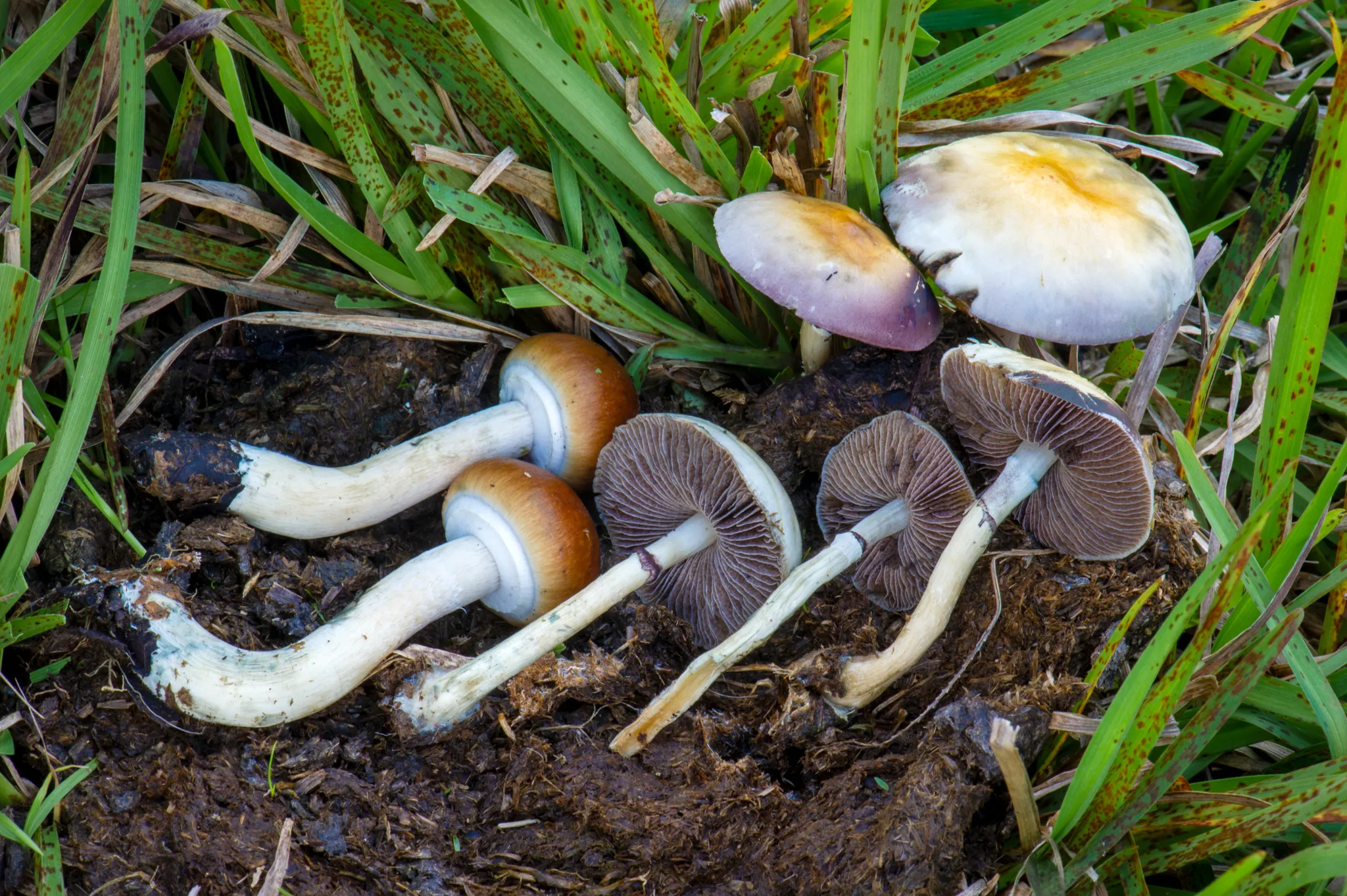
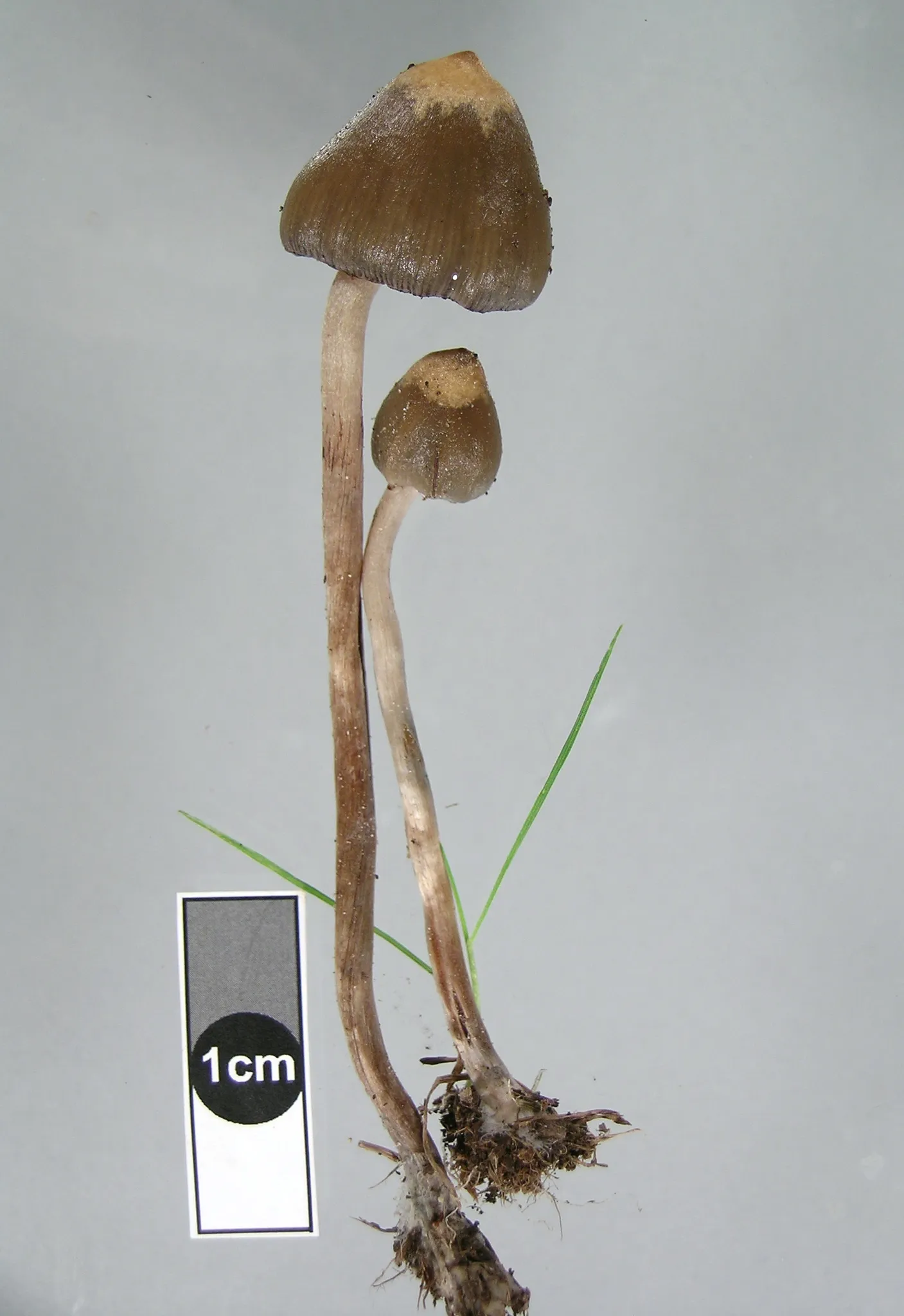
The cap is the clearest field mark: 0.5 to 2cm in diameter (one general reference extends that up to 2.5 cm), cream-coloured, sharply conical to bell-shaped, often with a nipple-like papilla1, and marked with striations that become more pronounced with age and in dry weather3.
Turn it over. The gills are olive-grey, free from the stem, turning purple-black with age. The stem is slender, 2 to 3mm thick and 4 to 10cm tall, usually wavy, fibrous, and sometimes tinged blue toward the base3. A thin, cobweb-like partial veil soon disappears, though it sometimes leaves an annular zone on the stem that may be darkened by spores1.
Handle or bruise it. Every part stains bluish when handled or bruised1, and it may also turn blue with age. The smell is musty. The spore print is dark purple-brown, from smooth, ellipsoidal spores 11.5 to 14.5 by 7 to 9 µm3.
Is liberty cap edible or poisonous?
Liberty cap is a psychoactive mushroom2 that contains the compound psilocybin3. It produces psilocybin, psilocin and baeocystin. Psilocybin content varies considerably between studies: one found an average near 1%, from 0.2% to 2.37%, another 0.62% to 1.28%, averaging about 1.0%, and a third a single specimen with 1.7% psilocybin and 0.36% baeocystin1.
Reported effects include visual distortions progressing to hallucinations, similar to LSD but milder, plus pupil dilation, a faster heart rate, unpleasant mood and overactive reflexes. A guide to psilocybin says an experience typically lasts four to six hours, with onset in 20 to 60 minutes4. The effect on mood depends on the person’s personality traits going in, and the same dose may affect different people very differently. Mushroom poisoning is possible too: First Nature notes it occasionally causes vomiting, stomach pains and anxiety attacks3, and one documented case describes an 18-year-old man in Poland1 who developed an irregular heartbeat and a heart attack after repeated ingestion over a month.
Legal status varies sharply by country. In the United Kingdom, psilocybin and its mushrooms are Class A under the Misuse of Drugs Act 1971, carrying up to seven years for possession and life imprisonment for supply; fresh liberty caps were legal to possess there until 2005. The Netherlands banned the mushroom itself in October 2008, the last European country to do so, though psilocybin truffles remain legal there and support a retreat industry. Sweden listed P. semilanceata itself as a narcotic from 1 October 1997, and Portugal has decriminalised it, and it is legal in Brazil; Jamaica and Costa Rica leave it unregulated, with retreat centres operating openly. In the United States, psilocybin and psilocin are Schedule I drugs, but Denver decriminalised possession in May 2019 and Oregon legalised therapeutic use in November 20201; Oregon and Colorado have since licensed centres for supervised sessions. In Canada, Section 56 exemptions have given some patients access to psilocybin-assisted therapy. Australia became the first country to formally approve therapeutic use, in July 2023, letting psychiatrists prescribe it for treatment-resistant depression4. Never eat a wild mushroom on the strength of a web page or an app: have it identified in person by an expert.
Where and when does liberty cap grow?
Liberty cap is saprotrophic, growing mostly in grassland that has not received artificial fertiliser, and it does not grow on dung. It is most often found on upland pastures, notably on hill slopes, and sometimes on lawns and lowland meadows3. MykoWeb describes it in California growing solitary to scattered to gregarious in grassy areas5.
It is fairly frequent but localised in Britain and Ireland, and found throughout Europe and in North America. Within California it is common on the far north coast and rare further south. In Britain and Ireland it fruits through summer and autumn3, while on the California coast MykoWeb records it fruiting from fall through winter5.
Liberty cap lookalikes
- Mower’s mushroom (Panaeolina foenisecii): also common on lawns, but First Nature lists it among the lookalikes and notes it is typically larger and lacks the pointed cap3. Its cap is 1 to 4 cm across, brownish when moist, tan when dry, with a deep brown, sometimes purplish spore print instead of liberty cap’s dark purple-brown. It is not edible and can cause sickness if eaten7. Many field guides list it as psychoactive6, but it contains only trace amounts of psilocybin and produces no noticeable hallucinogenic effect.
- Egghead mottlegill8 (Panaeolus semiovatus): the other lookalike First Nature names, there as the Dung Roundhead, likewise usually larger and lacking liberty cap’s pointed cap3.
- Inocybe geophylla: liberty cap has been confused with this muscarine-containing species1, which is poisonous and which First Nature rates deadly poisonous; its cap is 1 to 4 cm across, white or cream and silky, with gills cream at first, darkening to brownish instead of liberty cap’s olive-grey to purple-black, and a brown spore print instead of purple-brown. Its poisoning brings excessive salivation and sweating within half an hour (within 15 to 30 minutes9 in another account) and, depending on the amount eaten, may also bring abdominal pains, sickness, diarrhoea and laboured breathing10.
- Misidentification can run the other way too: one documented case involved a young Austrian man who mistook Cortinarius rubellus for liberty cap; he suffered end-stage kidney failure and needed a transplant. C. rubellus is poisonous1, and First Nature rates it deadly poisonous; its toxin orellanine destroys the kidneys and liver11.
Liberty cap in history
First described by Elias Magnus Fries in 1838 as Agaricus semilanceatus and transferred to Psilocybe by Paul Kummer in 1871, the author citation (Fr.) P.Kumm.2 still records that move. In 2009 the Nomenclature Committee for Fungi conserved the genus name Psilocybe with P. semilanceata as its type, avoiding changes to a well-known group of species. The common name liberty cap, used in the United States, refers to the Phrygian cap, also called a liberty cap1, which the mushroom’s shape resembles; in the UK it is more often called magic mushroom3.
The first reliably documented report of intoxication from this species dates to 1799, a British family who prepared a meal with mushrooms picked in London’s Green Park. In the early 1960s, Albert Hofmann confirmed 0.25% psilocybin by weight in dried samples, the first report of psilocybin in a European mushroom species. In 1965, forensic analysis identified liberty cap in mushrooms seized from British Columbia students1, Canada’s first recorded case of intentional recreational use of the species.