Contents
The death cap (Amanita phalloides) is deadly poisonous, responsible for more than 90% of fungus-related poisoning deaths in Europe. It grows in partnership with hardwood trees, especially oaks, and in Britain and Ireland it fruits from July to November. Its toxin, the heat-stable amatoxin alpha-amanitin, attacks the liver and kidneys, and half a mature cap is reportedly a lethal dose for an adult1.
How to identify death cap
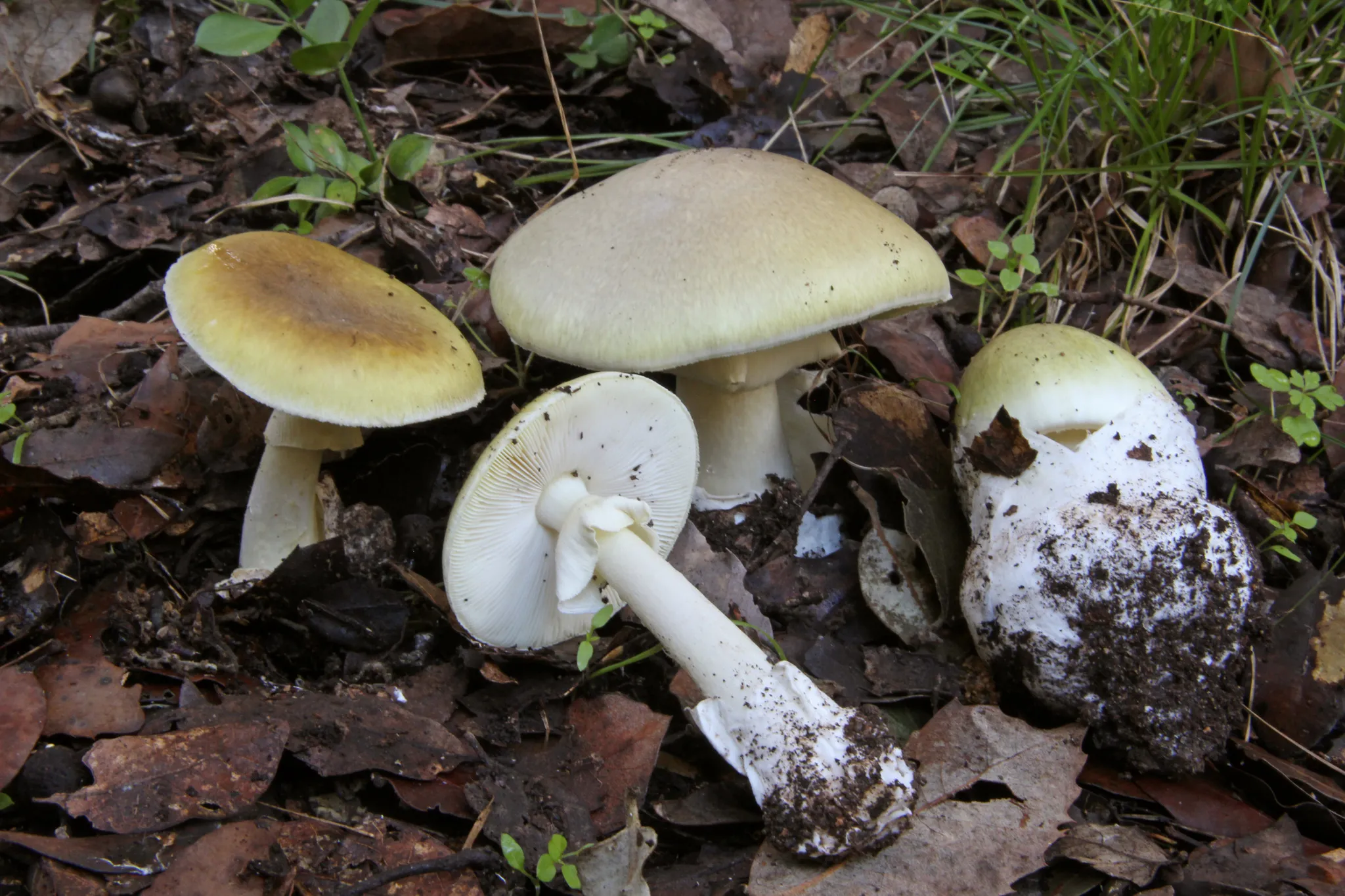
Start with the cap. A young death cap is almost white and egg-shaped; as it opens it takes on yellow, bronze or olive tones, usually a little darker at the centre, occasionally deep grass green shading almost to black in the middle, on a surface that is bald, sticky when wet and shiny when dry. Cap size runs 5 to 15 cm according to First Nature and up to 16 cm according to MushroomExpert2; the margin has no radiating lines1.
Turn it over. The gills are free from the stem, broad and crowded, starting pure white and ageing to cream, sometimes with a faint pinkish tinge. The stem runs 7 to 15 cm according to First Nature, or 5 to 18 cm according to MushroomExpert, off-white with faint zig-zag mottling, paler than the cap colour. It keeps a fragile, pendant ring through to maturity on a base that flares into a large, white, sack-like volva, often tinged green inside1; MushroomExpert warns it is sometimes underground or already broken up2, so dig below the surface to check.
Cut it. The flesh is white throughout and does not change colour when cut. Young specimens have no distinctive smell, but old ones develop an unpleasant, sickly sweet odour. The spore print is white, the spores themselves ellipsoidal and smooth: First Nature measures them at 7.5 to 10 by 6 to 7 µm and inamyloid1, while MushroomExpert gives a wider 7 to 12 by 6 to 9 µm and amyloid2.
Is death cap edible or poisonous?
Death cap is deadly poisonous. Its toxin is alpha-amanitin, an amatoxin that damages the liver and kidneys by blocking the enzyme RNA polymerase II3, which halts the cell’s production of new proteins; it is not broken down by freezing or cooking1.
Symptoms are deceptive. First Nature places the onset of diarrhoea, nausea and stomach pains at five to twelve hours after eating it, while a general reference gives six to twelve hours. These first symptoms can fade for a day or two, giving a false impression of recovery, even as a general reference describes liver and kidney damage progressing silently underneath it by the third to sixth day; First Nature says the first symptoms can also return with a vengeance as organ failure sets in, and without treatment, coma and death are almost inevitable. First Nature puts the mortality rate even with hospital treatment at 10 to 15%1; the general reference gives a similar modern range but a mid-20th-century rate as high as 60 to 70%. There is no antidote, but the reference describes hospitals using activated charcoal soon after ingestion, silibinin to stop the toxin entering liver cells, and a liver transplant for those who go into liver failure3. Never eat a wild mushroom on the strength of a web page or an app: have it identified in person by an expert.
Where and when does death cap grow?
Death cap is mycorrhizal with hardwood trees, especially oaks, and occasionally with conifers; in North America, MushroomExpert records it with coast live oak on the West Coast2 and other oaks in the east. It fruits in broadleaf and mixed woodland, most often under oak3, in Britain and Ireland from July to November1.
It is native throughout Britain and Ireland and mainland Europe, as well as northern Africa and parts of Asia, and First Nature says it reached the USA, Australia and South America with imported plants or timber1. A general reference credits its North American spread to imported chestnut trees and lists further introductions to New Zealand, Tanzania and South Africa, in some cases spreading with non-native oak, chestnut or pine plantings3; MushroomExpert maps its US range as the West Coast and the eastern states2.
Death cap lookalikes
- False death cap (Amanita citrina): carries brownish-cream veil fragments on the cap, with a volval rim rather than an open, sack-like volva1 at the base.
- Field mushroom and related Agaricus species: no volva at the base of the stem1.
- Paddy straw mushroom (Volvariella volvacea): death cap resembles this edible species, which is popular in Chinese and other Asian dishes3.
- Caesar’s mushroom (Amanita caesarea) and the white Caesar (Amanita princeps): prized edible Amanitas that death cap can be confused with, along with the edible Amanita velosa and Amanita calyptroderma3 in California.
- Puffballs: an unopened, egg-stage death cap can be mistaken for a puffball3.
Death cap in history, food and medicine
The name comes from the phallic shape of a young death cap as it emerges from its volva. A general reference credits the French botanist Sébastien Vaillant with first describing the species, in 1727, and says Johann Heinrich Friedrich Link placed it in the genus Amanita in 18333; First Nature’s taxonomic name, (Vaill. ex Fr.) Link1, credits the same Link without giving his full name or the year.
Death cap has a long history as a favourite weapon of poisoners, known to the ancient Greeks and Romans as a deadly poison: Agrippina allegedly used it to poison the Roman emperor Claudius, and First Nature calls it very probable that death cap killed Charles VI1 in 1740. More recently, Erin Patterson was convicted in 2025 of three murders and one attempted murder after serving a 2023 beef Wellington meal containing death caps to her relatives. As medicine, the research targets the toxin, not the mushroom: in one hospital study, patients treated with silibinin within 96 hours of ingestion3, whose kidneys had not yet failed, survived in every case.