Contents
The fly agaric (Amanita muscaria) is the red, white-spotted toadstool of fairy tales and children’s books, and it is a hallucinogen that must be considered poisonous. It grows in woodland and heathland among birch, pine or spruce across the temperate and boreal Northern Hemisphere1, and in Britain and Ireland it fruits from August to November2. Its main toxins, ibotenic acid and muscimol, act on the central nervous system. Reports of human deaths are extremely rare3, but poisoning can be severe enough to need a ventilator4.
How to identify fly agaric
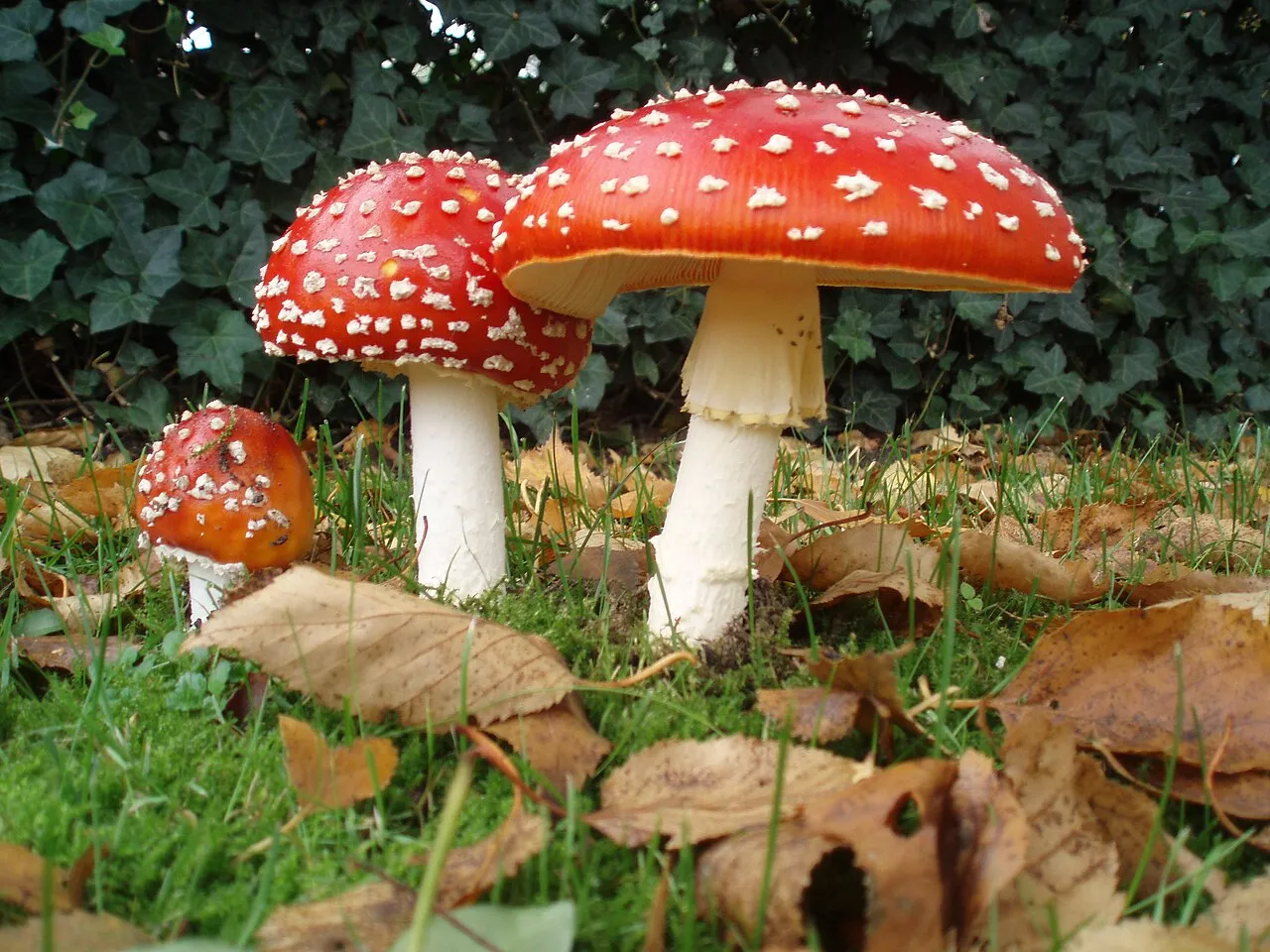
Start with the cap. A young fly agaric comes up through the leaf litter as a rounded button covered entirely in pointed white warts; as it expands, the red skin shows between them, and the mature cap usually flattens out or even turns slightly concave. Mature caps vary widely in size across the sources: 8 to 14 cm according to Wild Food UK5, 8 to 20 cm according to The Wildlife Trusts6, 10 to 20 cm at maturity according to First Nature2, 7 to 21 cm according to MushroomExpert, 5 to 30 cm according to one general reference1, and 6 to 39 cm in MykoWeb’s data for California8. The colour is deep to bright red, fading to orange-red or dull orange7. The warts are what is left of the white veil that enclosed the young mushroom, and rain sometimes washes them off3, so a smooth red cap can still belong to a fly agaric.
Turn it over. The gills are white, free from the stem and crowded, turning pale yellow with age. Stem size is another spread: 8-14 by 1-2 cm per Wild Food UK5, stem height 8-18 cm per The Wildlife Trusts6, 7-18 by 2-3.5 cm per MushroomExpert, 10-25 by 1.5-2 cm per First Nature, 5-20 by 1-2 cm per one general reference1, and 7-16 by 2-3 cm per MykoWeb8. It has a high, skirt-like ring and a swollen base. Check that base: instead of a loose cup it carries concentric bands of felty veil tissue7 at the top of the bulb or on the lower stem, the remains of a sack-like volva that breaks up into rings of scales2.
Cut it. The flesh is white and does not change colour when sliced, apart from a thin layer just under the cap skin that turns yellow in the air. First Nature finds the smell not distinctive; the Woodland Trust calls it savoury3. The spore print is white2, and under a microscope the spores are smooth and broadly ellipsoid, 10 to 13 by 8 to 9 µm according to MushroomExpert7, though MykoWeb gives elliptical spores, 9 to 13 by 6.5 to 9.5 µm8 and one general reference gives oval spores, 9 to 13 by 6.5 to 9 µm1.
Not every fly agaric is red with white warts: the Eurasian var. muscaria, the form described above, is absent from most of North America, recorded by MushroomExpert only in western Alaska; one general reference adds that it also occurs alongside imported European trees near the West Coast, and MykoWeb lists it as one of only two A. muscaria varieties commonly found in California’s San Francisco Bay Area8. In the rest of that continent other varieties replace it7: flavivolvata (red, with warts yellow when young), guessowii (orange to yellow), persicina (peach) and alba (white). A 2006 DNA study by Geml and colleagues found that colour does not reliably follow the genetic lines, and the fly agaric is probably a species complex1. All forms share warts on the cap, a ring on the upper stem and concentric shaggy zones on the swollen base9.
Is fly agaric edible or poisonous?
Fly agaric is poisonous: The Wildlife Trusts say it should not be eaten6. It is not a death cap, though: unlike some other amanitas, it does not contain the amatoxin α-amanitin1, confirmed in the Minnesota case below, where the mushroom the patient ate did not contain amatoxin4.
The toxins that matter are ibotenic acid and muscimol, which resemble the brain’s messengers glutamate and GABA; ibotenic acid is capable of producing central nervous system excitation such as hallucinations, agitation or seizures, and muscimol causes central nervous system depression. The mushroom gave its name to muscarine, but it contains too little of it to play a role in poisoning. The toxins sit mainly in the cap, and the amount varies greatly with age and between specimens2; spring and summer fruitings have been reported to hold up to 10 times more than autumn ones1. Cooking is no safeguard: the toxins might not be deactivated by it4.
Sources do not agree on how fast symptoms start. One general reference gives 30 to 90 minutes, peaking within three hours; a 2023 UK case report states that symptoms typically occur 30 minutes to 2 hours after ingestion; and in the Minnesota case below, symptoms began about 2–3 hours after the meal. That case report lists the cardinal symptoms as visual and auditory hallucinations, confusion, incoherent speech, agitation and dizziness, with nausea, vomiting, diarrhoea and abdominal cramps that may happen soon after ingestion, and notes that seizure and coma can occur, especially in children. Duration also varies: the general reference says recovery is usually complete within 12 to 24 hours, though it adds that certain effects can last several days1; the case report gives 8 to 24 hours; and the Minnesota patient below4 needed ventilation for days, not hours. There is no specific antidote; treatment is supportive10. Eaten raw, it has caused severe and violent stomach upsets according to First Nature2, and MykoWeb likewise lists it as toxic when raw8.
Old journal articles and newspapers reported some deaths, but with modern treatment a fatal poisoning is extremely rare; the North American Mycological Association has stated that there were no reliably documented deaths from these toxins in the past 100 years1. That is not the final word: a 2026 clinical review cites a published case of a 44-year-old man who died after eating several dried caps for their psychoactive effect, so a fatality, while still rare, can happen; the same review cites a second, 75-year-old man who made a full recovery after hospital treatment11 after accidentally eating a foraged mushroom. In Minnesota in 2018 a man picked mushrooms that looked like a mushroom he knew from Burma, the Ochre mushroom (Amanita hemibapha var. ochracea); a site visit to the location where they were picked turned up a matching mushroom, which a Minnesota Mycological Society mycologist identified as A. muscaria var. guessowii. He had cooked them, yet his symptoms began about 2–3 hours after the meal, he needed mechanical ventilation for 4 days and he left hospital 8 days after admission4.
Never eat a wild mushroom on the strength of a web page or an app: have it identified in person by an expert.
Where and when does fly agaric grow?
Fly agaric lives in partnership with trees: it is ectomycorrhizal with hardwoods and conifers, notably birches, pines and spruces, trading nutrients from the soil for the trees’ sugars. In Britain it grows in woodland and heathland on light soils, often with birch3, as well as moorland, towns and gardens6, and it usually returns to the same spot for several years2. In California it grows mainly under pines, especially Monterey and Bishop pine, alongside the king bolete (Boletus edulis)8.
It is native throughout the temperate and boreal Northern Hemisphere, including higher ground in the Hindu Kush, the Mediterranean and Central America, and pine seedlings have carried it to Australia, New Zealand, South Africa and South America. In New Zealand, Tasmania and Victoria it behaves like a fungal weed and has formed new partnerships with southern beech (Nothofagus)1, raising concerns that it spreads at the expense of native fungi2.
In Britain and Ireland the season runs from August to November2; Wild Food UK extends it to December5. North American fruitings come in summer and autumn over most of the continent, but later in autumn and in early winter on the Pacific coast1. Red squirrels, slugs and fungus gnats eat it6.
Fly agaric lookalikes
The warts that mark a fly agaric can mislead as much as identify it: rain can wash them off a red cap3, and outside Europe and Asia it need not be red at all. North America’s own red form, var. flavivolvata, is fairly widely distributed there9; alongside it grows the orange-yellow var. guessowii, and, more rarely, a white form, var. alba2. A fly agaric can also be the one mistaken, as the Minnesota case above shows: a forager picked it because it resembled the Ochre mushroom (Amanita hemibapha var. ochracea), an edible he knew from his native Burma; investigators noted more broadly that some local toxic mushrooms might resemble edible mushrooms found in Southeast Asia4.
- Blusher (Amanita rubescens): a pale reddish-brown cap with cream spots3. Damage it: its stem and cap flesh always turn red2, a blushing Wild Food UK also describes where damaged, while fly agaric flesh stays white7. First Nature calls the Blusher edible once well cooked, but most foragers avoid it because eaten raw it contains a toxin that can cause anaemia12; Wild Food UK agrees it is toxic raw but edible when cooked5.
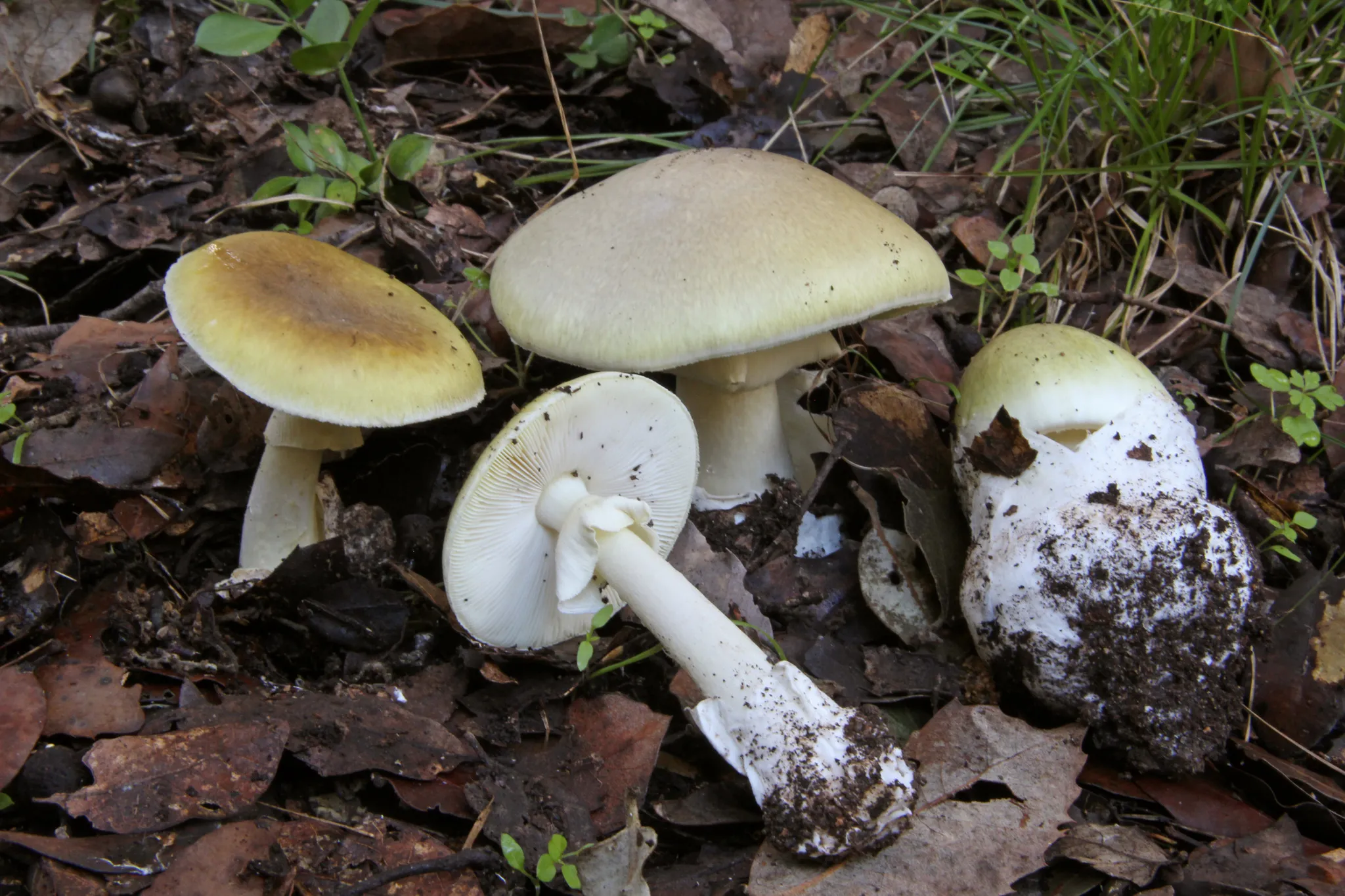
- Panther cap (Amanita pantherina): a brown cap. Sources describe its bulb differently: MushroomExpert calls it usually a collar-like rim of tissue at the top of the bulb9, while First Nature describes one or more woolly rings, or a helix, above a narrow gutter — either way, not fly agaric’s concentric shaggy zones. It is no safer: it has the same toxins, in more variable and usually higher concentrations5, and First Nature calls it deadly poisonous13.
- Caesar’s mushroom (Amanita caesarea): a highly regarded edible, though First Nature counsels cooking it thoroughly even though some authorities call it edible raw. Its orange to red cap lacks white warts. The sources disagree on its colours below the cap: one general reference gives a bright yellow stem, gills and ring1, while First Nature describes them as pale to mid orange stem, yellow-orange gills and a pale orange ring, with a white bag-like volva14 at the base, instead of fly agaric’s rings of scales. It is rarely if ever found in northern Europe2.
- Beechwood sickener (Russula nobilis): a bright red cap, but no ring, no volva and a very brittle texture2 — traits the whole Russula genus shares, lacking any partial veil or volva tissue on the stem15. First Nature treats it as a toxic toadstool: eaten raw or undercooked it causes nausea, vomiting and stomach pains16; a second source agrees it is inedible and probably poisonous in quantity, though not deadly, with gastrointestinal symptoms including diarrhoea, vomiting and colicky cramps17.
- Vermilion grisette (Amanita xanthocephala): this Australian native grows with eucalypts. Unlike fly agaric, a collected specimen described by the Queensland Mycological Society had a ring absent from the stem, matching the general reference’s account of no ring on the stem; unlike fly agaric’s warts scattered over the whole cap, that specimen carried white velar remains concentrated at the cap’s centre19, close to the general reference’s description of it as generally lacking the contrasting white warts1 of fly agaric. Its toxicity claim carries no citation in that source; the only incident on record there is one taster who became unwell after eating a small piece in 199718.
- Jewelled amanita (Amanita gemmata): closely related to fly agaric and the Panther cap, it could pass for a yellowish fly agaric since yellow forms of fly agaric exist, but its cap is a dull to golden shade of yellow, not red, with a flimsy, easily lost ring in place of fly agaric’s high, skirt-like one — MushroomExpert likewise describes a fragile white ring that is easily lost21. Wild Food UK could not confirm its toxin content but called some books’ report of it as very poisonous5 reason enough to avoid it; a second source is more definite, calling it a toxic mushroom containing ibotenic acid and muscimol20, the same toxins as fly agaric.
- Amanita parcivolvata: often mistaken for fly agaric, though fly agaric is usually stockier22, with more prominent warts, a ring, and a stem base ringed with concentric shaggy zones — the features that mark it out. MushroomExpert gives no edibility verdict; the only one among the sources used here is an uncited infobox field23 marking it edible, unconfirmed elsewhere, so treat it with the same caution as fly agaric itself.
- Honey fungus (Armillaria mellea) and immature puffballs: fly agaric has been mistaken for yellow-to-red Armillaria species, and its unopened button stage for puffballs1. Unlike fly agaric, honey fungus fruits in dense clusters at the base of trunks and stumps rather than singly from the soil. Honey fungus itself divides opinion: First Nature says some consider it edible only if well cooked, while others find it indigestible or even poisonous to a minority, so its own conclusion is that it should not be collected for the pot25; a general reference agrees it is considered a good edible, though not preferred by some foragers24.
Fly agaric in history, food and medicine
The name is thought to derive from flies: many European names refer to its use as an insecticide, sprinkled in milk, a practice Albertus Magnus recorded before 1256. Sources disagree on what attracts the flies, not on what kills them: the Woodland Trust says ibotenic acid attracts and kills the flies3, and First Nature adds that the milk dissolves the ibotenic acid out of the crumbled cap, poisoning the flies that drink it. A different isolated compound, 1,3-diolein, is said elsewhere to attract insects1, with no claim that it also kills them. Muscaria itself comes from Latin musca, a fly. Linnaeus described the species in 1753 as Agaricus muscarius. Sources disagree on who moved it to Amanita: Species Fungorum credits Lamarck, in 178326; First Nature instead credits Christiaan Hendrik Persoon, also in 1783; and MykoWeb cites a later publication by Hooker, in 18218. It is the type species of the genus2.
Shamans across northern Eurasia used it in a non-sacred, often recreational way, and the Koryak of eastern Siberia tell how the fly agaric gave Big Raven the strength to carry a whale home. Two other theories tying the mushroom to famous traditions have not held up under scrutiny. R. Gordon Wasson proposed in 1968 that it was the soma of the Rigveda; Vedic scholar John Brough rejected this in 1971, and the established scholarly consensus is that soma was Ephedra. The Viking berserker story goes back to the Swedish professor Samuel Ödmann in 1784, but no contemporary source mentions such use. The mushroom was a good-luck symbol on Victorian and Edwardian Christmas cards3, but the popular theory tying it to Santa Claus and Sámi shamans is one Sámi people have widely criticised as a romanticised misreading of their culture1.
As food, most modern field guides, Wild Food UK’s included, treat it as toxic5. Traditional medicinal use is recorded in Siberia, Ukraine and Eastern Europe for anxiety, insomnia and inflammation. To the best of its authors’ knowledge, a 2023 UK case report is the first on A. muscaria poisoning in the UK: it describes a 46-year-old woman, a Ukrainian emigrant, who ate the dried mushroom for an anxiolytic effect and developed acute delirium before fully recovering and being discharged 24 hours after presentation10. A 2023 study in Toxics analysed 5,600 social-media comments and included 684 people; the side effects they reported included headaches, nausea, vomiting, abdominal pain and drowsiness27. On 18 December 2024 the US Food and Drug Administration concluded that A. muscaria, its extracts, muscimol, ibotenic acid and muscarine are not authorised as ingredients in conventional food, noting their use in foods marketed as psychedelic edibles28.