Contents
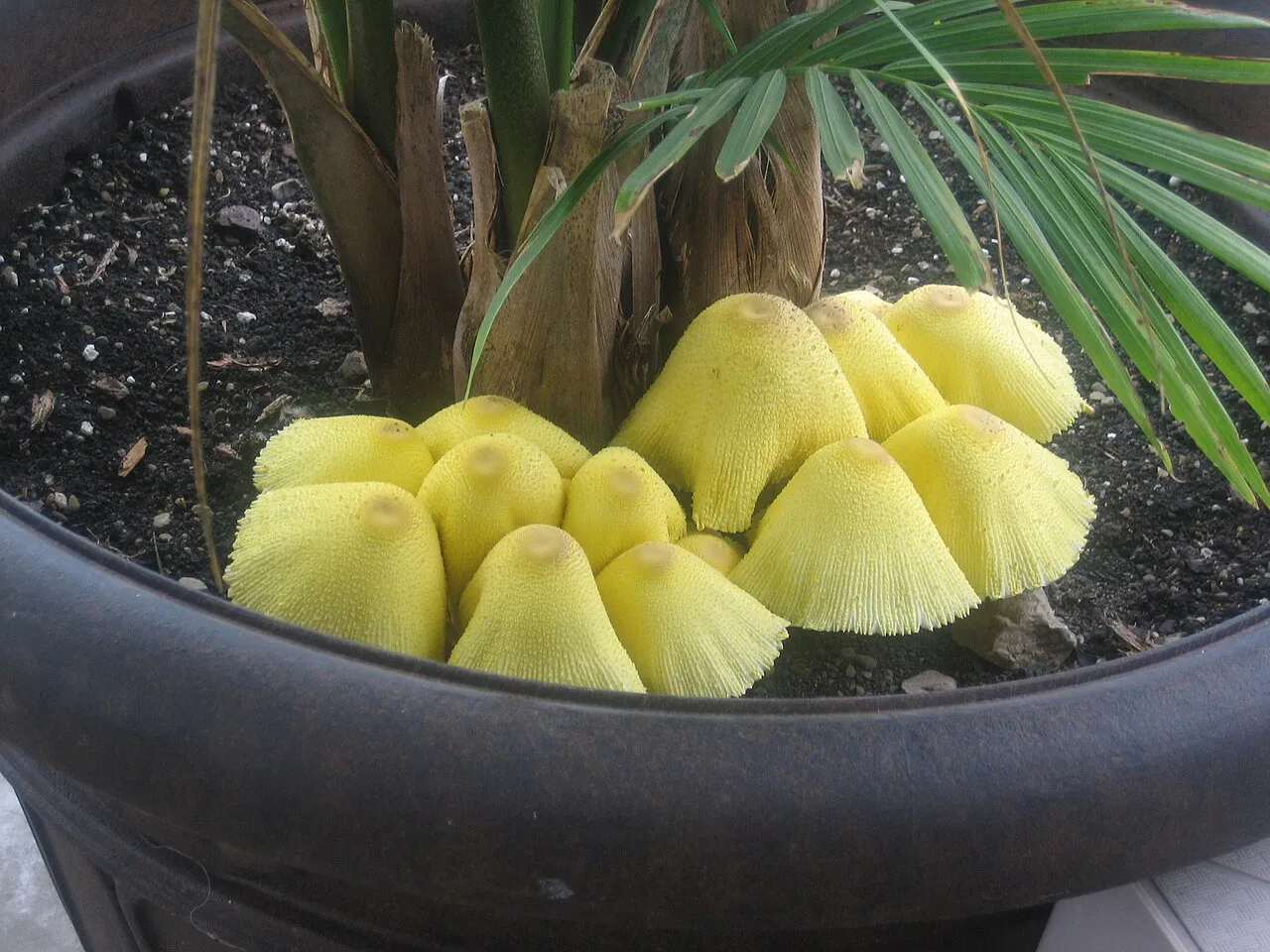
The flowerpot parasol (Leucocoprinus birnbaumii) is a species of gilled mushroom in the family Agaricaceae that is common in the tropics and subtropics and, in temperate regions, frequently occurs in greenhouses, flowerpots and indoor terrariums1. It is not edible: First Nature calls it a toxic toadstool that can cause a very unpleasant stomach upset2, and MykoWeb rates it possibly poisonous, to be avoided3. Indoors it can fruit year-round, and it won’t hurt your plant4, according to MushroomExpert’s Michael Kuo.
How to identify flowerpot parasol
Look at the colour first: the cap is bright to pale yellow, often with a darker (but not brown) center, and MykoWeb notes that the bright yellow fades rapidly in the sun3. Its yellow colour comes from a pair of indole alkaloids known as birnbaumins1. It measures 2 to 6 cm across at maturity according to First Nature2, and 2.5 to 5 cm according to MushroomExpert. Young caps are oval to egg-shaped, later broadly conical, broadly convex, or bell-shaped; the surface is powdery to finely scaly, and the margin is lined or grooved nearly to the center by maturity4.
The gills are free from the stem, crowded and pale yellow to yellow. The stem is 3 to 10 cm long and 2 to 5 mm thick above a slightly swollen base, and it carries a fragile, bracelet-like, yellow ring that sometimes disappears. The flesh is whitish to yellowish and very thin, and the smell is not distinctive4, though MykoWeb describes the odour as strongly of “mushrooms”3. The spore print is white2.
Under the microscope the spores are 8 to 12 by 5 to 7 µm, smooth, thick-walled and dextrinoid, with a 1–2 µm pore at one end4. Often visible on the soil are sclerotia amongst the mycelium: tiny (500–820 μm) hard, elliptical masses, described as whitish-beige or pale yellowish white1.
Is flowerpot parasol edible or poisonous?
Flowerpot parasol is poisonous. First Nature says if eaten it can cause a very unpleasant stomach upset, and another reference gives gastroenteritis-like symptoms1. MykoWeb lists its edibility as possibly poisonous, to be avoided3, and MushroomExpert contains no information about the edibility or toxicity of mushrooms4. First Nature judges the risk of a forager accidentally gathering it as part of a meal to be minimal, since it occurs in an unusual habitat, is insubstantial and is sufficiently rare2. Never eat a wild mushroom on the strength of a web page or an app: have it identified in person by an expert.
Where and when does flowerpot parasol grow?
It is saprobic, living on very decayed plant matter (humus or compost)1, and grows singly or in small groups on potting compost and other rich soils2. MushroomExpert finds it in flower pots, greenhouses and, in warm conditions, outside in gardens, lawns, and other cultivated areas, as well as in hardwood and conifer forests, especially in disturbed ground areas4. In California it is occasional outdoors in grass or well-decayed wood chips3.
It is a tropical/subtropical species, and in Britain and Ireland it is uncommon but widespread in hothouses, arriving there through the importing of exotic plants. It is also found in Australia and North America, where it is almost invariably seen in hothouses or in the pots of exotic house plants2. Garden centres and nurseries serve as hubs1 that spread it around Europe.
Indoors it fruits year-round in greenhouses. In unheated greenhouses in Britain First Nature gives June to October2. Outdoors it is limited to late summer or early fall3 in California, while MushroomExpert gives summer4.
Flowerpot parasol lookalikes
- Bolbitius titubans: a grassland species of similar size with a yellow cap, but its yellow gills turn cinnamon when the spores mature and its slender stem has no ring2.
- Leucocoprinus tricolor: a brown cap center, pale yellow colors and a chrome yellow stem base, where flowerpot parasol’s centre, often darker, is not brown4.
- Leucocoprinus flavescens: a brownish cap center and smaller spores4.
- Leucocoprinus straminellus: slightly paler (sometimes entirely whitish), and best distinguished microscopically by its smaller spores that lack a germ pore1.
- Leucocoprinus cepistipes: a white, striate cap, and it fruits outdoors on well rotted wood chips or in grass under conifers3.
Flowerpot parasol in history, food and medicine
James Bolton first described the species as Agaricus luteus, a name that was illegitimate because an unrelated Russula species1 already had it. In 1839, the Czech mycologist August Corda described it again from specimens found in a greenhouse by a garden inspector named Birnbaum, which gave it the epithet birnbaumii. Rolf Singer moved it to Leucocoprinus in 1962 according to MushroomExpert4, or in 1961 according to First Nature. The genus name comes from the Greek leucos, meaning white, and Coprinus2.
A 2015 study isolated fatty acids that showed moderate but selective anti-microbial effects from the mushroom; linoleic acid displayed some inhibition against Streptococcus pyogenes, while none of the compounds showed results against E. coli, MRSA or Candida albicans1.