Contents
The button mushroom (Agaricus bisporus) is the cultivated mushroom, sold white as the button mushroom or, as a separate brown strain, as cremini when immature and portobello when mature1, and it is a good edible mushroom. Away from cultivation it also grows wild, in grassland and pastures as well as lawns and compost heaps3, in mainland Europe and parts of North America2.
How to identify button mushroom
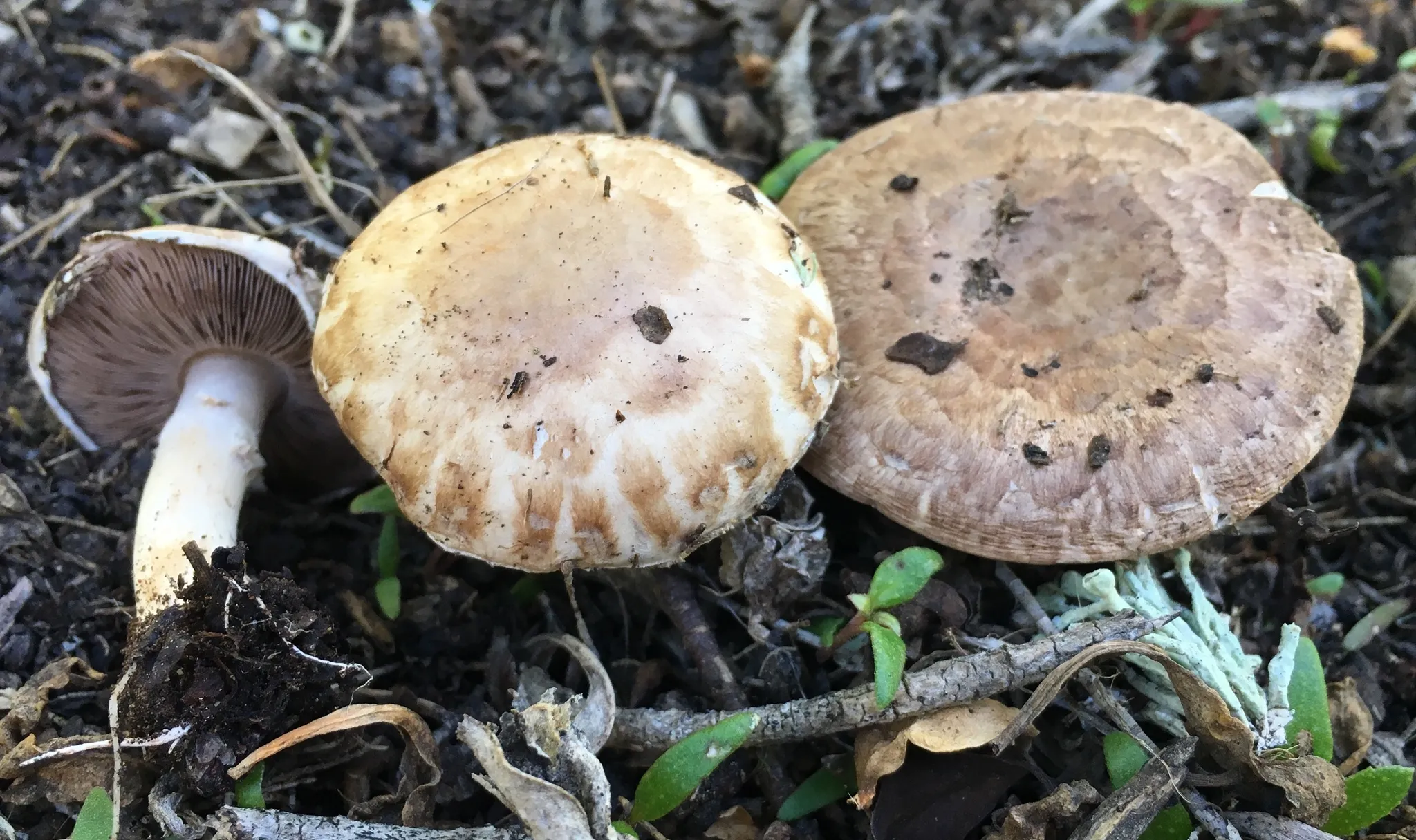
Cap size is reported differently from source to source: 2.5 to 14 cm according to MushroomExpert, usually 5 to 10 cm at maturity according to First Nature, and, per one general reference, typically 5 to 10 cm for the wild species1. It starts out hemispherical, becoming convex and then flattening2 with age; the surface is dry, bald or finely scaly, white in the standard cultivated form and brown in the cremini strains, and it often bruises pinkish to reddish when rubbed3.
The gills are crowded, narrow and free from the stem, starting pink and darkening through reddish to chocolate brown as the spores mature. The spore print is dark brown according to MushroomExpert, or deep chocolate brown according to First Nature, though MushroomExpert warns a print is sometimes difficult to obtain from store-bought mushrooms. The stem runs 2 to 7 cm tall and 1 to 2.5 cm thick, carrying a thin ring that sometimes disappears in maturity3 — First Nature instead describes it as an insubstantial, membranous double ring2. There is no volva at the base of the stem4, unlike its deadliest lookalikes (see below).
Cut flesh is white, usually bruising pinkish to reddish and then slowly brownish, with a pleasant odour and taste, First Nature describing the smell as “mushroomy”. Under a microscope, MushroomExpert gives ellipsoid, smooth spores, 6 to 8 by 5 to 6 µm, while First Nature gives egg-shaped to round spores, 4 to 7.5 by 4 to 5.5 µm. Both sources point to the same unusual tell behind the name bisporus: its basidia carry two spores each2, where most other Agaricus species carry four3.
Is button mushroom edible or poisonous?
Button mushroom is edible: First Nature calls it a good edible mushroom2, while one general reference rates the cultivated form a choice edible and one of the most widely consumed mushrooms in the world. The real risk sits in species it could be confused with1: destroying angels, the yellow stainer, Entoloma sinuatum and a young death cap, sometimes collected by mistake4, covered under Lookalikes below. Never eat a wild mushroom on the strength of a web page or an app: have it identified in person by an expert.
Where and when does button mushroom grow?
In the wild, button mushroom is saprotrophic, growing on manured soil, compost piles and in lawns3 as well as grassland and permanent pastures, and in Britain and Ireland it fruits from late spring to autumn2; one general reference instead gives autumn to winter, in association with cypress, rich soil, compost and manure1.
It is native to grasslands in Eurasia and North America, though First Nature calls it uncommon to rare in the wild in Britain and Ireland2. MushroomExpert notes a few genetically distinct, genuine wild North American populations: under Monterey cypress on the California coast, in montane New Mexico, and under spruce in montane Alberta; all other studied North American populations are escapees from cultivation with European genetic roots3. By 1984 it was already cultivated in at least seventy countries worldwide1.
Button mushroom lookalikes
- Death cap (Amanita phalloides): an unopened young death cap can look like a closed button mushroom, its gills start pure white and turn only cream, sometimes with a slight pinkish tinge, never the grey or pinky-brown of a young button mushroom’s gills, and its swollen stem base sits inside a large, white, sack-like volva that button mushroom, which has no volva at all4, lacks entirely.
- Destroying angels (Amanita species): young specimens could be confused with button mushroom, but may be told apart by a volva or cup at the stem base and pure white gills, as opposed to its pinkish or brown ones1.
- Yellow stainer (Agaricus xanthodermus): a close relative whose cap and stem base quickly turn chrome yellow when scratched or cut, a reaction button mushroom’s own flesh does not show so fast or so strongly; it also carries a noticeable smell of ink, phenol or iodine that button mushroom lacks, and can cause stomach cramps, nausea, vomiting, sweating and diarrhoea if eaten, though a small minority eat it with no ill effects5.
- Entoloma sinuatum: a poisonous1, deadly poisonous European species, its yellowish white gills turning pinkish as the spores mature and its stem bearing no ring6, where button mushroom’s gills start pink rather than yellowish white, and its stem usually keeps a thin ring.
Button mushroom in history, food and medicine
Commercial cultivation goes back to 1707, when the French botanist Joseph Pitton de Tournefort first described the practice. It stayed unreliable until 1893, when the Pasteur Institute in Paris produced sterilised, pure-culture spawn for growing it on composted horse manure. The familiar white form is more recent: in 1925 a white mutation was discovered growing among a bed of brown mushrooms at Keystone Mushroom Farm in Coatesville, Pennsylvania, and Louis Ferdinand Lambert, the farm’s owner and a mycologist by training, brought it back to his laboratory; growers took to it because it looked more appealing as food1.
The names track how far it has grown: button, common or white mushroom for the immature white form, cremini or chestnut for the immature brown form, and portobello once fully expanded. Raw, 100 g provides about 22 kilocalories and is 92% water, with riboflavin, niacin and pantothenic acid each supplying roughly a quarter to a third of a day’s recommended amount. Exposing the mushroom to UV light raises its vitamin D2 content from about 0.2 to as much as 11.2 micrograms per 100 g1.