Contents
The shaggy ink cap (Coprinus comatus), also called the lawyer’s wig or shaggy mane, is a large and conspicuous edible (when young and fresh) fungus that occurs in meadows, woods and roadside verges. It is widespread and common in Britain and Ireland, occurs throughout mainland Europe and in North America, and in Britain and Ireland it fruits from April to November1. Among its distinguishing features, the gills “deliquesce,” turning themselves into black ink as they mature2.
How to identify the shaggy ink cap
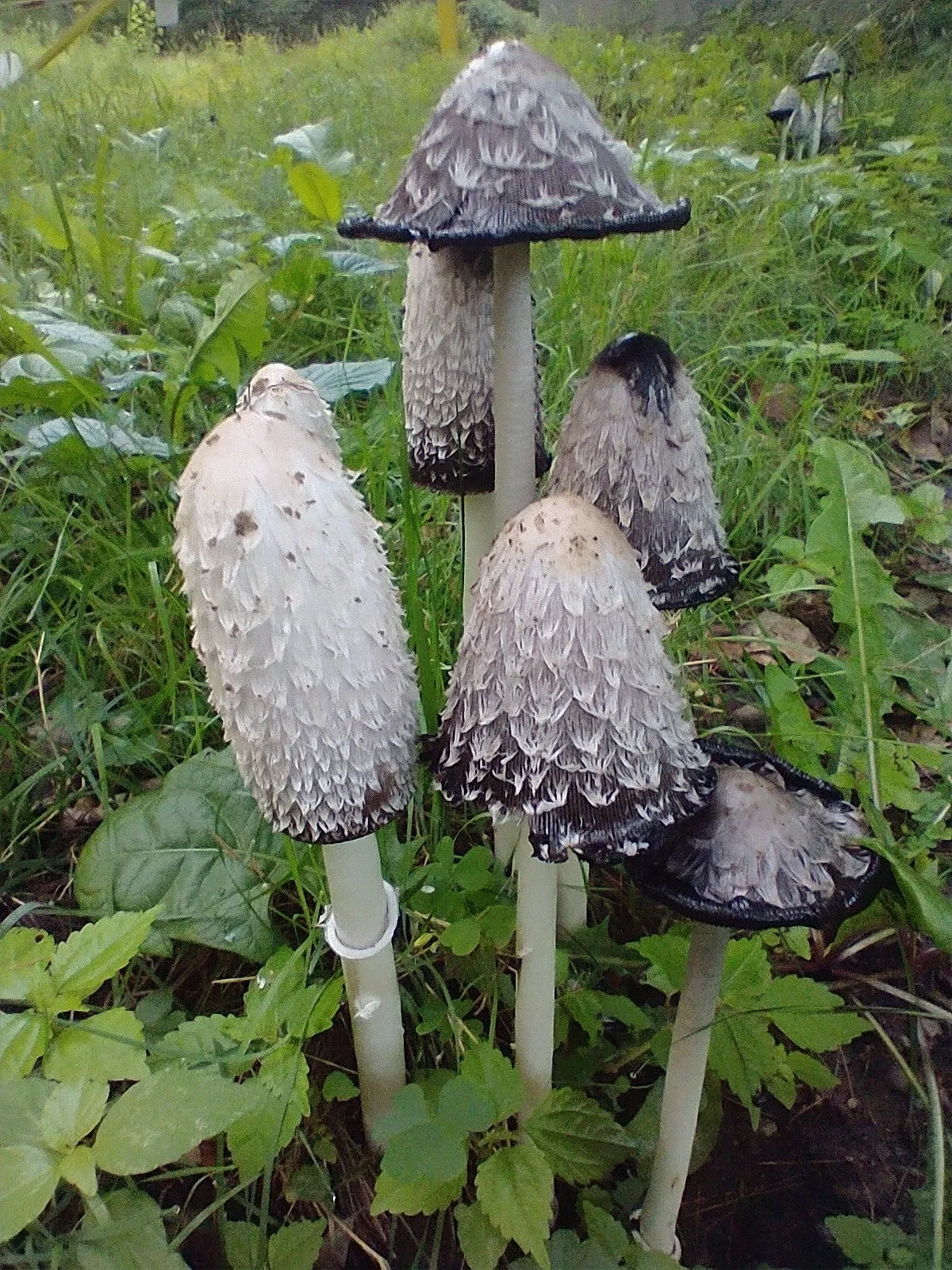
MykoWeb calls it one of the easiest of all mushrooms to recognize3, thanks to its columnar, shaggy cap which dissolves into ink at maturity. The cap is initially egg-shaped and opening into a long bell, pure white at first with a pale brown area at the top that breaks up into large recurved scales. In dry weather the whole of the cap breaks into pale flaking scales1, while rain flattens them.
Sizes differ by source. First Nature gives caps typically 5 to 10cm but occasionally 15 cm tall and up to 6cm in diameter1. MushroomExpert gives the cap as 3-15 cm2, and MykoWeb’s California specimens are 5-14 cm tall, 2.5-4.5 cm broad. As it matures, the gills deliquesce from the margin into a black, inky liquid3.
The gills are adnexed to free, crowded and initially white; they soon turn pink and then black before liquefying from the outside edge. Once that starts, in a few hours the mushroom will have been reduced1 to little more than a stem with a small inky disc.
The stem is white, quite brittle, and hollow, up to 30 cm tall according to First Nature; MushroomExpert gives 5-20 cm long; 1-2 cm thick. Inside the hollow stem hangs a string-like strand of fibers, and the stem is easily separable from the cap. The ring becomes stained with black spores1, soon becomes movable and often falls down to the base of the stem. MushroomExpert notes that the ring and the string-like strand are better predictors of the genus Coprinus2.
The flesh is white throughout; soft. The smell and taste are faint and quite pleasant, but not distinctive. The spore print is black2, and the spores are ellipsoidal, smooth, 9-13 x 7-9.5µm1.
Is the shaggy ink cap edible or poisonous?
The shaggy ink cap is edible when young. First Nature calls it a good ‘second division’ edible species, lacking somewhat in flavour compared with ceps, morels or chanterelles, and MykoWeb rates it edible and choice, but it must be cooked quickly3 before the caps turn to ink. The fruitbodies must be young and fresh, because as they age these fungi deliquesce and become an inedible sticky mess. First Nature advises eating them within an hour or two of gathering them1, as they deteriorate very quickly even in a refrigerator.
Related inkcaps carry a risk with alcohol that the shaggy ink cap does not. The common inkcap (Coprinopsis atramentaria) contains coprine, which causes negative disulfiram‐like reaction when eaten with ethanol, with symptoms that usually include flushing, vomiting, nausea, tachycardia, headache, dizziness. First Nature calls the common inkcap poisonous when consumed in conjunction with alcohol5, with effects that are sometimes severe. A 2020 review notes that CC does not contain coprine4, CC being its abbreviation for Coprinus comatus.
The same review reports that the shaggy ink cap may also accumulate aluminum, barium, and vanadium even when harvested on unpolluted areas. Its legal status varies: in some countries in Europe, Poland among them, it lacks legal approval as a food mushroom4. Never eat a wild mushroom on the strength of a web page or an app: have it identified in person by an expert.
Where and when does the shaggy ink cap grow?
The shaggy ink cap is saprobic. First Nature finds it on grass verges and lawns, at the edges of footpaths and in open woodland, and MushroomExpert adds lawns, wood chips, or hard-packed ground. It is frequently found in disturbed ground2, and the edges of dirt roads can produce many mushrooms. In California it grows along roadsides, paths and in playing fields3. It often appears in small groups and occasionally in long, wandering lines or fairy rings1.
In Europe it is found from Scandinavia down to the southern edge of the Iberian Peninsula1 and the shores of the Mediterranean. In North America it is widely distributed2. It appears to have been introduced to Australia, New Zealand, and Iceland6.
The season in Britain and Ireland runs from April to November1, most plentiful in summer and autumn, and the mushrooms appear in greatest abundance soon after rain. MushroomExpert gives summer and fall2 for North America. In California it fruits any month of the year when moisture is available3, but is most abundant soon after the fall rains.
Shaggy ink cap lookalikes
- Magpie inkcap (Coprinopsis picacea): when young it could be mistaken for a Shaggy Inkcap. As its cap expands, the cottony veil breaks into separate patches to reveal the glossy dark background, whereas the shaggy ink cap is white with a brown central disc3. It grows most often in deciduous woodland, particularly under Beech trees, and is reported to be poisonous7.
- Common inkcap (Coprinopsis atramentaria): it has a smooth to fibrillose, not scaly cap surface3, and lacks the elongated cap shape of the shaggy ink cap. Its cap is grey or grey-brown before turning black, and it grows on or beside stumps (usually hardwood)5. It is poisonous with alcohol.
- Chlorophyllum molybdites: in America it is responsible for most cases of mushroom poisoning6 due to its similarity with the shaggy mane and other edible mushrooms. MykoWeb lists it as toxic, causes gastrointestinal upsets. Its cap expands to plano-convex while the shaggy ink cap becomes bell-shaped3, its gills turn greyish-olive in age rather than black, and its spore print is dull-olive to ochraceous8, not black.
Shaggy ink cap in history, food and medicine
The species was first formally described in 1780 by the Danish biologist Otto Friedrich Müller as Agaricus comatus, and Christiaan Hendrik Persoon moved it to Coprinus in 1797. The epithet comatus means hairy, after the shaggy scales on the cap. It is the type species of the genus Coprinus6. As of 2008, MushroomExpert reported that DNA studies show it is fairly closely related to species of Agaricus and Lepiota2, but only distantly to most other mushrooms whose gills turn to ink, which now sit in the family Psathyrellaceae1.
In the kitchen it can be used to make soups or sauces1 served with meat dishes, or cut into strips and fried. It is cultivated for food in Japan, China, and other Asian countries, and in China 382,000 tons of this mushroom4 were eaten in 2006.
Studies have reported antioxidant, anticancer, antiandrogenic, hepatoprotective and antidiabetic activity, among others, according to a 2020 review. The mushroom also attacks nematodes: it is a nematophagous fungus capable of killing and digesting6 the species Panagrellus redivivus and Meloidogyne arenaria, and the review describes how its spiny balls damage nematode cuticles4.