Contents
Shiitake (Lentinula edodes) is an edible mushroom native to East Asia and mainland Southeast Asia, which is cultivated and consumed around the globe. It is a white-rot fungus that grows on dead trees or sawdust, and a 2016 genome study ranks it the second most widely cultivated mushroom in the world, after Agaricus bisporus2, the button mushroom. Eaten raw or slightly cooked, it may rarely cause an allergic reaction called shiitake dermatitis1.
How to identify shiitake
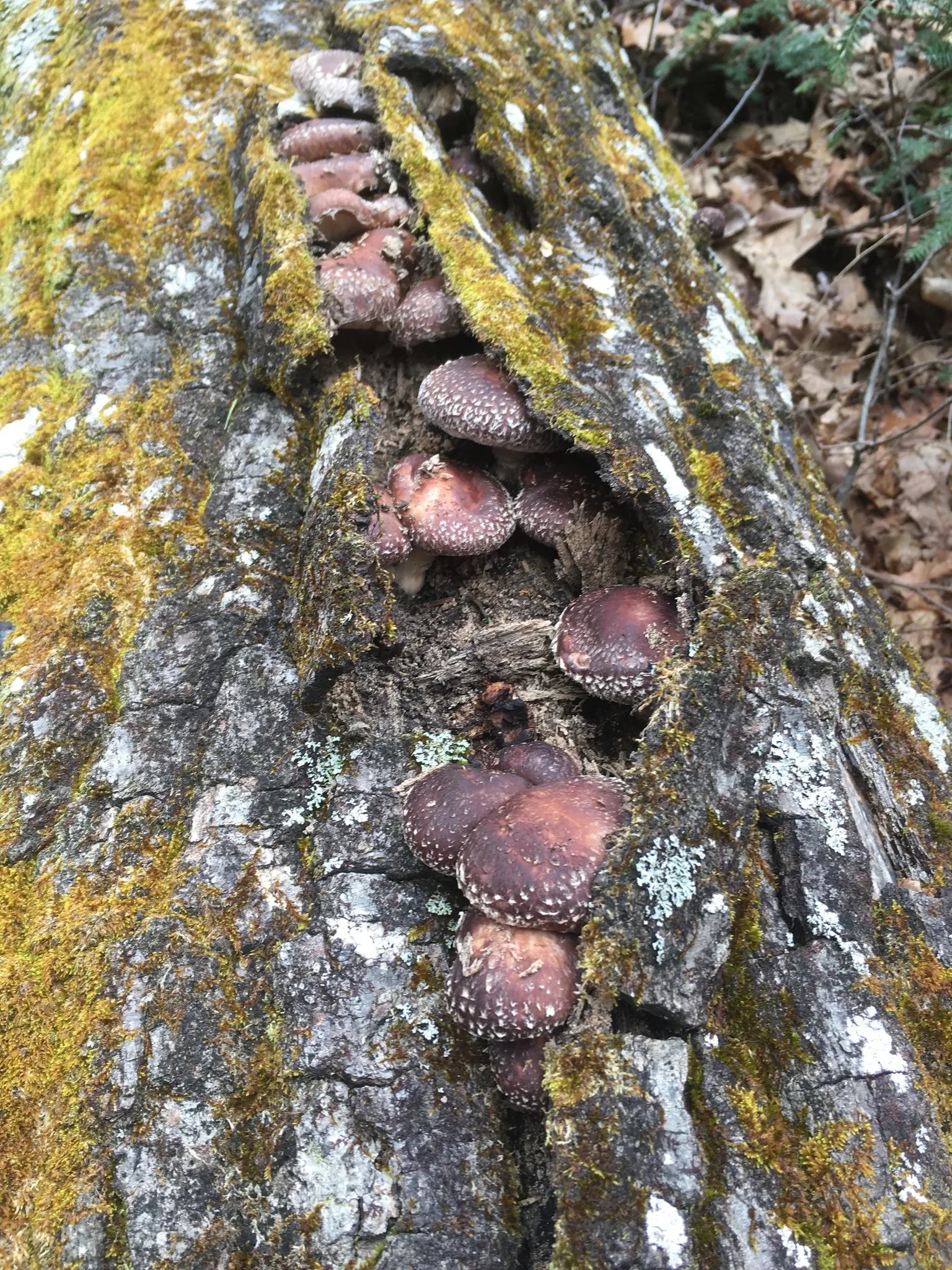
The Naturalis Biodiversity Center’s field guide describes a cap that is convex to expanded, 8–20 cm across, felted-fibrous and grey-brown to red-brown, with an incurved margin that carries whitish scales of veil3.
Under the cap are gills, whitish or cream to greyish flesh-brown, that stain rusty brown and have a serrated edge3. Their attachment is free1.
The stem is 3–5 cm long and 10–13 mm thick, brown, with large fibrous-woolly scales and a fibrous ring zone, and it has a tapering base3.
Cut it and the flesh is corky and white. The same guide gives the smell as aromatic and the taste as spicy3. The spore print is white to buff1.
Is shiitake edible or poisonous?
Shiitake is edible: the Naturalis guide lists it as edible3, and a 2016 genome study calls it one of the most popular edible mushroom species2.
The rash rarely occurs, but it may follow eating raw or half-cooked shiitake; a 2014 German case report describes it as rare, presumably toxic skin damage. Typically 24–48 hours after the meal, severely itching papules appear in parallel, whiplash-like red stripes, arranged like scratches, which gives rise to the name flagellate dermatitis. It turns up mostly on the trunk, the extremities and the nape, less often the face or scalp. As of that 2014 report, no life-threatening systemic reactions had been documented, and the rash usually clears on its own within a few days to several weeks4.
The report says the heat-sensitive polysaccharide lentinan is held responsible, though the precise cause is not yet completely understood. Cooking is no guarantee: it cites reports that nearly half of the patients developed the rash after eating thoroughly cooked shiitake, and notes that eating shiitake again can bring it back4. In a US case report, a 30-year-old man developed the rash 48 to 72 hours after eating several shiitake dishes at a restaurant serving Chinese cuisine; it resolved in approximately 10 days from the start of treatment5.
Among the lookalikes, tsukiyotake (Omphalotus japonicus) is mistaken for shiitake, but is poisonous and caused 31.6% of mushroom poisoning cases in Japan between 1996 and 20056; Japan’s health ministry warns that it can be mistaken for shiitake or oyster mushrooms7. The lookalikes section below shows how to tell it apart. Never eat a wild mushroom on the strength of a web page or an app: have it identified in person by an expert.
Where and when does shiitake grow?
In the wild, shiitake grow in groups on the decaying wood of deciduous trees, including shii and other chinquapins, chestnut, oak and maple. Its natural distribution includes warm and moist climates in Southeast Asia1. It grows on that wood by degrading cellulose, hemicellulose and lignin2.
Naturalis records it cultivated indoors and in the open, also in gardens, on dead trunks of deciduous trees such as oak, and says that in the Netherlands it has been encountered growing in the wild a number of times3.
The 2016 genome study describes it as widely cultivated in Asia, especially in China, Japan and Korea, and its cultivation as growing in Australia, America, Europe and the Latin American countries. Growers typically use artificial substrate or hardwood logs, such as oak1. In shiitake cultivation, sawdust normally accounts for 80% of the cultivation media; the classic Chinese formula is 78% hardwood shavings, 20% wheat bran, 1% gypsum and 1% sugar2. On logs, the grower Mushroom Mountain says it typically fruits in spring and fall once colonization is complete8.
Shiitake lookalikes
- Tsukiyotake (Omphalotus japonicus): this poisonous East Asian mushroom is mistaken for oyster mushroom, shiitake and mukitake, and it caused 31.6% of mushroom poisoning cases in Japan between 1996 and 2005. Japan’s health ministry, reported by Stars and Stripes in October 2026, warns that it can be mistaken for shiitake or oyster mushrooms and that eating it may cause vomiting and diarrhoea within 30 minutes to an hour7. Check the stem and gills: tsukiyotake’s off-centre stem makes the cap kidney- or half-moon-shaped, and its thick white gills run down the stem and glow with a whitish light6, while shiitake’s gills are free1.
- Jack-o’-lantern (Omphalotus olearius): Mushroom Mountain notes it is often mistaken for shiitake because it grows on wood, and that it glows faintly in the dark and causes severe gastrointestinal distress8. First Nature describes a brilliant orange mushroom that usually grows in dense tufts, far from shiitake’s grey-brown to red-brown cap3, and calls the genus seriously poisonous9.
- Deadly galerina (Galerina marginata): Mushroom Mountain lists it as a highly toxic mushroom that can grow on decaying wood8. A spore print tells them apart: rusty brown10 for galerina, white to buff1 for shiitake. It contains deadly poisonous amatoxins11, the same deadly amatoxins found in12 the death cap.
- Train wrecker (Neolentinus lepideus): it has a scaly cap similar to shiitake but a more fibrous texture, and it grows on conifers rather than hardwoods8.
- Tiger sawgill (Lentinus tigrinus): also a scaly cap like shiitake, but a more prominent central stem; it is typically found on hardwoods in wet environments8.
Shiitake in history, food and medicine
The earliest written record of shiitake cultivation is in the Records of Longquan County, compiled by He Zhan in 1209 during the Song dynasty in China. That account was later adapted in a 1796 book by the Japanese horticulturist Satō Chūryō, the first book on shiitake cultivation in Japan. Japanese growers cut shii trees with axes and placed the logs by trees already growing shiitake. A 1982 report on the Japanese variety revealed opportunities for commercial cultivation in the United States1.
The name shiitake joins shii, for Castanopsis cuspidata, the tree whose dead logs it is typically cultivated on, and take, mushroom. Miles Joseph Berkeley first described it as Agaricus edodes in 18771, and Species Fungorum dates the current name, Lentinula edodes, to Pegler in 1976. It has also been called Lentinus edodes13, the name the case reports above use.
In Chinese cooking, fresh and dried shiitake go into soups, braises and stir-fried vegetable dishes such as Buddha’s delight; in Japan they are served in miso soup and used for a vegetarian dashi. The most highly prized form is huāgū, “flower mushroom”, named for the flower-like pattern of cracks in the cap. Raw shiitake are 90% water and give 34 calories per 100 grams, and like all mushrooms they produce vitamin D2 when exposed to ultraviolet B light1.
Lentinan, the polysaccharide linked to the rash, has according to the 2014 case report been given in Japan since 2000 as an adjuvant cancer therapy4. The 2016 genome study found 101 gene models potentially involved in lignocellulose decomposition2, the breakdown of wood.