Contents
The enoki mushroom (Flammulina filiformis), also called enokitake or golden needle mushroom, is a gilled mushroom in the family Physalacriaceae that is widely cultivated as an edible mushroom in East Asia. In the wild it grows on dead wood of broad-leaved trees in China, Korea and Japan1, and the wild strain commonly fruits from late autumn to early spring3. It is edible and popular in Japanese, Chinese and Korean cooking, but since 2020 enoki mushrooms have been linked to listeriosis, and as of 2025 CDC advises people at higher risk not to eat raw enoki2.
How to identify enoki
Cultivated enoki are not exposed to light, which results in white or pale fruit bodies, long stems and small caps. First Nature describes them as grown in dark, cold places so that they develop slowly and are very pale, often almost pure white4, and MykoWeb notes that the cultivated product bears little resemblance to wild material5. Exposed to light, the same fungus produces more normal, short-stemmed, coloured fruit bodies1.
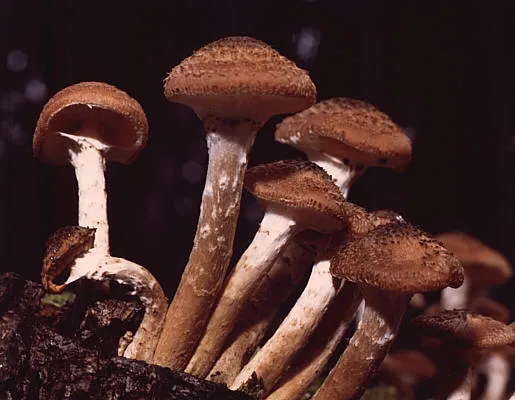
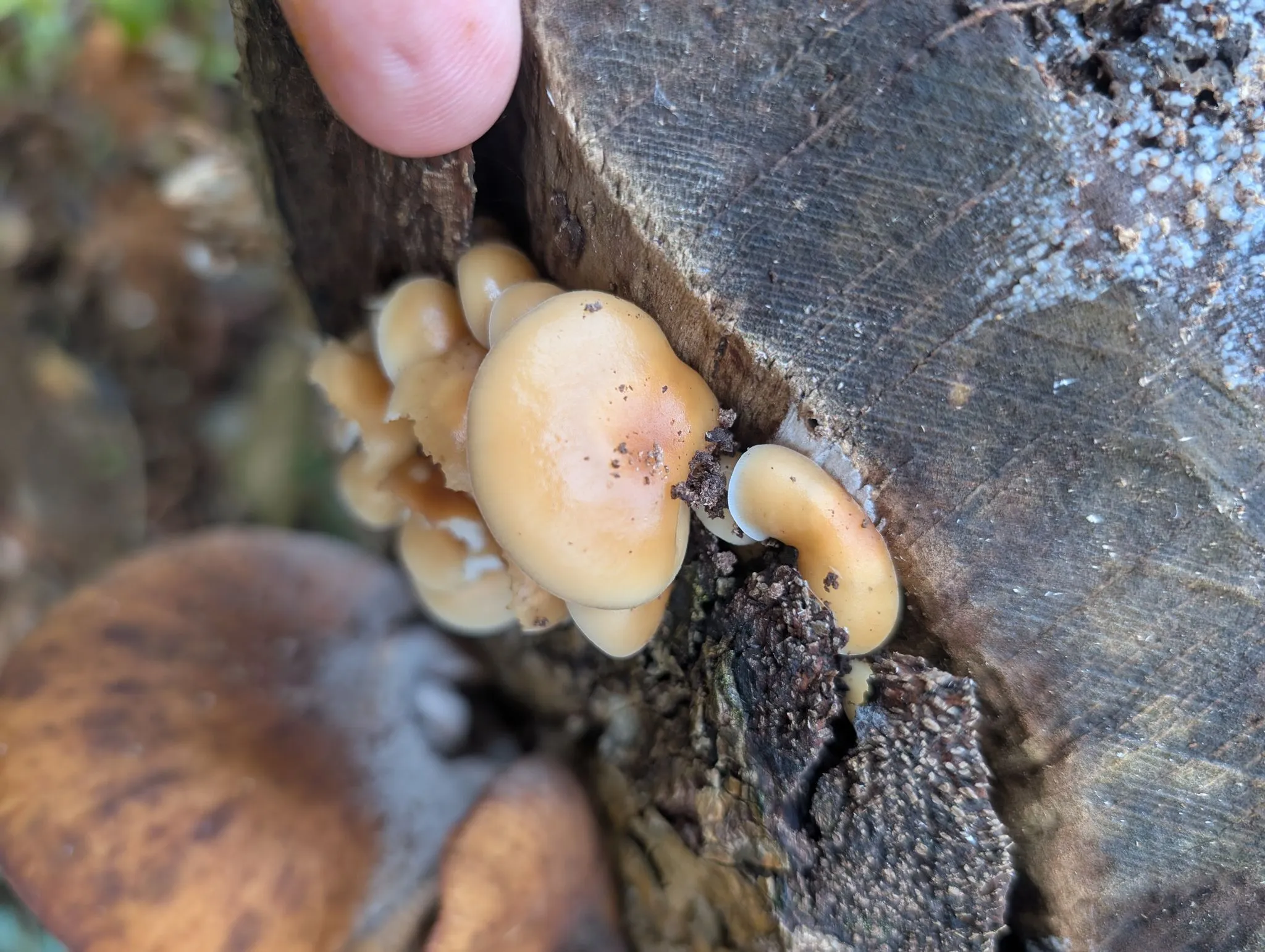
Wild enoki grow in clusters. The cap is convex at first, flattening as it expands, and measures up to 4.5 cm across, with a surface that is smooth, sticky when damp, and ochre-yellow to yellow-brown. The gills are cream to yellowish white1.
The stem is smooth and pale yellow at the top, turning yellow-brown to dark brown towards the base, and it has no ring. The spore print is white, and under a microscope the spores are smooth, ellipsoid to cylindrical and about 5 to 7 by 3 to 3.5 μm1.
Is enoki edible or poisonous?
Enoki is edible. It is widely cultivated as an edible mushroom in East Asia1, and First Nature, which treats the cultivated form under the older name F. velutipes, notes that the caps are edible and grown commercially in Japan as enoki or enokitake4. It is commonly used in soups, stir-fries, hotpots and salads2.
Cultivated enoki has instead been linked to a bacterium, Listeria monocytogenes. The first outbreak linked to enoki, in 2020, traced to mushrooms from one manufacturer in the Republic of Korea and included 48 ill people, 36 in the United States and 12 in Canada. Of the 41 with information, 37 were hospitalised and four died. The investigators wrote that their findings suggest uncooked enoki should be considered a potential vehicle6. A later outbreak was traced to enoki imported from China2.
A 2025 review by FDA scientists notes that, anecdotally, investigators in the United States found enoki are sometimes served raw, as a garnish, or lightly cooked at the end of preparation in a hotpot, while in other countries they are customarily served fully cooked. It reports that CDC, as of 2025, continues to advise people at higher risk not to eat raw enoki2. People at higher risk of invasive listeriosis include people aged 65 or older, pregnant people and their newborns, and immunocompromised people. In that outbreak, which ran from 2016 to 2020, seven illnesses were associated with pregnancy, and two of them resulted in fetal loss6.
For foragers the danger is a lookalike: Wild Food UK names the funeral bell (Galerina marginata) as similar to the wild velvet shank and deadly poisonous7. Never eat a wild mushroom on the strength of a web page or an app: have it identified in person by an expert.
Where and when does enoki grow?
Wild enoki is a wood rotter. It has been found on the dead wood of Betula platyphylla, Broussonetia papyrifera, Salix species and other broad-leaved trees. It grows naturally in China, Korea and Japan. The Japanese name means “hackberry mushroom” because it is often found growing at the base of hackberry (enoki) trees1.
It is a species with a preference for low temperatures: the wild strain commonly fruits from late autumn to early spring. One exception is a heat-resistant strain isolated in summer in subtropical Fujian province, China, that can fruit at 23 °C3.
In cultivation it grows on sawdust, wheat straw and paddy straw1, and commercial growing requires a low temperature of 15 °C or less3. Enoki sold in the United States is imported from Japan, China, Korea, Taiwan and Canada2.
Enoki lookalikes
- Velvet shank (Flammulina velutipes): the European species that until recently was thought to be the same as enoki, until DNA sequencing showed the two are distinct. Its stem tells it apart: velvet shank has a distinctively velvety stem that darkens from the base upward9, where enoki’s stem is smooth1. It grows especially on dead or dying elm, as well as ash, beech and oak8.
- Funeral bell (Galerina marginata): deadly. It contains the same deadly amatoxins as the death cap and is a known lookalike of the wild velvet shank, from which it differs by a skirt on the stem7. Check two features: the funeral bell has a fragile pale ring, which sometimes disappears with age, and a snuff-brown spore print10; enoki has no ring and a white spore print1.
- Common rustgill (Gymnopilus penetrans): compared with velvet shank, it has crowded, thin gills that develop rust-coloured spots, a usually dry cap, and rust-coloured spores7. A spore print helps: enoki’s is white1.
- Sulphur tuft (Hypholoma fasciculare): Wild Food UK finds it unlikely to be confused with velvet shank, as it is sulphur yellow, with dirty olive-green gills7, against enoki’s cream to yellowish-white gills1.
Enoki in history, food and medicine
Enoki has been cultivated in China since 800 AD. In 2010 China produced an estimated 1.57 million tonnes a year, with Japan adding 140,000 tonnes. In the United States, enoki were among the first species grown commercially, at a farm in Washington state, when specialty mushroom production began in the 1980s. In Mandarin it is called jīnzhēngū, “gold needle mushroom”1, and an FDA review lists it also as golden needle, futu, seafood or lily mushroom2.
The name is recent. The fungus was first described from China in 2015 as a variety of F. velutipes, and later molecular work showed that F. filiformis and F. velutipes are distinct and should be recognised as separate species1. MushroomExpert, under the older name, calls the enoki often found in grocery stores and restaurants a cultivated form of Flammulina velutipes9.
A 2020 study in PLOS ONE examined fruiting body development and the response to heat stress; its authors note that cultivation at low temperature costs large amounts of energy, especially during summer in East Asia3.