Contents
The dark honey fungus (Armillaria ostoyae) is a brown, scaly-capped mushroom that grows on the wood and roots of conifers, typically in dense clusters in summer and fall, and a ravaging parasite feared by forest managers1 across North America. First Nature says it is generally considered edible when properly cooked2, and a general reference calls it a choice edible. Most of the fungus lives out of sight: the bulk of the organism grows and spreads underground, and one individual in Oregon’s Malheur National Forest covers 3.5 square miles3.
How to identify dark honey fungus
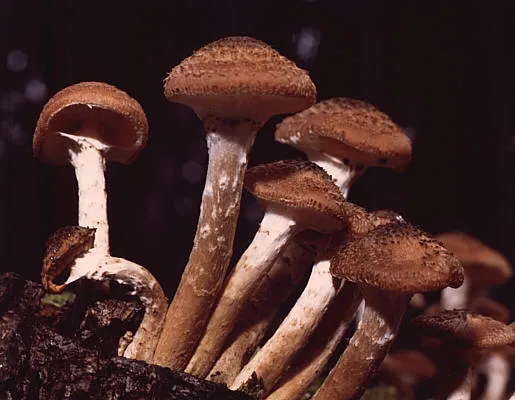
Look for brown colours, scales and a ring: in most of North America these three features, brown colours, fairly prominent cap scales and a well developed stem ring, separate it from other Armillaria species. The cap measures 3 to 10 cm according to MushroomExpert and 5 to 15 cm according to First Nature. It starts convex and becomes broadly convex or nearly flat in age, dark brown to pinkish brown, cinnamon brown or yellow-brown under small tan to blackish scales1. First Nature notes that the cap, typically red-brown, is hygrophanous and dries out much paler, and that the scales are less evident at maturity, when the margin becomes virtually scaleless and striate2.
The gills are weakly decurrent, crowded and white, gradually becoming cream or pinkish buff; MushroomExpert adds that they can develop pinkish hues or reddish brown spots. The stem is 5 to 10 cm long and 0.5 to 2 cm thick according to MushroomExpert, or 6 to 15 cm tall and 5 to 15 mm across, white above the ring and coloured like the cap below it. The ring helps separate it from honey fungus: First Nature describes a whitish double ring with dark brown or black scales on its underside2 that persists to maturity, and MushroomExpert a well-developed whitish ring that may have a yellowish or brownish underside or edge. At the base, the stem is attached to long black rhizomorphs that run through the wood1.
The flesh is whitish, often yellow in the stem base, and unchanging when sliced. The sources differ on smell and taste: MushroomExpert finds the odour not distinctive and the taste mild to slightly bitter, while First Nature reports a faint acidic odour and a strongly acidic taste. The spore print is white. Under a microscope the spores are ellipsoid and smooth, 7 to 10.5 by 4 to 6.5 µm according to MushroomExpert1 and 8 to 11 by 5 to 7 µm according to First Nature2. Like several other Armillaria, its mycelium can display bioluminescence, resulting in foxfire3.
Is dark honey fungus edible or poisonous?
First Nature says that dark honey fungus, which occurs on conifers and particularly often on spruces, is generally considered edible when properly cooked, and a general reference calls it a choice edible. First Nature says it is considered edible if well cooked, like the general reference that rates it a choice edible3, but notes that some people find this mushroom indigestible and that the stems are tough and best discarded2.
Across the honey fungus group, all Armillaria species were for many years generally considered edible when thoroughly cooked, but the species that grow on hardwoods are considered by some to be suspect, as cases of poisoning have been linked to eating them; First Nature puts this most probably down to a small but significant proportion of people being adversely affected2. Wild Food UK says honey fungus must be cooked before consumption but can still cause slight gastric upsets4 in a small number of people.
The funeral bell (Galerina marginata) also grows on wood, often in clusters, with a thin ring or ring zone, and it contains deadly poisonous amatoxins, the same deadly amatoxins found in the death cap (Amanita phalloides). Those toxins cause sickness and vomiting followed eventually by liver damage and, if not treated promptly, death6; a second source likewise describes severe liver damage with vomiting and eventual death if not treated rapidly7. The spore print separates them: Armillaria has a white spore print, Galerina marginata a rusty brown one5. Never eat a wild mushroom on the strength of a web page or an app: have it identified in person by an expert.
Where and when does dark honey fungus grow?
Dark honey fungus is parasitic and saprobic on the wood and roots of conifers, including spruces, pines and hemlocks, and less often on hardwoods, especially aspens and birches within conifer forests; it causes a root rot1. It is highly pathogenic to a number of commercial softwoods, notably Douglas-fir, true firs, pines and western hemlock, and by the time the fruit bodies appear, the tree is usually doomed2. Signs of infection include a white mycelial fan under the bark, black rhizomorphs on the roots and honey-coloured mushrooms near the tree’s base in fall3.
It is mostly common in the cooler regions of the northern hemisphere, on conifers in the forests of British Columbia and the Pacific Northwest and in parts of Asia3. In North America, a 2007 study by Hanna and collaborators found three groups: circumboreal, Rocky Mountain and Pacific Northwest1. First Nature calls it very common in most areas, particularly where the soil is acidic, and finds it throughout Britain and Ireland as well as mainland Europe2.
It typically fruits in summer and fall1; in Britain and Ireland the season runs from July to November2.
Dark honey fungus lookalikes
- Honey fungus (Armillaria mellea): First Nature tells it apart by a yellowish stem ring without dark scales on its underside2, unlike the dark-scaled ring of dark honey fungus. MushroomExpert describes it usually on the wood of hardwoods, with a fairly bald cap and a sturdy yellow-edged ring8.
- Armillaria gallica: it has a bulbous stem and a fleeting cobweb-like ring that becomes merely a yellowish ring zone2, and MushroomExpert finds it more apt to grow alone or in loose groups, typically near the bases of hardwoods9.
- Ringless honey fungus (Armillaria tabescens), as it is sometimes called: it has no stem ring and its gills turn pinkish-brown at maturity2.
- Armillaria gemina and Armillaria altimontana: in the north-eastern United States, the hardwood-loving A. gemina is morphologically inseparable, and in the western United States A. altimontana is another virtually inseparable species; mating or DNA testing may be required1 to tell them apart.
- Shaggy scalycap (Pholiota squarrosa): it is often confused with honey fungus, but Armillaria species produce white spore prints while all Pholiota have brown spores10. It also keeps an in-rolled margin, its gills turn uniformly rusty-brown and it has a radish-like smell and taste2.
- Pholiota limonella: dark honey fungus may be confused with it, but only if mycelial fans are not present3.
- Funeral bell (Galerina marginata): told apart by its rusty brown spore print and relatively small caps5.
Dark honey fungus in history, food and medicine
In 2000 a so-called humongous fungus was found in Malheur National Forest, in eastern Oregon, and DNA analysis showed that its fruitbodies came from a single organism. The figures differ by source. First Nature gives some 2,200 acres (800 hectares), a depth of three metres and an age estimated to be about 2,400 years; a general reference gives 3.5 square miles (2,200 acres), an estimated age of some 8,000 years and a weight of as much as 35,000 tons. That reference, as edited in 2026, counts it among the largest organisms on Earth by mass, area and volume3. An earlier record came from Washington state, where in 1992 a fairy ring of Armillaria ostoyae covering some 1,500 acres was declared at the time the world’s largest known living organism2.
French mycologist Henri Romagnesi described the species in 1970 as Armillariella ostoyae, and Czech mycologist Josef Herink moved it to Armillaria in 1973. The epithet honours the French journalist Paul Ostoya (1904–1969)2, General Secretary of the Société Mycologique de France. In 2008 Burdsall and Volk concluded that Charles Peck’s Armillaria solidipes of 1900 was the same species, and argued that the older name took precedence. A proposal to conserve Armillaria ostoyae was published in 2011 and approved by the Nomenclature Committee for Fungi3. MushroomExpert’s 2023 page uses A. solidipes and notes that more recent research, Klopfenstein et al. 2017 and Sahu et al. 2023, supports the two as distinct species separated by the Atlantic Ocean1.