Contents
Caterpillar fungus (Ophiocordyceps sinensis), called yartsa gunbu in Tibet, is an ascomycete fungus that is endemic to the Tibetan Plateau. It parasitizes larvae of moths1, especially Hepialus and Thitarodes, and its fruiting body grows out of the dead caterpillar. It has been used for centuries in Asia as a tonic, but wild fruiting bodies can be toxic: they have been shown to contain relatively high levels of lead, arsenic, and copper2, leading to cases of heavy metal poisoning, and are potentially toxic3 because they often carry arsenic and other heavy metals.
How to identify caterpillar fungus
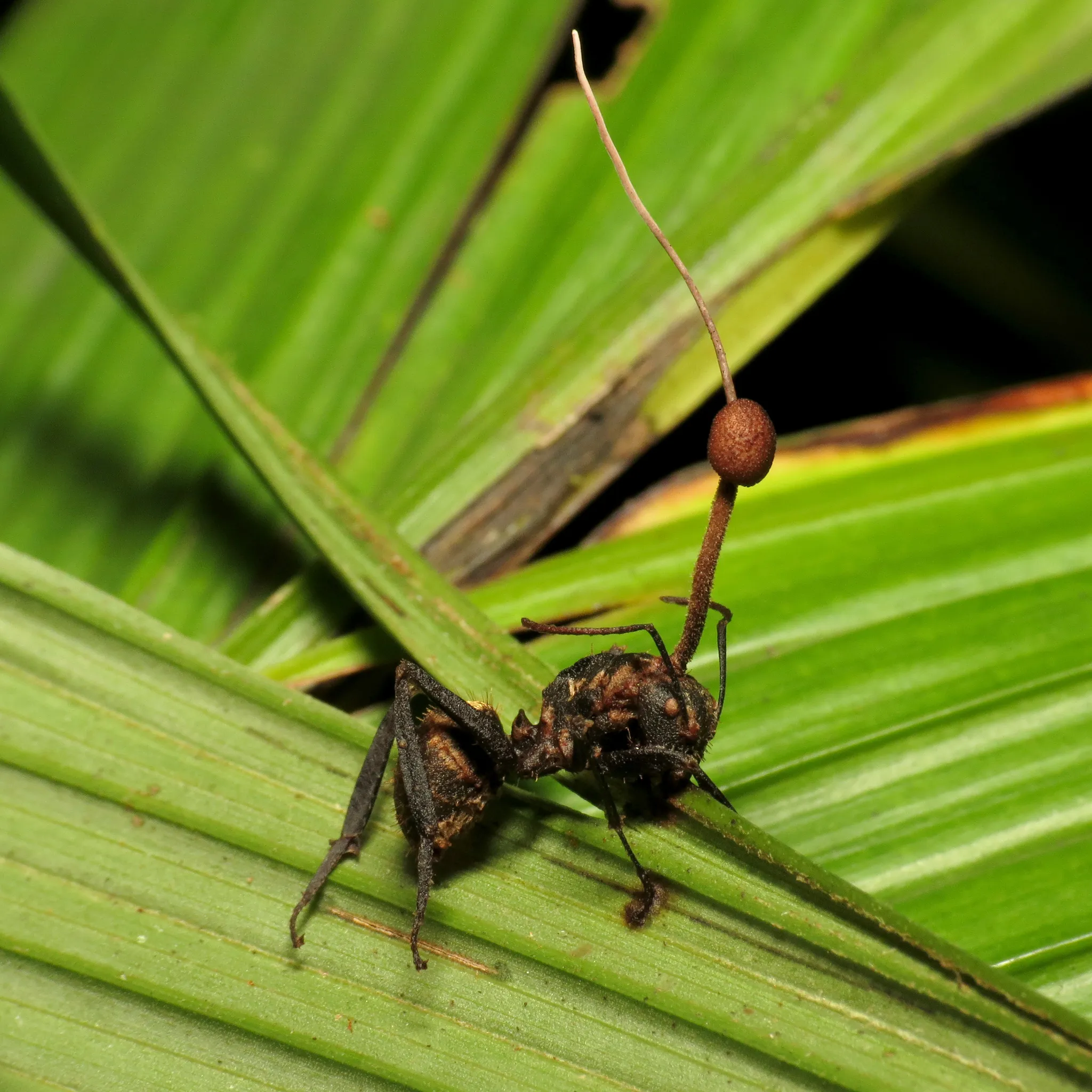
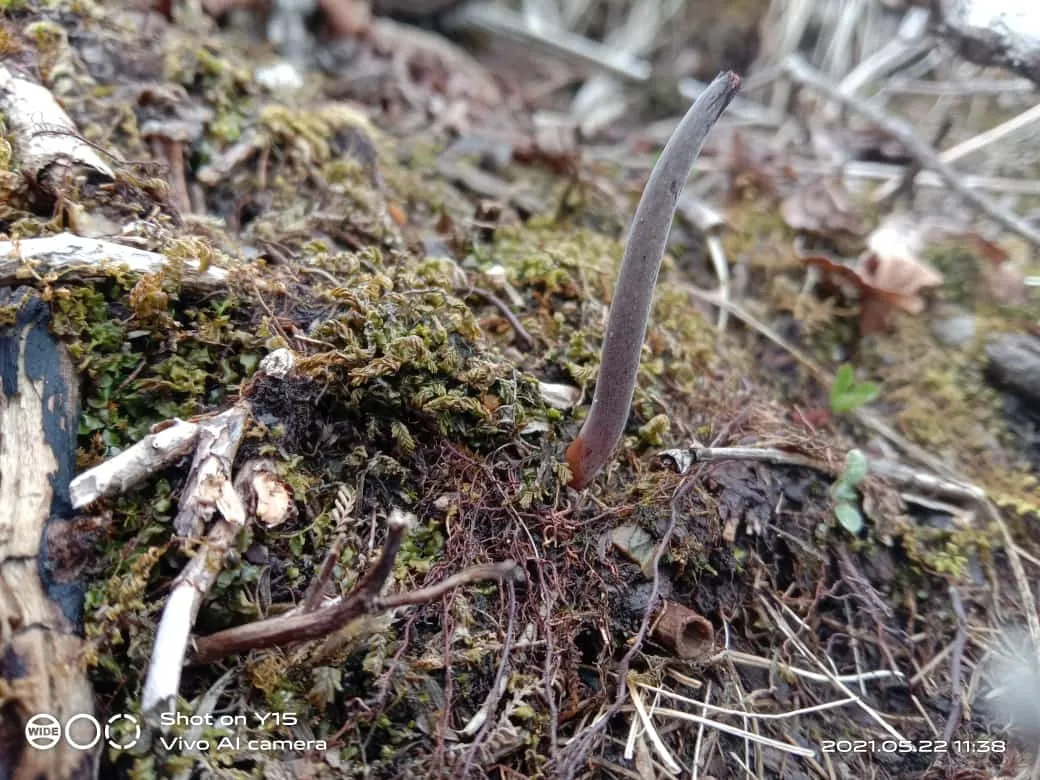
Look for a dark, upright stalk coming out of the ground, with the mummified caterpillar it grew from underneath. The fungus has two parts: a fungal endosclerotium inside the caterpillar, and a stroma. The stroma is dark brown to black, can be yellow when fresh, and is longer than the caterpillar itself, usually 4–10 cm3. It grows singly from the larval head and is club-shaped, spear-shaped or spindle-shaped, on a slender, smooth stipe that is furrowed or ridged lengthwise. A 2011 review in ZooKeys describes a clavate stroma1 growing from the sclerotium, the converted larva.
The fertile part is the head, which looks granular because of the openings of the embedded perithecia, which are ovoid. Its ascospores are clear, thread-like and divided by many cross-walls, 5–12 μm long3. The perithecia, asci and ascospores are the key identification characteristics of the species.
The dark colour fits its family: most species of the Ophiocordycipitaceae produce darkly pigmented stromata that are pliant to wiry, or fibrous to tough, according to the 2007 study4 that proposed the family. Cordyceps species, by contrast, generally have brightly coloured, fleshy stromata3. Wild “cordyceps” is not always true O. sinensis, even when the place and the host insect match.
Is caterpillar fungus edible or poisonous?
Caterpillar fungus has emerged as a major health supplement and tonic. It is marketed for various health benefits but lacks sufficient scientific evidence for its effectiveness, and quality can vary with inconsistent processing and labelling. Wild fruiting bodies often contain high amounts of arsenic and other heavy metals, which makes them potentially toxic; China’s State Administration for Market Regulation has strictly regulated their sale since 20163. A 2017 study in PLOS ONE notes that heavy metals, which wild fruiting bodies often contain, have led to cases of heavy metal poisoning, and that some sold on the market are adulterated with metal to increase product weight2. Never eat a wild mushroom on the strength of a web page or an app: have it identified in person by an expert.
Where and when does caterpillar fungus grow?
In China it is found in five provinces: Gansu, Qinghai, Sichuan, Tibet and Yunnan, in alpine meadow and shrub habitat from 3000 m up to the snow-line. It is also reported from the northern range of Nepal, Bhutan and the northern states of India. The host caterpillars generally live 15 cm underground, at 3,000 to 5,000 m3 on the Tibetan Plateau and in the Himalayas; the 2017 PLOS ONE study gives 3,500–5,000 m2 for the fungus. Its hosts belong to the family Hepialidae, the ghost moths, and the ZooKeys review lists fifty-seven species1 that are considered recognizable potential hosts.
The life cycle runs over a year. In late autumn, spores infect larvae of ghost moths in the soil, and the mycelium gradually consumes the insect’s internal organs. The infected larva is converted into a sclerotium, covered by the intact exoskeleton of the insect, to withstand the winter. The sources differ on when the stalk appears: one has it emerge from the soil by early spring, the ZooKeys review in the late spring or summer1 of the next year, and the PLOS ONE study in summer. The fruiting body disperses spores during late summer. The fungus grows at low temperature: below 21 °C3 by one account, ~16°C2 in the PLOS ONE study.
Caterpillar fungus lookalikes
Other insect-killing club fungi also grow from buried caterpillars or pupae. Colour, size, host and range tell them apart from the dark, Himalayan caterpillar fungus.
- Cordyceps militaris (scarlet caterpillarclub): its fertile head is bright orange or scarlet-orange, not dark brown, and the whole fruitbody is only 0.5 to 4 cm long. It grows on underground pupae of moths in grassland and on woodland edges, in summer and autumn. Its spores break into ellipsoidal part-spore segments5, while Ophiocordyceps species produce whole ascospores3.
- Ophiocordyceps robertsii (vegetable caterpillar, āwheto): a relative from New Zealand that invades the caterpillars of leaf-litter dwelling moths and sends up small brown stems through the forest floor6, from forest leaf litter rather than an alpine meadow.
Caterpillar fungus in history, food and medicine
The species was first described by Miles Berkeley in 1843 as Sphaeria sinensis and later moved to Cordyceps by Saccardo. Sung and colleagues transferred it to Ophiocordyceps in the 2007 study4, with Hirsutella sinensis as its anamorph. The Chinese name dōng chóng xià cǎo means “winter worm, summer grass”1: the larva that survives the winter is the “winter worm” and the stroma that comes up the next year the “summer grass”. “Vegetable caterpillar” is a misnomer3, as no plant is involved.
The oldest known text on its use was written in the late 15th century by the Tibetan doctor Zurkhar Nyamnyi Dorje, who describes it as an aphrodisiac. Its first mention in traditional Chinese medicine was in Wang Ang’s compendium of materia medica of 1694. In traditional Chinese medicine the fungus is believed to nourish the lungs and kidneys1, and it is a popular folk remedy in Asia for ailments including cancer, fatigue, impotence, liver disease and type 2 diabetes. The authors of the 2017 PLOS ONE study, who declare commercial interests, report that studies on cells and laboratory animals show a wide range of biological effects. The same paper cites an estimate that more than three quarter of studies2 on the fungus used unreliable, uncertain or unspecified material, and a 2017 study3 found that O. sinensis does not produce cordycepin, a compound earlier reported from store-bought material.
The harvest is valuable. In 2008, one kilogram traded for US$3,000 to over US$18,000 depending on quality, and top-grade fruiting bodies sold at $60,000/kg in 2007. Annual production on the Tibetan Plateau was estimated in 2009 at 80–175 tons. Overharvesting led to its listing as an endangered species in China2, under the second class of state protection1, and the IUCN Red List assessed it as Vulnerable in 2020. Collecting grounds have been fought over: in Nepal, seven farmers were killed in Manang in June 2009, and 19 villagers were convicted in November 20113. In India, fuelwood cutting by collectors near the treeline is reported to be depleting Himalayan birch.