Contents
The zombie-ant fungus (Ophiocordyceps unilateralis) is an insect-pathogenic fungus specific to ants of the tribe Camponotini, which include the carpenter ants (Camponotus). It grows mainly in tropical forests, with some reports from warm-temperate ones. The fungus alters the behaviour of the ant host2, causing it to die in an exposed position, clamped to a leaf vein, before fruiting bodies grow from its head1. Species Fungorum places it in the family Ophiocordycipitaceae, order Hypocreales, phylum Ascomycota3.
How to identify zombie-ant fungus
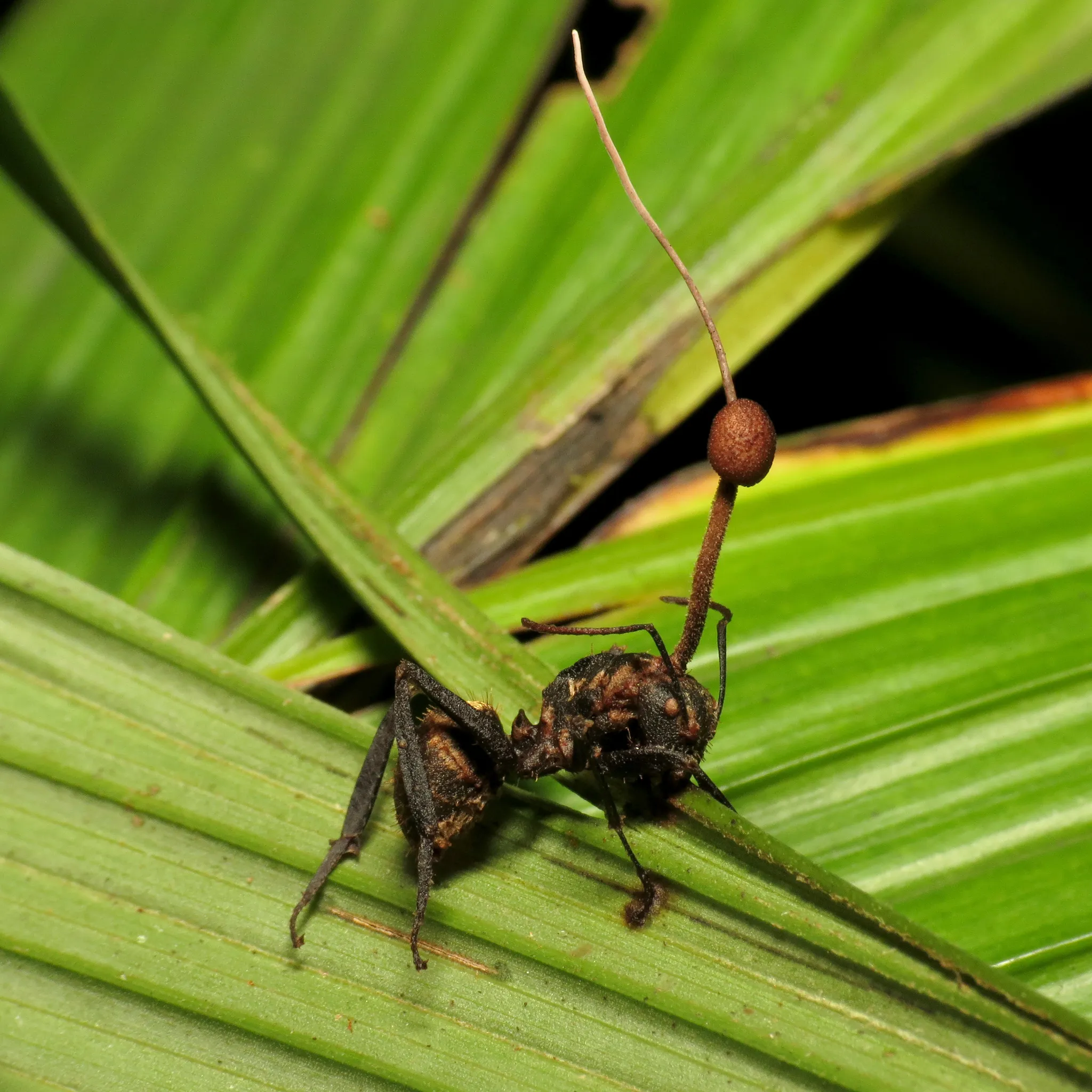
Look for the ant before the fungus. The fungus is easily identifiable on its dead host, usually a carpenter ant, which remains fixed in place, hanging upside-down on the leaf. The bite leaves dumbbell-shaped marks on the leaf vein, and in temperate forests the ants attach to the lower side of twigs instead1.
The fruiting body is typically a single, wiry, darkly pigmented stroma from the ant’s dorsal pronotum; a 2011 study in PLOS ONE describes it as a single stalk arising from the dorsal neck region of the ant. On that stalk the asexual stage occupies the tip and the sexual stage forms lateral cushions or plates2. The spore-bearing perithecia can be seen on the stalk, just below its tip, and more fungal threads sprout from the ant, securely anchoring it to the plant1.
The spores are aerially projected, thin-walled and hyaline (clear), and so susceptible to desiccation and UV damage. The process leading up to the ant’s death takes 4–10 days1, but the fruiting body has a latent period of at least two weeks before it first releases mature spores. The fungus secures the ant cadaver so efficiently4 that it can go on reproducing in successive bouts without the body decaying.
Is zombie-ant fungus edible or poisonous?
The zombie-ant fungus is a parasite of ants: after more than 150 years of collecting, it has only ever been recorded on ant hosts of the tribe Camponotini2. Even among ants, its effect depends on the host: ant species that are not typically infected are killed, but their behaviour is not altered. In fiction it goes further: in the video game series The Last of Us, the fungus has evolved to infect humans1. Never eat a wild mushroom on the strength of a web page or an app: have it identified in person by an expert.
Where and when does zombie-ant fungus grow?
Its main host is principally Camponotus leonardi, an ant that in tropical forests lives in the high canopy and has an extensive network of aerial trails. Where canopy gaps are too hard to cross, the trails sometimes descend to the forest floor, where the spores attach to the ants and break through the exoskeleton using mechanical pressure and enzymes. An infected ant has full-body convulsions that dislodge it from its canopy nest, then climbs a plant and generally clamps onto a leaf vein 26 cm above the forest floor, at 94–95% humidity and 20–30 °C. A study in Thailand found that this biting is synchronised at solar noon1.
The dead ants gather in graveyards 20 to 30 metres in range, with a local density possibly exceeding 25 per square metre1. A 2012 study notes that the fungus makes workers die close to their host colony in high-density graveyards that may persist on the same location for years4.
The species has a pantropical distribution. Its range includes tropical rainforests in Brazil, Australia and Thailand and temperate forests in South Carolina, Florida and Japan. In Brazil, four new species of the complex were described in 2011 from remnant Atlantic rainforest in Minas Gerais2. Dead infected ants increase in the rainy season, and large rain events at its start and end1 are thought to stimulate fungal development.
Zombie-ant fungus lookalikes
The name covers a complex of many species, sometimes written O. unilateralis sensu lato, “in the broad sense”, and 15 new species of it were described in 20181. In Brazil, each of four carpenter ant species is attacked by a distinct species of Ophiocordyceps, readily separated using traditional micromorphology and named according to their ant host. The whole complex is macroscopically characterised by a single stalk2 from the ant’s neck with side cushions.
- Ophiocordyceps camponoti-rufipedis: grows on the red-legged ant, Camponotus rufipes, with a single stalk from the dorsal pronotum, commonly 5–8 mm and up to 15 mm long, ginger to dark brown at the base, white to pinkish above, carrying 1–3 disc-shaped to hemispherical cushions. Its ascospores are worm-shaped, 80–95 by 2–3 µm, with 4–7 septa2.
- Ophiocordyceps camponoti-balzani: grows on Camponotus balzani. Its stalk is similar, but the fertile region is dark brown to black when mature, and its ascospores are cylindrical, 135–175 by 4–5 µm, with 14–22 septa2.
- The Ophiocordyceps kniphofioides subclade: here the stroma grows laterally from the thorax and produces an orange ascoma, instead of a dark stalk from the neck. These fungi do not show the death grip; their hosts are usually neotropical ants, which usually die at the base of large Amazonian trees, among moss carpets1.
Zombie-ant fungus in history, food and medicine
The fungus was discovered by Alfred Russel Wallace in 1859. It was first described as Torrubia unilateralis in 1865 by the Tulasne brothers. L. Tulasne listed the host as the leaf-cutting ant Atta cephalotes from Brazil, but the ant his brother drew strongly resembles a carpenter ant, and by 2011 the type specimen could not be located at the Paris Museum. Spegazzini moved it to Cordyceps as Cordyceps unilateralis in 1881, and Petch transferred it to Ophiocordyceps in 19313. That genus, which had around 140 species in 2011, became the type genus of the new family Ophiocordycipitaceae2. A 48-million-year-old fossil leaf stem from the Messel pit1 in Germany shows dumbbell-shaped marks characteristic of an ant in the death grip.
The fungus has its own enemies: the hyperparasites Niveomyces coronatus and Torrubiellomyces zombiae attack it as the stalk emerges, which can stop it releasing spores1. Such hyperparasites often castrate Ophiocordyceps: in five Brazilian graveyards of O. camponoti-rufipedis, a 2012 study counted 432 dead infected ants, of which 6.5% were mature and 55.4% were hyperparasitized4.
Six naphthoquinone derivatives isolated from it showed activity in in vitro antimalarial assays, and its red naphthoquinone pigments have been studied as a dye for food, cosmetics and pharmaceuticals1.
The name “zombie ants” is used in popular media and scientific articles, but has also been called “catchy, yet misleading”. In the 2014 novel The Girl with All the Gifts1, a strain of the fungus infects people through the exchange of bodily fluids.