Contents
Jianshouqing (Lanmaoa asiatica) is a red-stemmed, brown-capped1 bolete mushroom of the family Boletaceae, with a pored underside and olive-brown spores. It grows wild in Yunnan, China, where it is considered a choice edible once thoroughly cooked2, and in the Cordillera region of the northern Philippines. Eaten raw or undercooked, it reliably causes Lilliputian hallucinations3: vivid visions of tiny, fully autonomous humanoid figures in the eater’s own surroundings4.
How to identify jianshouqing
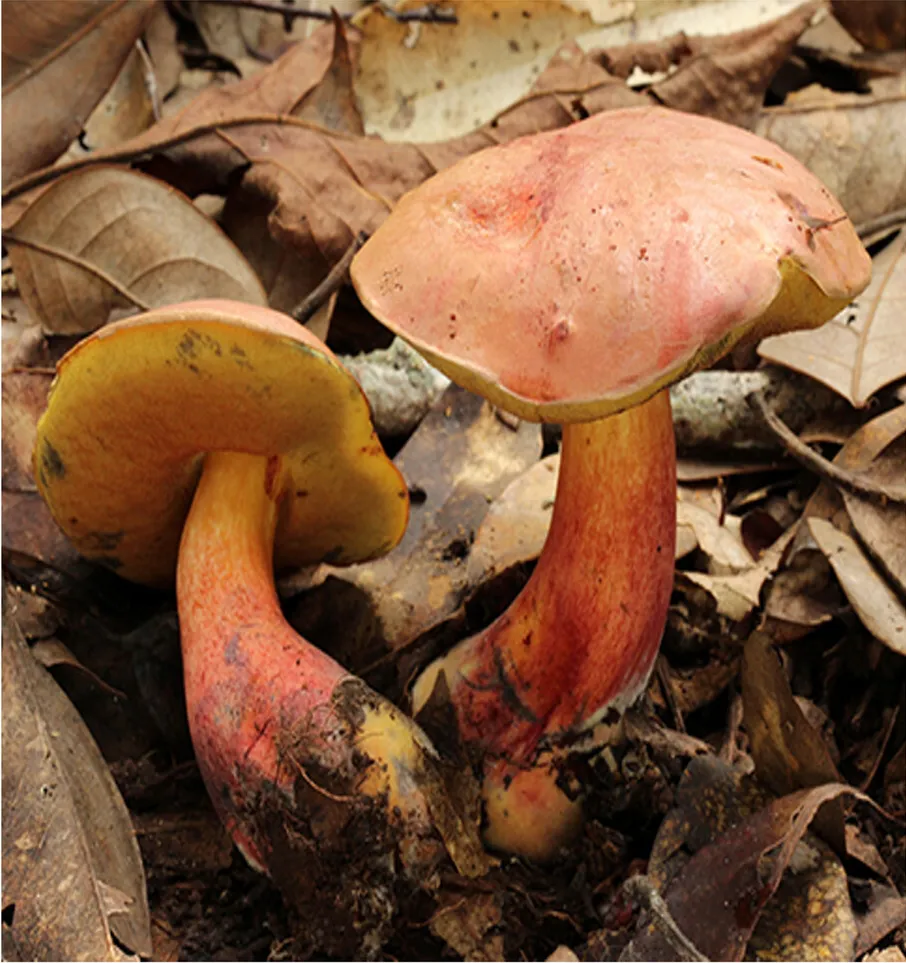
The cap is convex and brown, atop a red stem1. Underneath, the hymenium is made of pores, attached to the stem in an adnate line, and the stem itself is bare with no ring. Cut or bruise the flesh and it turns blue through a pigment that oxidises on contact with air, the reaction that gives the mushroom its Chinese market name, Jianshouqing (literally “see-hand-blue”). That blue bruising looks like the blue staining of psilocybin mushrooms, but it is chemically unrelated: psilocybin mushrooms blue through an oxidised dimer of psilocin, and jianshouqing has not been shown to produce either compound2.
Is jianshouqing edible or poisonous?
Jianshouqing is considered a choice wild edible and safe to eat when properly cooked; in Yunnan it is a prized delicacy, usually served without incident, and the visions are kept at bay unless it is undercooked. Eaten raw, it induces Lilliputian hallucinations more reliably than any disease known to cause them: Colin Domnauer, a PhD researcher who studies the species, has said it is the only known source of reliable Lilliputian hallucinations, in which the eater sees tiny humanoid figures, reported as about 2 cm tall4 in one account or 10 to 30 cm tall2 in another. The figures are stable, three-dimensional and generally obey the laws of physics — one account describes little people submerging in a soup and resurfacing. Genome sequencing found it carries neither of the gene clusters that build psilocybin and ibotenic acid, the two best-known fungal hallucinogens; Domnauer has said the active compound is very likely something new1 that the team has not yet identified, possibly an unusual, comparatively large protein3.
The hallucinations have a delayed onset of 12 to 24 hours and a duration of 1 to 7 days, sometimes weeks. Domnauer has suggested the delay may mean the body makes the active agent from the mushroom during digestion, and has wondered whether a disturbance in the gut might alter perception3 by way of the brainstem. Alongside the hallucinations, eaters can get gastrointestinal symptoms and, occasionally, delirium; people usually stay aware they are intoxicated and recover fully, with no deaths or organ damage reported. In Yunnan, one hospital alone treats hundreds of such cases every year, often visions of tiny figures going under doors, climbing furniture and scaling walls. Restaurants there guard against it with mandatory cooking timers and an alcohol ban; researchers studying the mushroom have themselves waited out a server’s 15-minute timer before eating it1. In 2023, then US Treasury Secretary Janet Yellen reportedly ate the mushroom during an official visit to China; she said it had been cooked thoroughly and that she experienced no adverse effects2. Never eat a wild mushroom on the strength of a web page or an app: have it identified in person by an expert.
Where and when does jianshouqing grow?
Jianshouqing is ectomycorrhizal with the pine Pinus yunnanensis2 and, because of that partnership, cannot be cultivated and must be gathered wild, unlike lab-grown psilocybin mushrooms. It grows in Yunnan, in southwestern China, and the northern Philippines, where researchers in 2024 confirmed the local mushroom, sedesdem, is genetically the same species as the Yunnan one. In Yunnan it is sold openly in markets and served through the summer3.
Jianshouqing lookalikes
Jianshouqing is one of several Yunnan boletes sold and eaten under the market name jianshouqing, a term that applies broadly to any bolete that blues on exposure to air2, not to this species alone; packages of dried mushroom labelled jian shou qing have been found to contain poisonous species with no trace of the hallucinogenic one4, so the market name by itself tells a buyer nothing about which species, or how dangerous, is in the bag.
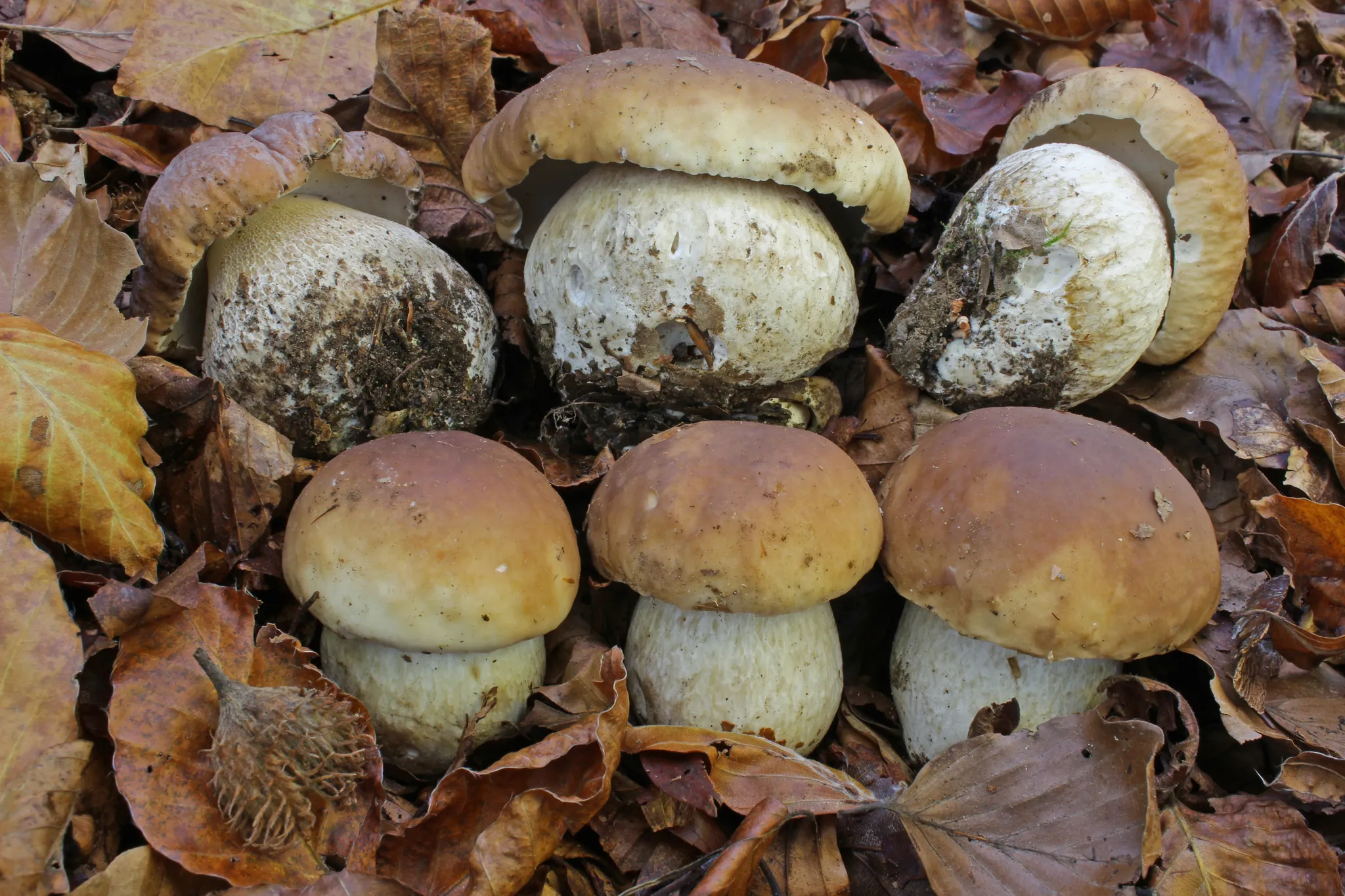
- Rubroboletus sinicus: also blues on cutting — its flesh stains blue with injury, so bruising alone cannot tell the two apart. Its cap is brown, scaly and cushion-shaped, with small red pores5.
- Butyriboletus roseoflavus, known in Yunnan as xiaomei niuganjun: shares almost the same convex cap, pored hymenium and olive-brown spore print6.
Jianshouqing in history, food and medicine
The effect may go back much further: a third-century Chinese text describes a mushroom that, eaten raw, lets one see “a little person”, and the species and its syndrome may have been described then by a Daoist in China. A similar effect from local boletes, called “mushroom madness”, was recorded separately in Papua New Guinea as early as 1934, from a mushroom called nonda; Lanmaoa species themselves do not grow in that country, and the phenomenon was brought to North American attention by David Arora and others in the 1990s. The species was formally described in 2015, by G. Wu and Zhu L. Yang. Genetically, it is a closer relative of the common porcini than of any known psychedelic3. The genus Lanmaoa itself is named after Lan Mao2.
Colin Domnauer, a PhD student at the University of Utah working under curator Bryn Dentinger, and colleagues published a phylogenomic study of the genus Lanmaoa in the journal Mycologia in June 2026, revealing cryptic diversity within the genus and suggesting a novel psychoactive lineage. Chemical and genomic analyses indicate it does not contain psilocybin or muscimol2; Domnauer has said the team has looked for every known hallucinogenic compound and found none of them, leaving an unidentified compound responsible. To narrow it down, the researchers compare the chemistry of cooked and uncooked tissue, since the active substance breaks down with heat, and have tested fungal tissue extracts in mice for behavioural changes4; progress is slow partly because the mushroom cannot be grown in the lab3 and must be gathered wild each time. Dentinger has noted that the mystery itself makes funding hard to find, since investors are unlikely to back a compound nobody can yet describe1.