Contents
Porcini (Boletus edulis), also known as cep or penny bun, is a most sought-after edible bolete, and MykoWeb rates it edible and choice2. It grows on soil beneath trees, notably beech and birch, across Britain, Ireland, mainland Europe and Asia, and in Britain and Ireland it fruits from June to October. It also occurs in the USA, where it is known as the King Bolete, though it is a matter of ongoing debate1 whether the American mushroom is the same species as the European one.
How to identify porcini
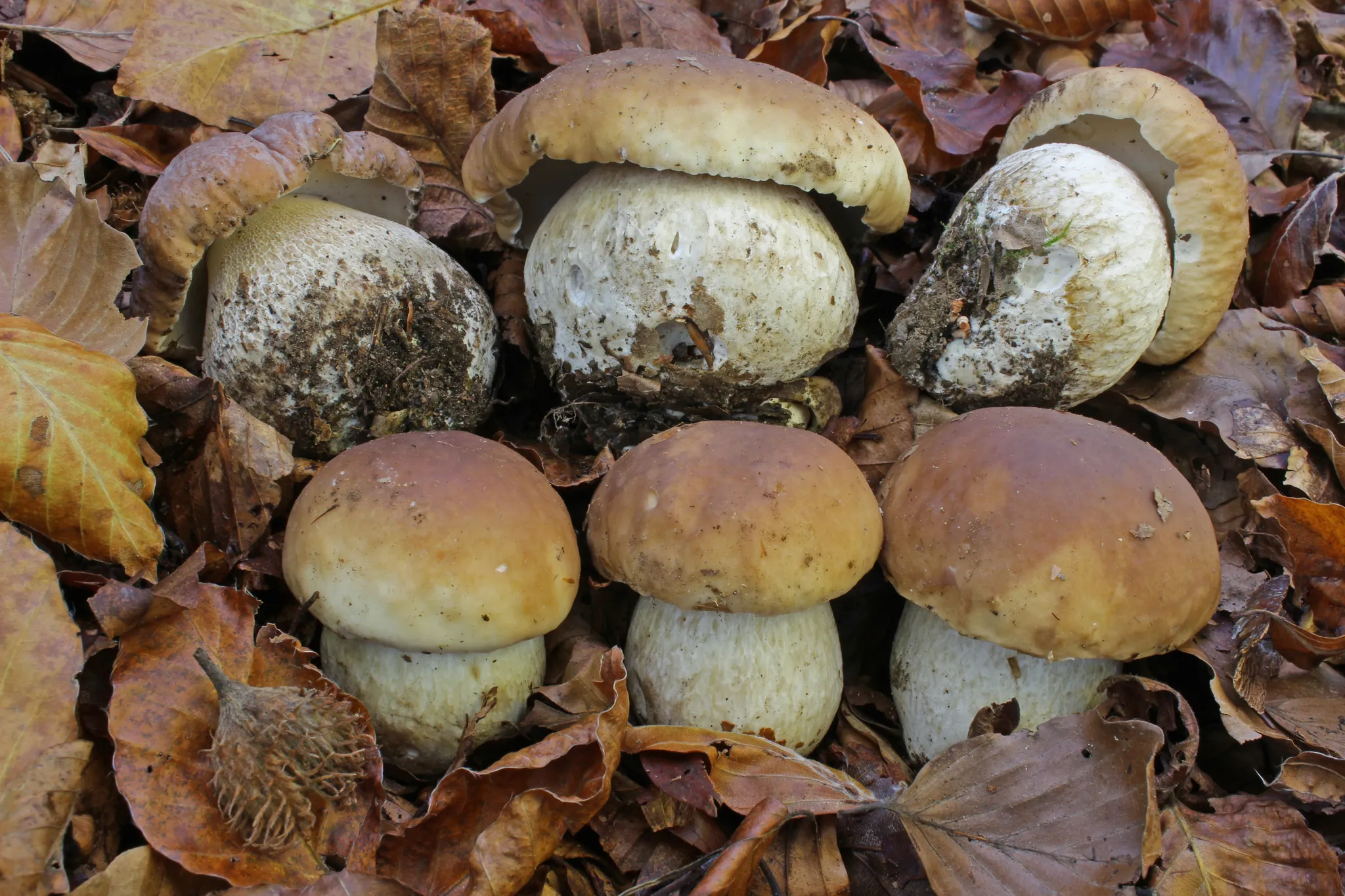
Start with the cap. It has a slightly greasy penny-bun-like surface texture, coloured yellow-brown to reddish-brown, and it measures 10 to 30 cm across at maturity according to First Nature; MykoWeb gives 7 to 25 cm2 for its California porcini. The margin is usually a lighter colour than the rest of the cap. MushroomExpert describes the cap as greasy to tacky, bald and brown3. An exceptionally large cap can weigh more than 1 kg1, and a specimen from the Isle of Skye in 1995 weighed 3.2 kg, with a cap 42 cm wide4.
Turn it over. There are no gills: like other boletes it has tubes under the cap, and its spores escape through the tube openings (pores)4. The pore surface is initially white, with “stuffed” pores, and as the mushroom ages the pore surface becomes greenish yellow3. The tubes are pale yellow or olive-brown and easily removed from the cap. When cut or bruised, the pores and tubes do not change colour1, whereas the pores of some otherwise similar species do.
Look at the stem. It is meaty and swollen, with fine reticulation3, a net pattern: First Nature describes a faint white net, generally visible on a cream background. The stem is club- or barrel-shaped, 10 to 20 cm tall and up to 10 cm in diameter1 at its widest point; MykoWeb gives 7 to 20 cm long and 3 to 8 cm thick, and notes the veil is absent2.
Cut it. The cap flesh remains white, with no hint of blueing, and the stem flesh is white and solid; MushroomExpert adds that its surfaces do not bruise on handling3. It has a faint but pleasant smell and a mild nutty taste. The spore print is olive-brown, and the spores are subfusiform and smooth, 14 to 17 by 5 to 7 µm per First Nature1, or 12 to 17 by 4 to 6 µm per MykoWeb2.
Is porcini edible or poisonous?
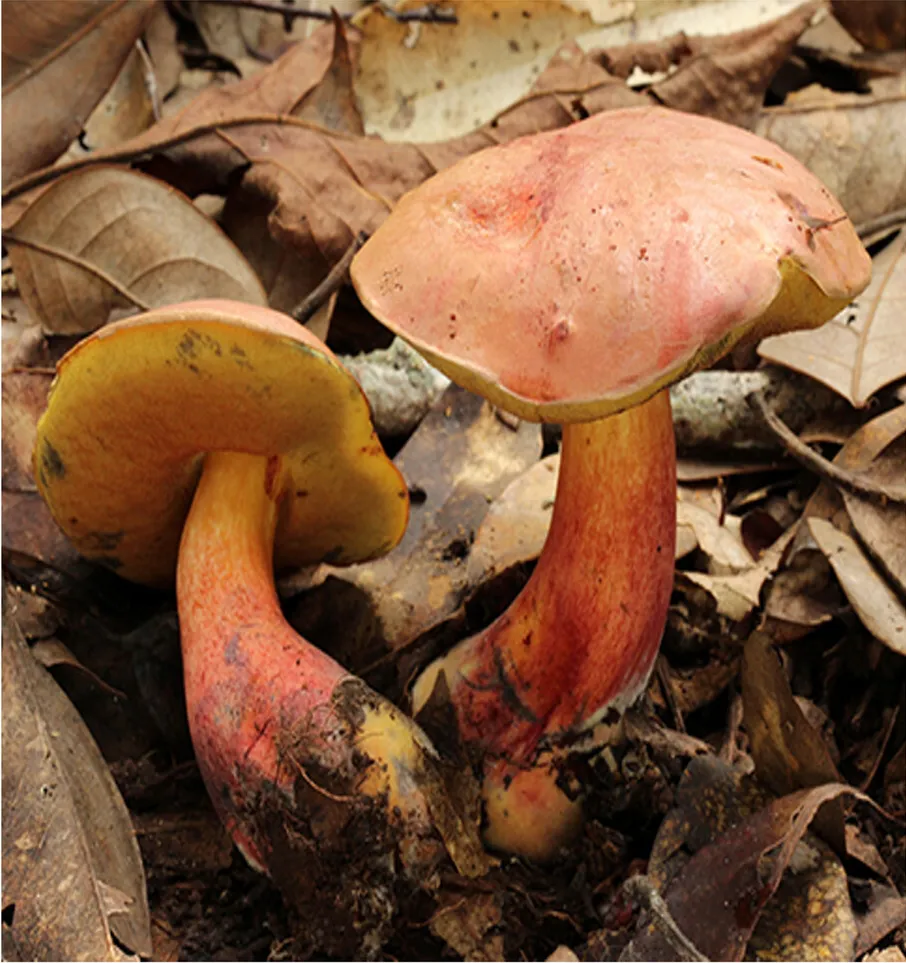
Porcini is edible: First Nature calls it one of the finest edible mushrooms, and MykoWeb lists it as edible and choice2. First Nature advises avoiding boletes with red or pink pores1. Few poisonous species closely resemble it, but the most similar poisonous one may be the devil’s bolete (Rubroboletus satanas), which has a red stem and stains blue on bruising4; First Nature calls it a poisonous mushroom, particularly if eaten raw5.
The bitter bolete (Tylopilus felleus) is a cep look-alike that First Nature calls very bitter indeed6, and a general reference very bitter and unpalatable. Porcini are often infested: MykoWeb notes that the fruit bodies are frequently colonized with fly larva2, and First Nature warns that by the greenish-yellow stage a cep is very likely indeed to be maggoty1. Some reported cases of stomach ache after eating dried porcini have been blamed on the bolete eater (Hypomyces chrysospermus), a mould that grows over the fruit bodies. Several studies have shown that porcini can bioaccumulate heavy metals such as mercury4, so caution is advised when picking near polluted or contaminated sites. Never eat a wild mushroom on the strength of a web page or an app: have it identified in person by an expert.
Where and when does porcini grow?
Like most boletes, porcini is ectomycorrhizal: it lives in partnership with tree roots, helping the tree obtain vital minerals from the soil in return for the products of photosynthesis. It grows on soil beneath trees, notably beech and birch, and less commonly oaks, pines, spruces and occasionally other conifers. In southern Europe it is found in scrubland dominated by Cistus ladanifer and other rock roses. It is frequently found at the edges of clearings in broad-leaved and coniferous forests, and because tree roots reach far, porcini could come up some tens of metres away from the trunk1 of its partner tree. MushroomExpert describes the European species as associating with spruces and, depending on how the species is defined, various hardwoods3.
It is fairly frequent throughout Britain and Ireland as well as on mainland Europe and in Asia, and has been introduced to southern Africa, Australia and New Zealand1. As of 2016, MushroomExpert called it up for debate whether the true species grows in North America: studies since 2008 had begun to sort out the edulis-like species, and its key separates 14 North American edulis-like species3. California’s porcini has been named Boletus edulis var. grandedulis by Arora and Simonini in 2008; there it grows primarily with pine, particularly Bishop pine and Monterey pine2.
In Britain and Ireland the season runs from June to October1. In California it fruits sporadically during spring and summer2, with significant fruitings after the first soaking rains of autumn.
Porcini lookalikes
- Bitter bolete (Tylopilus felleus): a brown net-like pattern on the stem sometimes leads to it being mistaken for porcini. Check the pores: in the bitter bolete they turn coral pink as the fruitbody matures, while porcini pores do not flush coral pink. The two are often confused, but the net differs: in porcini it is whitish on a brownish stalk, in the bitter bolete a dark pattern on white4. Its spore print is clay-pink, not olive-brown. Cooking only seems to enhance the bitter taste6.
- Devil’s bolete (Rubroboletus satanas): a similar shape, but a red stem, and it stains blue on bruising, while porcini flesh remains white, with no hint of blueing1. First Nature names its distinctive chalky cap and red bulbous stem as the marks that make it easy to identify. It may be the most similar poisonous mushroom4, and First Nature calls it a poisonous mushroom, particularly if eaten raw5.
- Queen bolete (Boletus regineus): a close relative in California that has a darker cap with a whitish wash when young, and grows with mixed hardwoods rather than pines2.
- Gyroporus castaneus: generally smaller, with a browner stem4.
Porcini in history, food and medicine
The species was first described in 1782 by the French botanist Bulliard, and Boletus edulis is still its formal name; it is the type species of the genus Boletus3. The epithet edulis means ‘edible’, and the species is an edible mushroom. The Italian porcino means porcine, echoing suilli, “hog mushrooms”, a term of the Ancient Romans, and the English penny bun refers to its rounded brownish shape4. In Sweden it is the Karljohan svamp, named after the king Carl XIV of Sweden and John III of Norway, who tried to cultivate it in the park grounds of the royal palace, but it seems without success; First Nature adds that ectomycorrhizal fungi such as porcini are in general much more difficult to cultivate1.
In the kitchen, First Nature finds young but fully developed fruitbodies best of all, and calls porcini one of the very finest fungi for drying or freezing1. MykoWeb notes that in California buttons are usually prepared fresh while large specimens are typically dried2. The mushroom is low in fat and digestible carbohydrates, and high in protein, vitamins, minerals and dietary fibre. Trade has its own pitfalls: in the 1990s some dried porcini exported to Italy from China contained Tylopilus species4, hard to tell from Boletus once dried.