Contents
The common inkcap (Coprinopsis atramentaria) is a mushroom with a gray to brownish gray cap whose gills turn black and eventually liquefy into an “ink”. It is poisonous when consumed in conjunction with alcohol, and Wild Food UK goes further: it has moved it to its poisonous section and does not recommend eating it. It grows in clusters from senescent root systems around stumps1 or from buried wood3, and it is frequent in Britain and Ireland and throughout Europe and North America. In Britain and Ireland it fruits from May to November2.
How to identify common inkcap
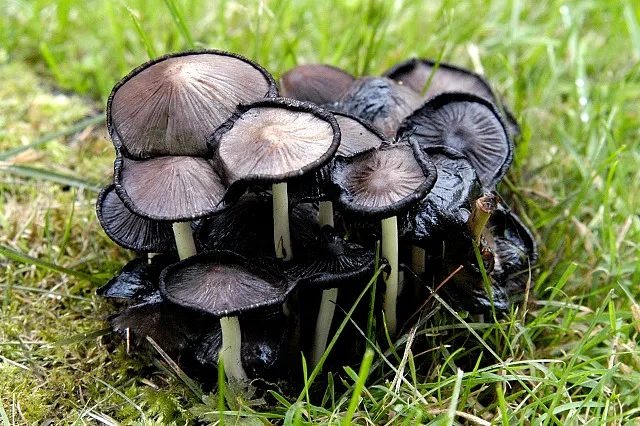
Start with the cap. When young it is 3 to 6 cm high and oval, at first egg-shaped and mostly smooth, with a small central patch of flattened scales; it then becomes bell-shaped with a slight umbo before deliquescing from the margin. Sources give different widths: 3 to 7 cm according to First Nature2, 3 to 8 cm according to MykoWeb4, 5 to 7 cm according to Wild Food UK and up to 10 cm according to MushroomExpert. The colour is lead gray, grayish, or gray-brown, and Wild Food UK notes caps that are sometimes quite pink3. The surface is faintly grooved, and a mature cap often has a curled up or tattered margin. It lacks prominent scales or the mica-like granules of Coprinellus micaceus1.
Turn it over. The gills are close or crowded, whitish, becoming black and then dissolving. First Nature describes them as white at first, turning brown and then black, while MykoWeb has them white, becoming pinkish-grey, blackening in age4. MushroomExpert finds them attached to the stem or free from it1; First Nature calls them free2.
The stem is white, fibrous and hollow, with reddish-brown fibrils towards the base according to First Nature. Its size varies by source: 8 to 15 cm by 6 to 12 mm per MushroomExpert1, 5 to 12 cm by 8 to 15 mm per First Nature2, 6 to 15 cm by 1 to 2 cm per MykoWeb, and 7 to 9 by 0.4 to 0.6 cm per Wild Food UK. The sources also disagree on a ring. Wild Food UK describes a skirt-like ring near the base of the stem3, MykoWeb a fibrous veil that forms a short-lived ring at the base4, and one general reference says the stem lacks a ring5.
Cut it. The flesh is white to pale gray, thin and soft, and the smell and taste are not distinctive. The spore print is black. Under a microscope the spores are elliptical and smooth, with a central pore, 6.5 to 10.5 by 4 to 6.5 µm per MushroomExpert1; First Nature gives 7.5 to 11 by 4.5 to 6 µm, ellipsoidal to almond-shaped2.
Is common inkcap edible or poisonous?
Treat the common inkcap as poisonous: Wild Food UK can’t recommend eating it3, and First Nature calls it poisonous when consumed in conjunction with alcohol, with effects that are sometimes severe2. Other sources are milder: one general reference says the mushrooms are considered edible when young5, and MykoWeb calls the species edible, but not recommended4 because of its reaction with alcohol.
The problem is a compound, coprine, which, when ingested with alcohol, can cause nausea, facial flushing, and an accelerated heart beat4. Its active metabolite, 1-aminocyclopropanol, blocks the enzyme acetaldehyde dehydrogenase, which breaks down acetaldehyde in the body. Coprine heightens the body’s sensitivity to alcohol in a similar manner to the drug disulfiram. Symptoms include facial reddening, nausea, vomiting, malaise, agitation, palpitations and tingling in the limbs, starting five to ten minutes after consumption of alcohol. If no more alcohol is drunk, they generally subside over two or three hours. Rarely, a cardiac arrhythmia may develop5.
Symptoms can occur if even a small amount of alcohol is consumed up to three days after eating the mushrooms, and the sources set the window differently. First Nature calls it unwise and can be dangerous to eat if alcohol has been drunk during the three days before a meal, or is likely to be drunk during the three days afterwards2. Wild Food UK gives 48 hours either side of eating the mushroom and adds that even applying alcohol based aftershave after eating it can cause a reaction. Beyond the alcohol reaction, Wild Food UK reports that recent studies suggest it contains toxins with a carcinogenic potential3, and in testing large and prolonged doses of coprine had gonadotoxic effects on rats and dogs5. Never eat a wild mushroom on the strength of a web page or an app: have it identified in person by an expert.
Where and when does common inkcap grow?
The common inkcap is saprobic, growing in clusters on decaying wood; that wood may be buried, causing the mushrooms to appear terrestrial1. In Britain it grows on or beside stumps, usually hardwood, beside woodland footpaths and at the base of trees in parks and gardens, and on tree-lined grassy roadside verges where fallen timber has become buried. It prefers disturbed habitats, which puts it at home in the urban environment: dirt parking lots, gardens, and grassy areas4. It also usually appears in clusters but occasionally as solitary specimens2.
Beyond Europe and North America, where First Nature calls it frequent2, it has also been found in South Africa as well as Australia, including the Royal Botanic Gardens in Sydney5.
The season depends on the region. First Nature gives May to November in Britain and Ireland2; Wild Food UK gives a season from April to November3. In North America it fruits in spring, summer, and fall (sometimes in winter)1, and in California from fall to spring, though in any month that moisture is available4.
Common inkcap lookalikes
Several other ink caps look superficially similar, but Wild Food UK finds the common inkcap’s shape and smooth cap quite distinctive3.
- Shaggy ink cap (Coprinus comatus): a columnar-shaped, scaly cap4, where the common inkcap’s cap is fairly smooth, but usually finely scaly1 over the centre.
- Glistening inkcap (Coprinellus micaceus): it occurs in similar habitats but is smaller and redder, with mica-like veil fragments when young2, granules the common inkcap’s cap lacks1. Its caps are typically 2 to 4 cm tall, with a cap colour of ochre-brown with a russet central eye6.
- Magpie inkcap (Coprinopsis picacea): Wild Food UK names it among the other inkcaps that look superficially similar; the common inkcap is told apart by its shape and smooth cap3.
- Coprinopsis romagnesiana: the scaly-capped form once named var. squamosa, which most authors treat as a separate species; the common inkcap’s cap has only a few tiny scales over the center1.
Common inkcap in history, food and medicine
The French mycologist Jean Baptiste François Pierre Bulliard first described it in 1786 as Agaricus atramentarius. Elias Magnus Fries moved it to Coprinus in 1838, and DNA analysis by Redhead, Vilgalys and Moncalvo in 2001 shrank that genus to very few species, and this species was moved to the new genus Coprinopsis5. The epithet comes from the Latin atramentum, a black liquid such as ink2. The black mess left after the cap dissolves was used as ink after boiling with a little water and cloves, or urine3.
The name tippler’s bane comes from its ability to create acute sensitivity to alcohol, an interaction only known since the early part of the 20th century5.
It is also a strong mushroom: it has been known to burst through asphalt and to lift the corners of paving stones, and research has shown that the strength of the vertically-aligned hyphae in the stems2 gives it that force.