Contents
The giant puffball (Calvatia gigantea) is a puffball that can grow to 80 cm across and weigh several kilograms, and First Nature calls it a very easy to recognise edible puffball as long as it is fresh and white throughout. It grows on roadside verges, field edges and woodland edges, from July to November in Britain and Ireland1 and in North America from the Great Plains eastward2. The Missouri Department of Conservation says it is considered a choice edible, with caution3.
How to identify giant puffball
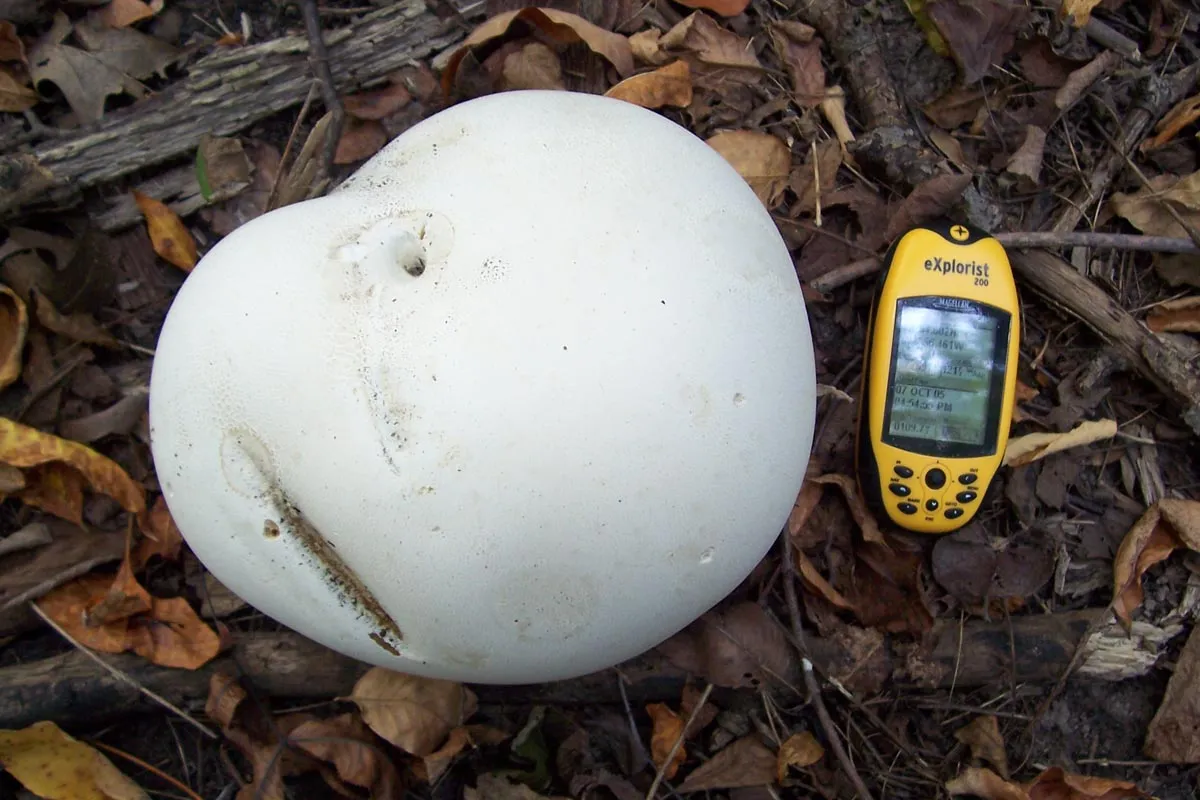
A giant puffball has no cap, gills or stem. The fruitbody is a large, slightly flattened, irregular globe, white at first, with a lumpy and leathery surface. Sizes differ between sources: MushroomExpert puts typical specimens at about the size of a soccer ball, 20 to 30 cm or more across and 14 to 25 cm or more high, while First Nature says they are typically 10 to 80 cm across, with exceptional specimens of more than a metre1 reported. MushroomExpert mentions a reported 5-foot, 50-pound specimen, and the Missouri Department of Conservation says giant puffballs can occasionally weigh 25 pounds or more3. Very large ones can be more “blob-ish” than round, but the giant puffball is never shaped like an inverted pear, since it lacks the sterile base2 found in many other puffballs.
The surface is finely velvety when young, later becoming bald or developing very inconspicuous, fine scales in places. The outer skin is less than 1 mm thick, sloughing away in very old specimens. At the base a root-like mycelial cord holds it to the ground; MushroomExpert describes this as a short but thick cord, up to 6 cm long and 2 cm wide2. Often the cord breaks, letting the puffball roll around in the wind1 and spread its spores once the skin has split.
Cut it from top to bottom. A young, fresh giant puffball is white and soft inside, like a marshmallow, with no sign of a cap or stem. Virtually the whole puffball is filled with fertile spore mass, which turns from white to yellowish olive and eventually brown as the spores mature. First Nature finds the smell very faint and pleasant; MushroomExpert calls it not distinctive. The spore print is olive-brown according to First Nature and greenish brown according to the Missouri Department of Conservation. Under the microscope the spores are more or less round: 4 to 5 µm, smooth or more often minutely warted, per First Nature, and 2.5 to 4 µm and smooth per MushroomExpert2. One large fruitbody produces spores in their trillions1; one mycologist estimated as many as seven trillion in a 15-inch puffball3.
Is giant puffball edible or poisonous?
Giant puffball is edible when young: First Nature calls it an edible puffball, and the Missouri Department of Conservation says it is considered a choice edible, with caution. The flesh has to be white. First Nature says giant puffballs become inedible once the spores start to ripen and the flesh turns greenish yellow or olive and eventually brown1, and one general reference says they can cause digestive issues if the spores have begun to form. The same reference notes that some people experience a laxative effect from eating this species4. The Missouri Department of Conservation advises peeling off the tough outer skin before cooking, since it can be hard to digest, and making sure they are cooked3.
The place it grows matters too. Giant puffballs from busy roadside verges are likely to be contaminated by toxins from vehicle exhausts1, First Nature warns, and the Missouri Department of Conservation notes that they are often found on lawns, so the area should be free of lawn-treatment chemicals3.
The serious risk is a wrong identification. Some other white mushrooms, including the deadly destroying angel (Amanita bisporigera), have stages in which they could be mistaken for a puffball, and a general reference warns that some may mistake juvenile death caps for edible puffballs5. The Missouri Department of Conservation’s check is to cut through any puffball from top to bottom and confirm it is pure white inside, with no sign of a cap or stem3; a general reference adds that a puffball whose inside looks gelatinous may be a stinkhorn and should not be consumed4. Never eat a wild mushroom on the strength of a web page or an app: have it identified in person by an expert.
Where and when does giant puffball grow?
Giant puffball is saprobic and terrestrial. First Nature says it is often found on roadside verges, at the edges of fields and among briars, nettles and other rank vegetation, and occasionally in open woodland or woodland clearings. MushroomExpert records it in woods or in grass, often at the edges of meadows, in drainage ditches, or under brush2, and in Missouri it grows in open pastures, woods, and lawns3. It usually occurs in small groups, sometimes in fairy rings, and it usually reappears in the same places for many years1.
The season runs July to November in Britain and Ireland1. In central Illinois it is a harbinger of fall, appearing as the leaves begin to turn, in late summer and early fall2; the Missouri Department of Conservation gives May to October3.
First Nature calls it a localised and infrequent find in Britain and Ireland; across mainland Europe it is common in some countries but rare in others, and it also grows in parts of North America and several countries in the southern hemisphere1. In North America MushroomExpert gives it as fairly widely distributed from the Great Plains eastward, with reports from the Southwest and West Coast perhaps erroneous; most of the records are very old2.
Giant puffball lookalikes
- Common earthball (Scleroderma citrinum): typically 4 to 10 cm across, with a tough thick skin covered by a network of coarse scales, and much less spongy than the puffballs. Sliced, it shows a white outer rind and a purple-gray to purple-black, mottled interior7, not the even white flesh of a young giant puffball. First Nature treats it as a toxic species just for looking not for cooking6, and a general reference calls it poisonous4.
- Destroying angel and death cap (Amanita): before they open, immature gilled species, including various Amanita species, can look similar to puffballs, and juvenile death caps may be mistaken for edible puffballs5. Cut through, edible puffballs have a solid white interior with no gills4, and a true puffball shows no sign of any developing cap or stem3.
- Calvatia booniana: a western species that can also grow to 60 cm or more, common in the Rocky Mountains, but its surface is prominently sculpted with large polygonal warts8, where the giant puffball’s is finely velvety to bald2.
- Calvatia craniiformis: 5 to 10 cm across and often skull-like, reminiscent of an inverted pear, the result of a well-developed sterile base9, which the giant puffball lacks2.
- Handkea utriformis: much smaller, shaped like a vertically-squashed pear, with a sterile base section1.
Giant puffball in history, food and medicine
The species was originally described in 1786 by the German naturalist August Batsch, who called it Lycoperdon giganteum, according to First Nature; MushroomExpert dates Batsch’s name to 1801. It got its current name in 1904 from the American mycologist Curtis Gates Lloyd. The genus name Calvatia comes from Latin for ‘a bald head or skull’1. MushroomExpert wrote in 2017 that the synonym Langermannia gigantea reflects a taxonomic argument that DNA studies had yet to resolve2.
The puffball is one of several fungi used as a styptic dressing to stem the bleeding of wounds, cut into thin strips. A 2023 review in Mycobiology reports that its spores were traditionally powdered and applied to wounds to stop bleeding by American Indians in the Missouri River region and in the Balkan peninsula10. It was also used as tinder to carry fire before matches, and beekeepers used the smoke of a smouldering giant puffball to calm their bees1.
In the kitchen, First Nature finds puffballs not possessed of the strongest of flavours, so they are often peeled, cut into strips and cooked in casseroles with meat, and compares them to tofu1. The Missouri Department of Conservation suggests using sliced giant puffball in place of eggplant in “puffball parmesan”3.