Contents
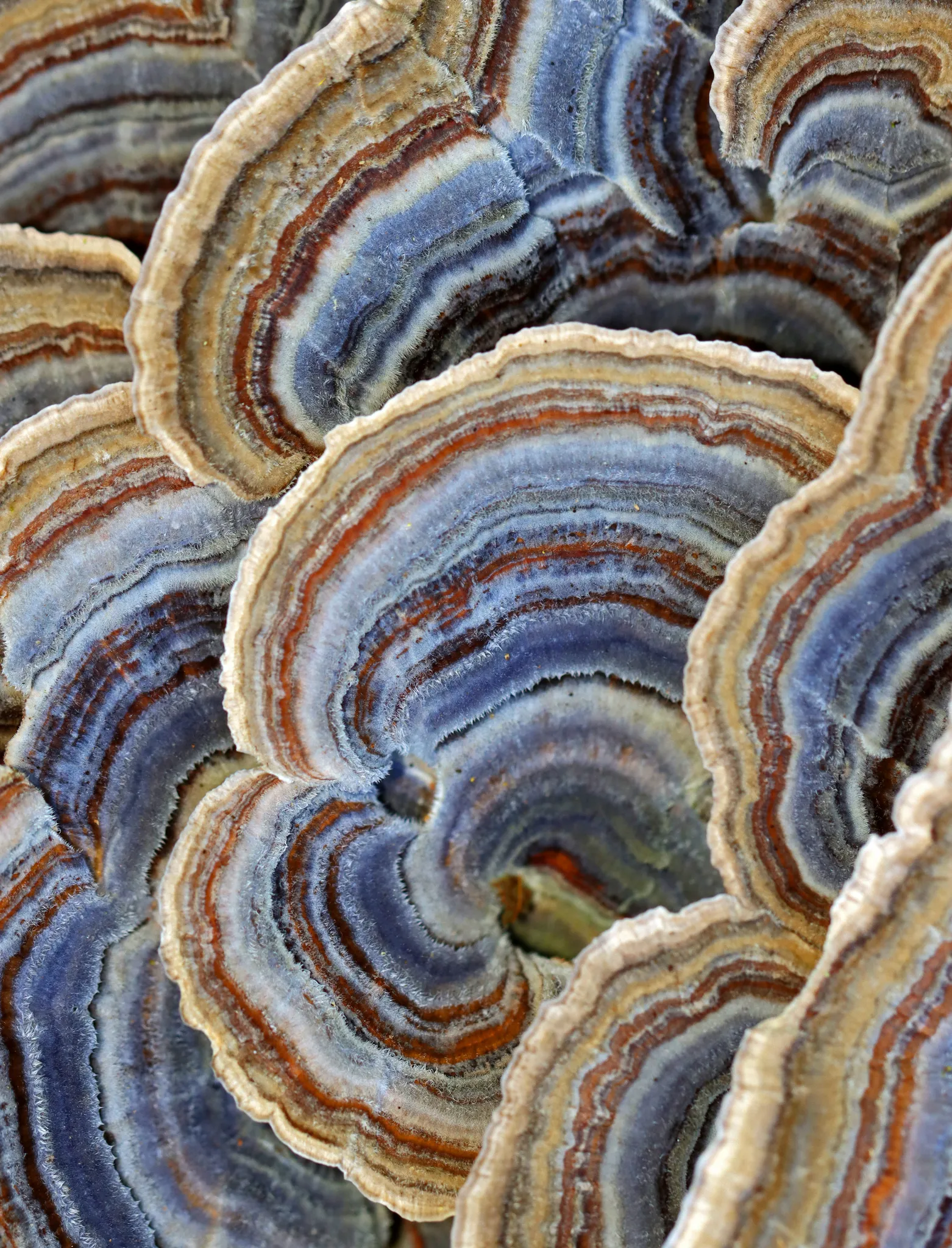
Turkey tail (Trametes versicolor) is a common polypore mushroom found throughout the world, and it is most commonly referred to as turkey tail1 because its shape recalls a wild turkey’s spread tail feathers. It grows mainly on dead hardwood, including stumps and standing dead trees as well as fallen branches, and it can be found all through the year, but it is most obvious in the winter months. It is not a food: First Nature calls it tough and therefore inedible, though not generally reported as poisonous2, and MykoWeb rates it too tough to try3.
How to identify turkey tail
Start with the cap. Turkey tail is a bracket with no discernable stalk1, attached along one side or just near the middle of one side3. Single caps are 2 to 8 cm across according to MushroomExpert and up to 10 cm according to First Nature, and they frequently overlap in layers to form much larger compound fruiting masses2. In outline a cap can be circular, semicircular, fan-shaped, bracket-shaped, or kidney-shaped, and it is flexible when fresh. The surface is finely fuzzy or velvety, and fuzzy zones alternate with smoother ones4.
The colours are extremely variable. MushroomExpert finds that they tend to stay in the buff, brown, cinnamon, and reddish brown range, in sharply contrasting concentric zones of color4; First Nature describes concentric zones of red, yellow, green, blue, brown, black and white2. The margin is mostly white, off-white or buff5, and older specimens can have zones with green algae growing on them1.
Turn it over. The underside is covered in tiny shallow pores, 3 to 6 pores per mm and is white or cream; MykoWeb counts 3-5 pores per mm3. The pores do not stain significantly when bruised2. MushroomExpert’s test for a true turkey tail asks for about 3-8 pores per millimeter, which would make them very tiny4.
Cut it. The brackets are only 1 to 3mm thick, and the flesh is tough and leathery and whitish, except for a very thin black line in cross-section separating the cap surface from the flesh4. It has no distinctive smell or taste. The spore print is white, and the spores are curved cylindrical (sausage-like!), smooth, 4-6 x 1.5-2.5µm2.
Is turkey tail edible or poisonous?
Turkey tail is inedible because of its texture, not its toxins: First Nature says it is not generally reported as poisonous but is far too tough to be considered edible2. MykoWeb gives its edibility as too tough to try3, and Wild Food UK lists it as inedible, without distinct taste or smell5. One general reference agrees it is considered too tough to eat, but notes it can be prepared in many ways, such as teas and powders1. Telling it apart takes care: MushroomExpert warns that a number of similar polypores, and even a few species of crust fungi, look more or less identical to the casual eye4, and the US National Cancer Institute says it can be hard to tell the difference between turkey tail and other Trametes without the use of special testing6. Never eat a wild mushroom on the strength of a web page or an app: have it identified in person by an expert.
Where and when does turkey tail grow?
Turkey tail is a wood-rotting fungus. MushroomExpert describes it as saprobic on the deadwood of hardwoods, or rarely on the wood of conifers, causing a white rot of the sapwood. First Nature finds it most commonly on hardwoods such as beech and oak, mainly as a saprobic (wood-rotting) fungus but sometimes as a weak parasite on living trees2. It grows in dense, overlapping clusters or rosettes on logs and stumps4; MykoWeb describes it as typically in rows or overlapping shelves on stumps and logs of hardwoods3.
It is very common and widespread across Britain and Ireland and occurs also throughout mainland Europe, from northern Scandinavia right down to the Mediterranean region. It is also found in Asia and is very common in North America2, where MushroomExpert counts it among the most common mushrooms in North American woods4.
The brackets are annual and can be found all the year round, but they are at their best in autumn and winter, which is when they release their spores2. In California it fruits from fall to spring, though shelves can be found almost any month of the year3. Insects feed on it: it may be eaten by caterpillars of the fungus moth Nemaxera betulinella, maggots of the fly Polyporivora picta and the fungus gnat Mycetophila luctuosa1.
Turkey tail lookalikes
Check the underside first, then the cap’s hairs and colours, then whether it bends.
- False turkey tail (Stereum ostrea) and hairy curtain crust (Stereum hirsutum): crust fungi with no pores. Hairy curtain crust has no visible pores at all; its underneath is smooth and yellow, while false turkey tail has smooth, reddish brown to reddish buff underneath5. Species of Stereum have orange-brown zoned caps but can be distinguished by their smooth hymenial surface3.
- Smoky bracket (Bjerkandera adusta): it has a greyish pore surface5, where turkey tail’s pores are white or cream.
- Ochre bracket (Trametes ochracea): it has less colour on its cap and different brown colours are the dominant, and it is mostly found on Birch5. MushroomExpert separates it by feel: a fresh one that is rigid and hard is T. ochracea, while a turkey tail is thin and flexible4.
- Trametes hirsuta: in MushroomExpert’s key, a fresh cap whitish to grayish4 points to this species, not turkey tail.
- Trametes pubescens: its cap lacks starkly contrasting color zones: the zones are merely textural or subtle shades of the same color4.
- Trametes suaveolens: a much paler bracket and does not usually grow in overlapping tiers2.
- Lenzites, Daedalea, Daedaleopsis and Gloeophyllum: they also have multicolored, zonate upper surfaces, but their undersides are irregular, mazelike, or elongated gill-like pores3, not turkey tail’s tiny round pores.
Turkey tail in history, food and medicine
Versicolor means of several colours, a name that fits both the variation between specimens and several colour bands on the upper surface of a single fruitbody. Carl Linnaeus described it in 1753 as Boletus versicolor. Sources disagree on who moved it to Trametes: MushroomExpert cites Lloyd, 19214, one general reference gives Lloyd (1920)1, First Nature says it was as recently as 1939 that this species was renamed Trametes versicolor by the Czech mycologist Albert Pilát, and MykoWeb cites Pilát in 19363. The name turkey tail originated in the USA and in Britain and Ireland it largely replaced the formerly popular English common name Many-zoned Polypore. Its colour forms have made it a decoration: at one time it was even used as a hat decoration2.
In China it has been most notably consumed for thousands of years under the name “Yunzhi”, and the US National Cancer Institute writes that it has been used in traditional Chinese medicine to treat lung diseases for many years. Its best-known compound is Polysaccharide K (PSK), and in Japan, PSK is an approved mushroom product used to treat cancer. The institute describes a randomized clinical trial in Japan done between 1978 and 1981 that included 751 patients who had surgery for gastric cancer; on average, the patients who received chemotherapy and PSK lived longer than those who received chemotherapy alone6. In the United States, neither the extract nor the mushroom preparation is approved or prescribed for any clinical condition, according to a general reference revised in 2026. It is commonly marketed as a dietary supplement, and quality can vary due to inconsistent processing and labeling1. Michael Kuo of MushroomExpert is blunter: this mushroom is not going to cure your cancer, nor any other ailment you may have4.