Contents
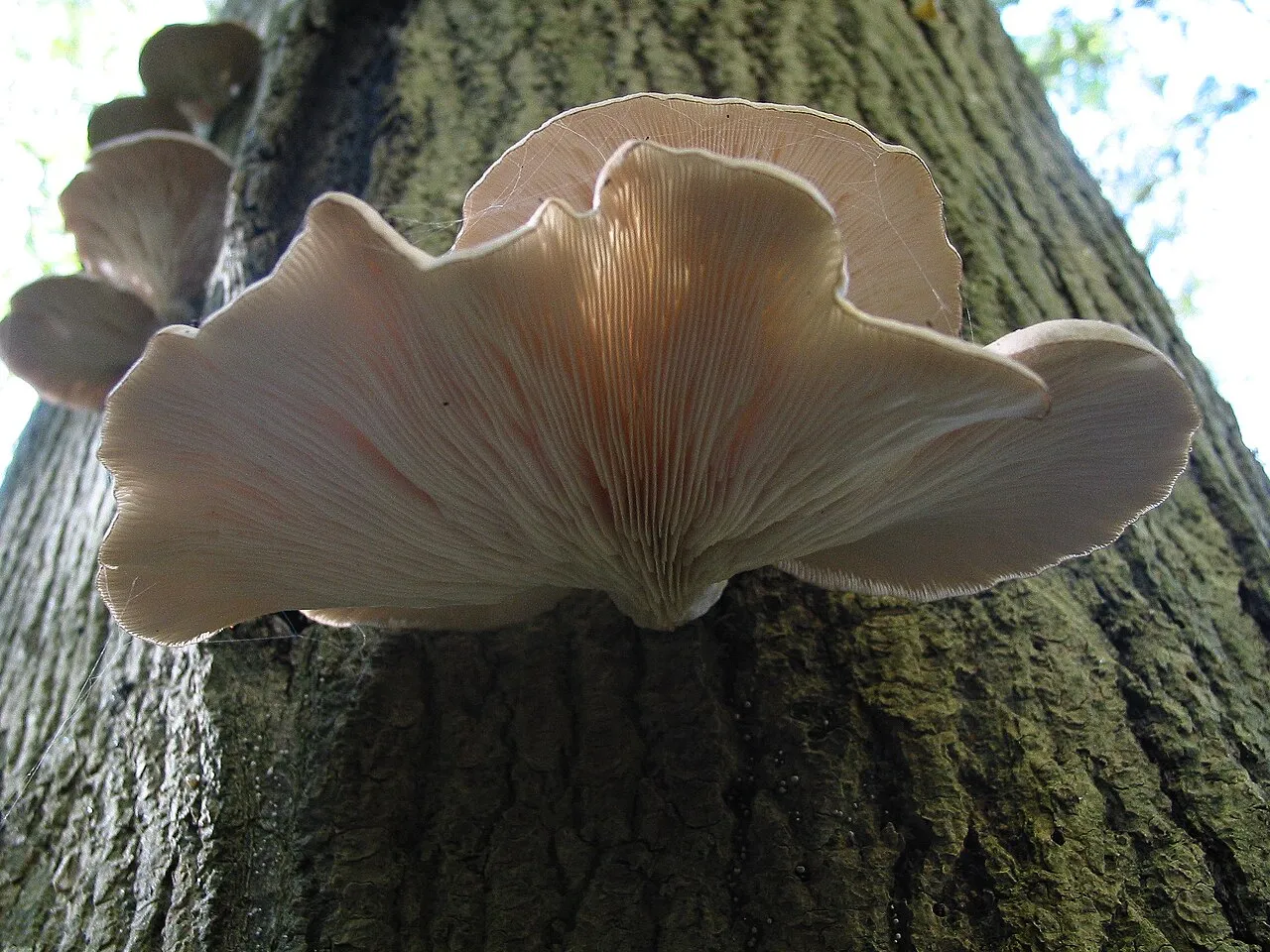
The oyster mushroom (Pleurotus ostreatus) is a popular edible mushroom found in temperate and subtropical forests around the world1, and First Nature confirms that it is edible. It grows in shelf-like clusters on dead logs and living trees, primarily hardwoods, and in North America it appears between October and early April3. In Britain and Ireland its season is summer, autumn and early winter2. It is also cultivated on a commercial basis4 and sold in supermarkets.
How to identify oyster mushroom
MushroomExpert names four field marks: growth in shelf-like clusters on wood, a relatively large size, whitish gills that run down a stubby, nearly-absent stem and a whitish to lilac spore print3.
The cap is kidney-shaped to fan-shaped in outline, or nearly round on the top of a log, with the margin somewhat inrolled when young. Sizes differ by source: 3-15 cm across according to MushroomExpert, 5 to 18 cm according to First Nature, and 5-25 cm according to MykoWeb5. Colour varies too: MushroomExpert describes it as pale to dark brown, fading to buff3, while First Nature lists white, cream, brown, or blue-grey2, the blue-grey form being var. columbinus. Wild Food UK describes a cap with wavy, sometimes split edges, coloured smoky grey/silver/brown6.
Underneath, the gills run down the stem: white, turning pale ochre with age; crowded; decurrent2. MushroomExpert adds that they are often filled with black beetles3 in its collecting areas.
Where it has one, the stem is usually rudimentary and lateral (or nearly absent) on the side of a log or tree but sometimes more or less central on top of one, measuring 1-7 x 1-3 cm3 in MushroomExpert’s description, and First Nature notes that it is sometimes stemless, with no stem ring2. MykoWeb notes the veil absent5.
Cut one open and the flesh is thick; white; unchanging when sliced. Sources disagree on the smell: MushroomExpert finds it distinctive but hard to describe, First Nature calls it pleasant but not distinctive, and MykoWeb gives an odor of anise5. The spore print is white or more often pale lilac-grey in First Nature’s account; under a microscope, MushroomExpert measures the spores at 7-11 x 2-4 µm3, First Nature at 8-12.5 x 3-4.5µm2.
Is oyster mushroom edible or poisonous?
Oyster mushroom is edible: First Nature says it is edible and is said to taste like its bivalve namesake, and MykoWeb calls it edible and very popular, although a few people are allergic to it5. First Nature finds the texture rather flaccid2 compared with field mushrooms. It is best when picked young: as the mushroom ages, the flesh becomes tough and the flavor becomes acrid1.
Among the lookalikes, Wild Food UK warns that angel’s wings (Pleurocybella porrigens) can be deadly if you suffer kidney disease6. In Japan, where the angel’s wing is widely consumed, an outbreak of acute encephalopathy in autumn 2004 is considered the most severe case of food poisoning in post-World War II Japan: 59 patients, of whom 17 died7. Most victims of the Japanese outbreaks had preexisting kidney disorders8. In North America the possible lookalikes include Omphalotus olivascens (the western jack-o’-lantern mushroom) and Clitocybe dealbata, and in Australia Omphalotus nidiformis1 is one. Never eat a wild mushroom on the strength of a web page or an app: have it identified in person by an expert.
Where and when does oyster mushroom grow?
Oyster mushroom rots wood: MushroomExpert calls it saprobic, causing a white rot, on primarily hardwoods, but sometimes on conifers3. First Nature says it is sometimes weakly parasitic but more often saprobic, growing on dying or dead standing deciduous broadleaf trees, particularly Beech and oaks2, and sometimes on fallen trunks and large branches. Wild Food UK finds it in large shelf-like clusters on stumps and fallen wood6, and the Woodland Trust calls it common in UK woods4. In California, MykoWeb finds it on stumps and logs of hardwoods, uncommon on conifers5.
It occurs throughout Britain and Ireland and in most parts of mainland Europe, is widely distributed throughout much of Asia, including Japan, and is present in parts of North America2. It is absent from the Pacific Northwest of North America1, where P. pulmonarius and P. populinus replace it.
In North America MushroomExpert gives between October and early April3, and MykoWeb early fall to mid- winter5 in California. In Britain and Ireland First Nature gives summer, autumn and early winter, with a longer season in parts of southern Europe, where it can sometimes be found through to January or February2. The Woodland Trust lists its UK fruiting season as year-round4, and Wild Food UK says it can be found in large numbers at any time of year but is more common in the Winter months6.
Oyster mushroom lookalikes
- Angel’s wings (Pleurocybella porrigens): whitish and fan-shaped, but it grows on conifer wood, particularly hemlock, while the oyster mushroom grows on primarily hardwoods3. Its cap is about 4–9 centimetres wide, and the flesh is thin and fragile compared to the oyster mushrooms8. Wild Food UK adds that it is usually funnel shaped with a split and rare and found mainly in Scotland6.
- Pale oyster (Pleurotus pulmonarius): a close relative that is paler (and frequently smaller) than the brownish Pleurotus ostreatus, with a cap of 3-10 cm across. The cold fruiting season makes a better separator3 than colour: the pale oyster appears from late April through September, while the oyster mushroom favors cold-weather conditions9. Wild Food UK notes that either can grow at any time of year6.
- Pleurotus populinus: virtually identical, but it grows only on the wood of Populus species (aspens and cottonwoods)9.
- Oysterlings: they look similar but never grow more than four centimetres across6.
- Lentinellus species: some Lentinellus species are similar in appearance, but they have gills with jagged edges and finely haired caps1.
- Pleurotus dryinus: it has a frosted cap; its stem has a short-lived ring2.
Oyster mushroom in history, food and medicine
The name Pleurotus is Latin for ‘side ear’, for the stem attached at the side, and ostreatus is a reference to oysters. Dutch naturalist Nikolaus Joseph von Jacquin first described it in 1775 as Agaricus ostreatus, and in 1871 German mycologist Paul Kummer transferred2 it to Pleurotus.
Commercial cultivation of this mushroom first began in Germany as a subsistence measure during the First World War. In Czech, Polish and Slovak cooking it goes into soups and stews in a similar fashion to meat1, and the Woodland Trust says it is particularly popular in Asia for their subtle nutty flavour4.
It is one of the few known carnivorous mushrooms4: First Nature describes how it can trap and feed upon nematode worms using ‘lassos’ made of hyphae2, and this is believed to be a way in which the mushroom obtains nitrogen1.
On health, the Woodland Trust reports that a study has shown that eating oyster mushroom extracts can lower cholesterol levels4. MushroomExpert’s Michael Kuo is blunter about wider claims, writing that it is not going to cure your cancer, nor any other ailment you have, and calling ideas of cleaning up pollution with it pseudoscience, with no legitimate scientific support3.