Contents
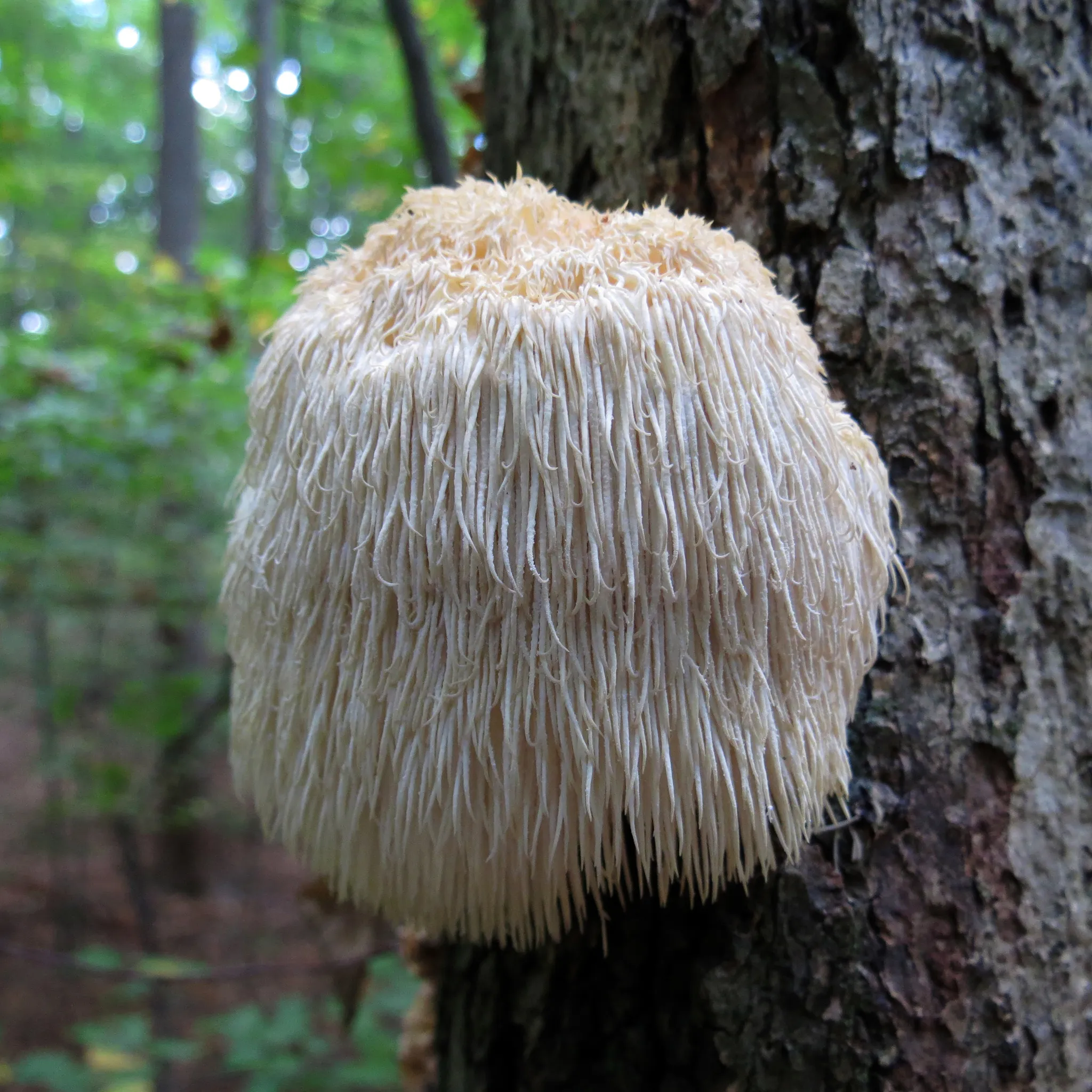
Lion’s mane (Hericium erinaceus) is a choice edible fungus that grows as a single, unbranched clump of dangling white spines, unlike the branched structure of related species. It fruits on damaged or felled hardwood trees, usually in old, mainly deciduous woodland, mainly beech and oak in Britain and especially oaks2 elsewhere, from July to November in Britain. It is also known as bearded tooth, tree hedgehog and pom-pom mushroom1, or, in Japan, yamabushitake3.
How to identify lion’s mane
The whole fruiting body of lion’s mane is a single, unbranched clump of hanging spines; the related Hericium species, by contrast, often begin as a single clump too, developing their branches with age. Mature clumps reach 8 to 24 cm across according to MushroomExpert2, while First Nature gives 15 to 20 cm typically, up to 30 cm. The soft, pointed spines hang 1 to 5 cm long from a single point, cascading down like a mop head1.
Fresh spines and the clump behind them are white or pale yellow-brown, discolouring brownish or yellowish with age; the top of an older clump can show shortened spines that look hairy. First Nature finds the smell not distinctive. The spore print is white; under a microscope the spores are broadly ellipsoidal to subglobose, smooth or with a very slightly roughened surface, with First Nature giving 5–6 by 4–5.5 µm1 and MushroomExpert 5–6 by 5.5–6 µm2.
Is lion’s mane edible or poisonous?
Lion’s mane is a choice edible fungus, with a fine flavour and texture similar to fish or tender meat when young and fresh; cooked, its taste is reportedly delicious, likened by some to lobster cooked in butter. It is also listed as a choice mushroom4 by one data reference. In Britain, though, it is rare enough to be protected: picking or destroying it is an offence under Schedule 8 of the Wildlife and Countryside Act 19811. Never eat a wild mushroom on the strength of a web page or an app: have it identified in person by an expert.
Where and when does lion’s mane grow?
Lion’s mane is saprobic and parasitic, feeding on damaged or felled trees, usually in old, mainly deciduous woodland. MushroomExpert finds it fruiting especially on oaks2, while First Nature records it in Britain as nearly always on beech and oak trees, stumps and fallen logs, occasionally on sawdust piles1.
It grows across Europe, North America and Asia; MushroomExpert traces North American records from Canada to Mexico, and into Central America2. In Britain it is very rare, found mainly in southern England and eastern Wales, while it is particularly widespread and abundant in central and southern France1. One general reference notes it is red-listed in several European countries3 because of poor germination and establishment there.
It fruits from July to November in Britain and Ireland1; MushroomExpert gives late summer and fall, or over winter and spring2 in warmer climates.
Lion’s mane lookalikes
Lion’s mane stays a single, unbranched clump2 of hanging spines, while these lookalikes differ in branching and growth habit:
- Hericium americanum: usually carries its spines on several branches1, not hanging from one unbranched base.
- Hericium coralloides: a rubbery, coral-like branching fruitbody1, unlike lion’s mane’s single mop-head clump.
- Hericium cirrhatum: shorter spines on a much thinner, bracket-like fruitbody1, not a hanging ball of spines.
- Hydnum rufescens and Hydnum repandum: these carry their spines underneath a smooth-topped cap1, unlike lion’s mane’s single, unbranched clump of spines2.
Lion’s mane in history, food and medicine
The name Hericium means pertaining to a hedgehog, and erinaceus like a hedgehog, after its spines. Jean Baptiste François Bulliard first described it, as Hydnum erinaceus, in 1780; Christiaan Hendrik Persoon transferred it to the genus Hericium in 17971, giving it its current name. In Japan it is known as yamabushitake; one general reference also records its Chinese name, hóutóugū, meaning “monkey-head mushroom”, and its Korean name, noru gungdeng-i beoseot, meaning “deer butt mushroom”3.
Birch plugs impregnated with its mycelium can be bought for inserting into holes in cut logs, producing cascades of white fruiting bodies1; one general reference notes that its production is widespread in Asia, mostly on wood logs or stumps. That reference gives the mushroom’s composition as 57% carbohydrates, 22% protein and 4% fat, and its meaty texture3 has prompted interest in it as a meat substitute.
Used in traditional Chinese medicine for centuries, lion’s mane is commonly marketed as a dietary supplement for its purported benefits to memory, and researchers have isolated compounds called hericenones and erinacines from it. That reference is careful to note that this marketed use lacks sufficient scientific evidence for safety or effectiveness, and that, though it is a generally safe edible mushroom, its efficacy and specific active compounds remain unconfirmed in living organisms3.