Contents
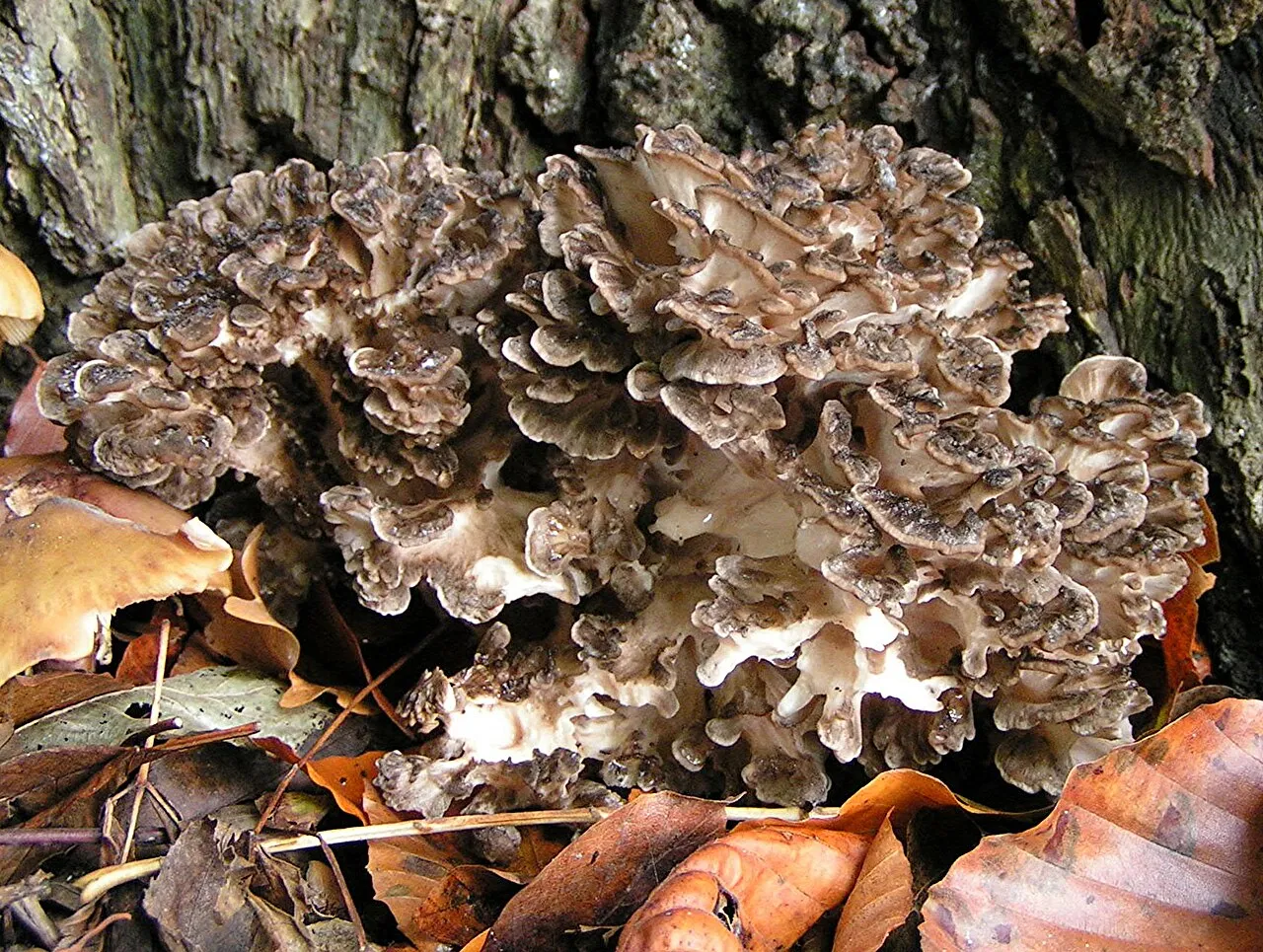
Hen of the woods (Grifola frondosa), also called maitake, is a soft-fleshed polypore recognized by its smoky brown, wavy caps, which grow in large clusters of rosettes arising from a single, branched stem structure1. It is usually found at the base of an oak tree in summer and autumn, and it is generally reported to be a very good edible species if gathered when young. It occurs in Britain and Ireland, mainland Europe and North America, and it attacks living trees and causes a white rot2.
How to identify hen of the woods
Start with the whole cluster. First Nature describes a cauliflower-like rosette 20 to 50 cm across of tongue-like fronds in circular tiers; MushroomExpert gives 15 to 40 cm across and 10 to 30 cm high, made of multiple caps sharing a branched, stemlike structure. The individual caps are 4 to 10 cm across and 5 to 10 mm thick according to First Nature, or 3 to 14 cm across and more or less fan-shaped according to MushroomExpert. MushroomExpert describes them as dark to pale gray-brown, often with vague concentric zones, yellowing with old age, with wavy margins1; First Nature’s run from tan to olive, grey or cream in undulating concentric zones, and very occasionally it occurs in an almost pure white form2.
Turn a cap over. There are no gills, but many small pores on the white underside3. MushroomExpert finds the pore surface lavender gray when young, becoming white and, with age, staining yellowish, not bruising, with 1 to 3 angular pores per mm and tubes 1 to 3 mm deep, and running down the stem, often nearly to the base. The shared stem is branched, whitish, tough and often off-center1, and below ground the fungus grows from a tuber-like sclerotium about the size of a potato4.
Cut it and smell it. The flesh is firm, white and unchanging when sliced. First Nature notes a pleasant sweet odour when young, less so when decaying, and an old, rotting fruitbody smells unpleasantly sickly. The spore print is white; under a microscope the spores are smooth and ellipsoid, 4 to 6 by 3 to 4 µm according to MushroomExpert1 and 5 to 7 by 3.5 to 5 µm according to First Nature2.
Is hen of the woods edible or poisonous?
Sources agree hen of the woods is edible: a general reference calls it a choice edible mushroom, especially the young caps4. First Nature notes that it is generally reported to be a very good edible species if gathered when young, and Wild Food UK lists it as edible, with a good mushroomy taste that is strengthened by drying3. Age matters: the generally good reports cover young fruitbodies, while like other polypores it becomes too tough and leathery to eat when it is fully mature and the taste of older specimens can be quite acrid2.
It does not suit everyone. Wild Food UK warns that it can cause allergic reactions in a small amount of people3, and a general reference likewise notes that some may be allergic to it and that the softer caps must be thoroughly cooked4.
Wild Food UK names one lookalike as possibly confused with it: the giant polypore (Meripilus giganteus). First Nature says young specimens are reportedly edible if cooked very slowly, but they have been known to cause stomach upsets in some people and are probably best avoided altogether5. Wild Food UK is less cautious than First Nature’s reportedly edible, calling it an edible mushroom so confusion is not a problem3. Never eat a wild mushroom on the strength of a web page or an app: have it identified in person by an expert.
Where and when does hen of the woods grow?
Hen of the woods is weakly parasitic on living oaks and other hardwoods, also saprobic on decaying wood, and causes a white butt rot. It fruits at the bases of oak trees and occasionally other hardwoods; a general reference names old growth oaks or maples4. It is often reappearing in the same place in subsequent years1. Each fruitbody is relatively short-lived compared with most polypores2.
In North America it is widely distributed east of the Rocky Mountains, rare in the west1, though it has been found as far west as Idaho. In Britain and Ireland it is uncommon and rather localised2; Wild Food UK rates it fairly uncommon3. It is also native to China4.
MushroomExpert gives the season as summer and fall1. In the UK, Wild Food UK’s season runs from August to November3, while a general reference gives August to October in Europe and September to October in eastern North America4.
Hen of the woods lookalikes
- Black-staining polypore (Meripilus sumstinei): in North America hen of the woods is often mistaken for this species, as both are brownish by maturity and fruit near the bases of hardwoods in large clusters. It has larger caps and a pore surface that is pure white when young, not lavender grey, and it bruises and discolors black. Its pores are much finer, 6 to 8 per mm6 against about one to three per millimetre4 on hen of the woods.
- Giant polypore (Meripilus giganteus): the European counterpart often forms rosettes at tree bases or from underground roots, but its fronds are much thicker and its main host is Beech2, not oak. Its caps reach 10 to 30 cm across and 1 to 3 cm thick, and when bruised the pores turn dark brown or black5. Wild Food UK, which names it as possibly confused with hen of the woods, adds that it is less frondose and more tan brown rather than grey brown3.
- Polyporus umbellatus: much rarer in Britain and Ireland2 and encountered far less frequently in North America. Its fruitbody is many small, smoky brown, roundish caps, only 2 to 4 cm across, each on a stem central to the cap, where hen of the woods has larger, fan-shaped and irregular caps7 on a stem that is often off-center1.
- Wood cauliflower (Sparassis crispa): it could possibly be confused with hen of the woods, but it is much paler, and it grows only at the bases of conifers, and most frequently Scots pines2. The segments of hen of the woods, by contrast, have pores on the underside8 and are grey-brown.
- Chicken of the woods (Laetiporus sulphureus): MushroomExpert’s Michael Kuo receives e-mails confusing the two officially named-for-fowl mushrooms, but chicken of the woods is bright yellow or orange6, unlike the grey-brown hen.
Hen of the woods in history, food and medicine
Scottish mycologist James Dickson described it in 1785 as Boletus frondosus, and Samuel Frederick Gray moved it to Grifola in 1821. The epithet frondosa means having fronds2.
In Japan it is a popular and highly-prized edible, and the Japanese name maitake means the dancing mushroom. Wild Food UK reports that the large weight of a find has earned it the name King of Mushrooms3 there. In Japan, First Nature notes, fruitbodies are cultivated on impregnated logs made from compressed sawdust2 instead of being gathered from the wild.
First Nature mentions that it is reputedly having medicinal value including cancer-resisting properties2, and Wild Food UK reports research finding that compounds in it can help inhibit the growth of some cancer cells3. Yet despite years of laboratory and preliminary clinical research on its polysaccharides, there were no completed, high-quality Phase III clinical studies as of 20194. MushroomExpert’s Michael Kuo is blunter: in his view, this mushroom is not going to cure your cancer1.