Contents
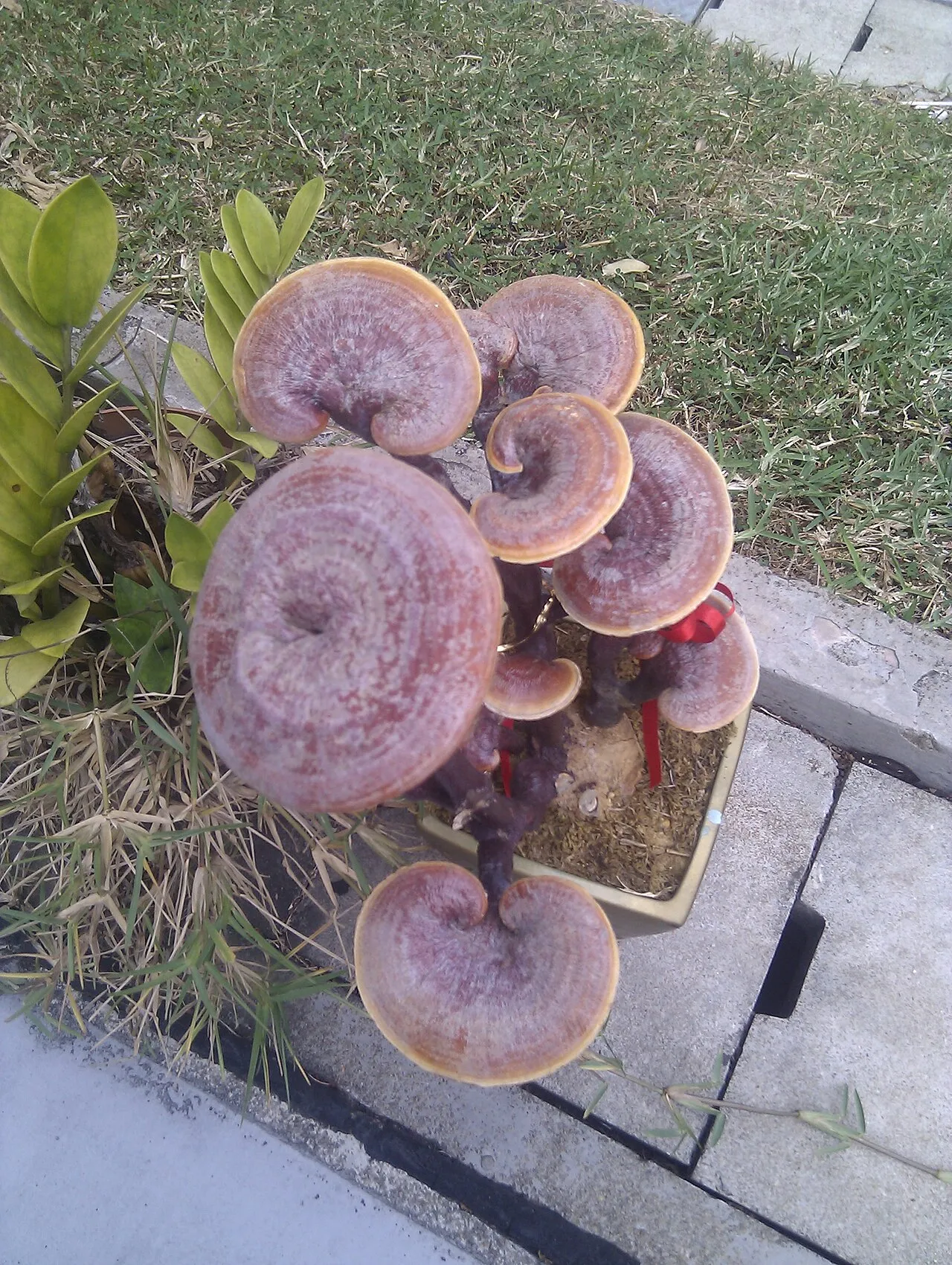
Reishi or lingzhi (Ganoderma lingzhi) is a polypore fungus (“bracket fungus”) native to East Asia, with a reddish brown, varnished, kidney-shaped cap and a peripherally inserted stem. In the wild it grows at the base and stumps of deciduous trees, especially maples; it is too hard to eat and is instead used in traditional Chinese medicine1.
The name is tangled. Ganoderma lingzhi was described in 2012 as a novel species. A 2023 re-examination of the holotype confirmed Ganoderma sichuanense as the correct name for the species widely cultivated in China2, and since that study G. lingzhi has been treated as a later synonym1. A 2012 PLOS ONE study had already concluded that the Chinese “G. lucidum” should be considered conspecific with G. sichuanense. In 2012 the fungus was still named ‘G. lucidum’ in many scientific articles and commercial reports, the name of a species originally described from England3.
How to identify lingzhi (reishi)
The fruiting bodies are annual, stalked, corky to woody. In the 2012 study’s description the cap measures 3.0–14.5 by 6.0–15.5 cm and 0.5–2.5 cm thick, kidney-shaped to nearly round, its upper surface yellowish brown to bay and lacquered, sometimes with radial furrows and concentric grooved zones. The margin is cream-coloured or the same colour as the cap3.
It lacks gills on its underside1; instead it carries 4–6 pores per mm, with a surface whitish to yellow brown, darker when bruised, over cinnamon tubes up to 0.5–13 mm long3.
The stem is 2.0–9.0 cm long and 1.0–4.0 cm thick, attached at the side or off-centre, and bay to black and lacquered. The flesh is 3.0–20 mm thick and cream-coloured to buff, darker near the tube layer3.
The spore print is brown. Under the microscope the study found strongly echinulate basidiospores of medium size (9.0–11.0 µm long), and a high variability of basidioma morphology3 in cultivated specimens. Growing conditions change its shape: elevated carbon dioxide levels result in stem elongation, and it may resemble antlers, with no umbrella cap1.
Is lingzhi (reishi) edible or poisonous?
Reishi is listed as too hard to eat. Because of its bitter taste, it is traditionally prepared as a hot water extract product for use in folk medicine1. For reishi supplements, Memorial Sloan Kettering says side effects may include nausea, insomnia and liver injury, and warns that reishi can increase your risk of bleeding4 for people on blood thinners. Never eat a wild mushroom on the strength of a web page or an app: have it identified in person by an expert.
Where and when does lingzhi (reishi) grow?
Reishi is found in East Asia growing as a parasite or saprotroph on a variety of trees, at the base and stumps of deciduous trees, especially maples1. Specimens examined in the 2012 study came from stumps of Quercus (oak) and Juglans (walnut) and from rotten wood, across Chinese provinces including Jiangsu, Guangxi, Shanxi and Yunnan3. The holotype of G. sichuanense was collected in Panzhihua, Sichuan Province, on the rotten wood of a broad-leaved tree, 19762.
The study’s field collections include one made on 16 June, on an oak stump in Jiangsu, and one on 14 October, on a stump in Guangxi. It is widely cultivated in mainland China, Japan, Korea3, on sawdust, woodchips, and hardwood logs1.
Lingzhi (reishi) lookalikes
- Ganoderma lucidum (lacquered bracket): Wild Food UK describes it as a European species, not native to Asia5, and First Nature gives its cap as up to 25cm across6. Based on characters such as the thickness of context and diameter of the stipe, Pegler and Yao suggested that the cultivated Chinese fungus was not conspecific with the species described in Europe2.
- Ganoderma tsugae: also lacquered, but found almost exclusively on the wood of eastern hemlocks, its range east of the Rocky Mountains7.
- Ganoderma applanatum (artist’s fungus): it has an unvarnished, furrowed and lumpy, dull brown cap surface, not reishi’s laccate3 surface, and its stem is usually absent8.
- Ganoderma sessile: the large, stalkless form found in North America, once thought a growth form of lingzhi, which recent molecular evidence has identified1 as a distinct species; reishi is stalked3.
Lingzhi (reishi) in history, food and medicine
Lingzhi is the ancient “mushroom of immortality”, revered for over 2,000 years, and its use is documented in Chinese literature dated back nearly two thousand years to the Shen Nong Materia Medica (102–200AD)3. In Chinese art it symbolizes great health and longevity. The name means ‘divine mushroom’ in Chinese, and reishi is its Japanese pronunciation1.
In 1959, the first successful cultivation2 of its fruit bodies was developed at the Institute of Microbiology, Chinese Academy of Sciences. The world trade value of products sold as “G. lucidum” reached US$2.5 billion in 20033. The fungus contains triterpenes (ganoderic acids) and polysaccharides (such as beta-glucan)1.
Memorial Sloan Kettering, which files reishi under the name Ganoderma lucidum, summarises the research this way: randomized controlled trials do not support the use of reishi for reducing cardiovascular risk factors in type 2 diabetes, and a pilot study of spore powder did not find it helpful in treating patients with Alzheimer’s disease. It concludes that further research is needed4 on reishi as an adjunctive cancer treatment.